My own example to explain the solution
Consider the following input:
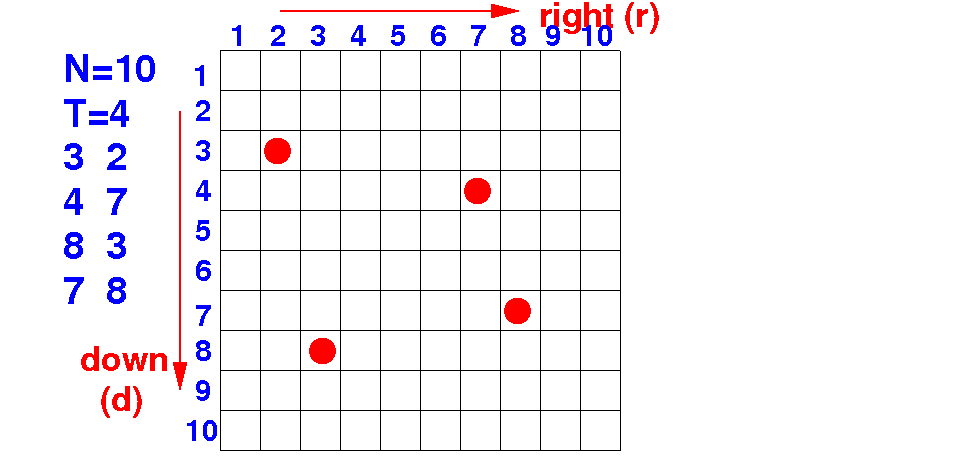
 First thing you must take care of is:

    How do I store the input data ?
|
My own example to explain the solution
Let's use variables and arrays:
N = 10 // Grid size T = 4 // # Trees tree[0][0] = 3 tree[1][0] = 4 tree[2][0] = 8 tree[3][0] = 7 tree[0][1] = 2 tree[1][1] = 7 tree[1][1] = 3 tree[3][1] = 8 |
My own example to explain the solution
Developing a solution:
 First thing you must take care of is:

    How do I represent a (correct or incorrect) solution ?
|
My own example to explain the solution
Question: how do we present this (square) pool ?
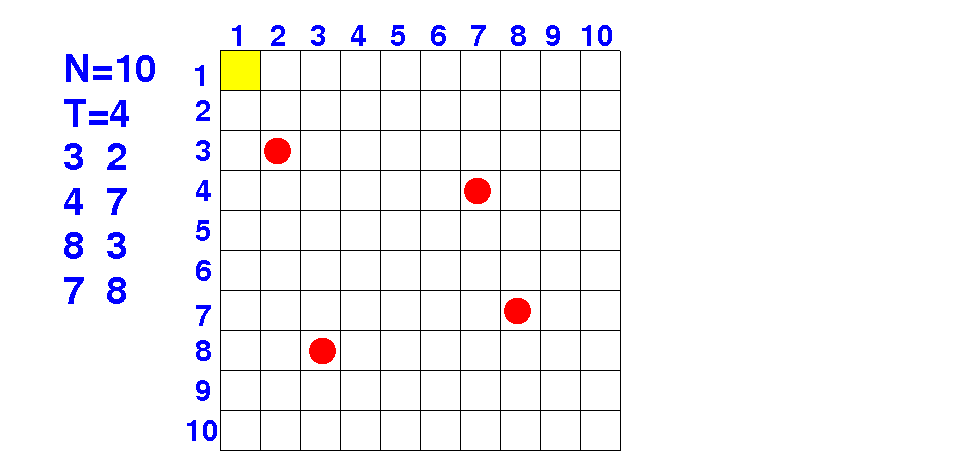
 The representation must be enable you to test for correctness !

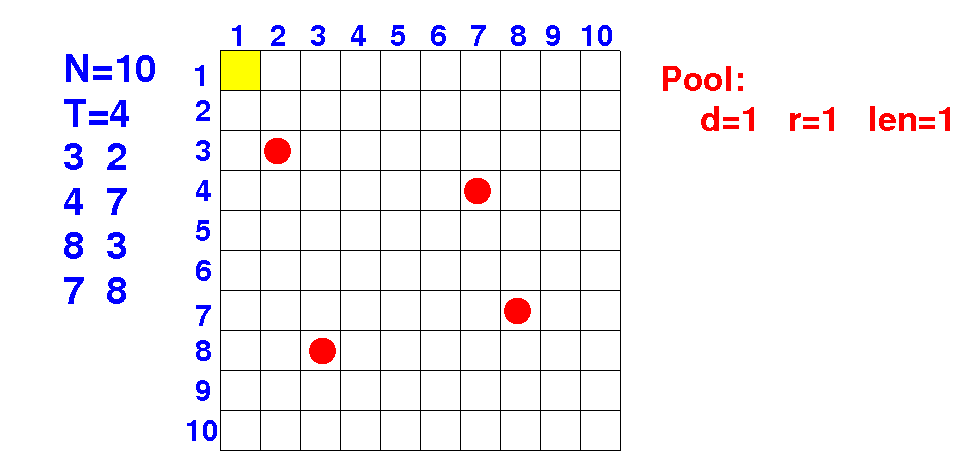
    How do I represent the pool above ?
|
My own example to explain the solution
We use the upper-left corner coordinate and size and
|
|
My own example to explain the solution
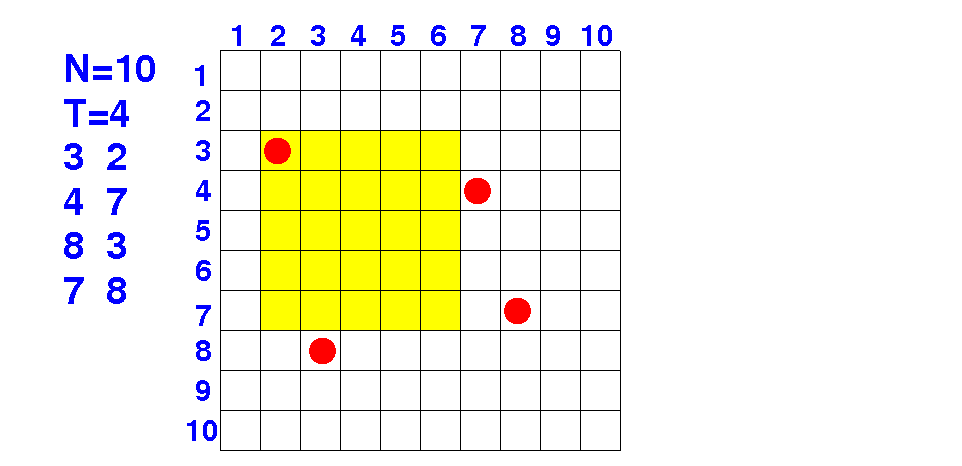
Quiz: how do we present this (square) pool ?
|
|
My own example to explain the solution
Answer:
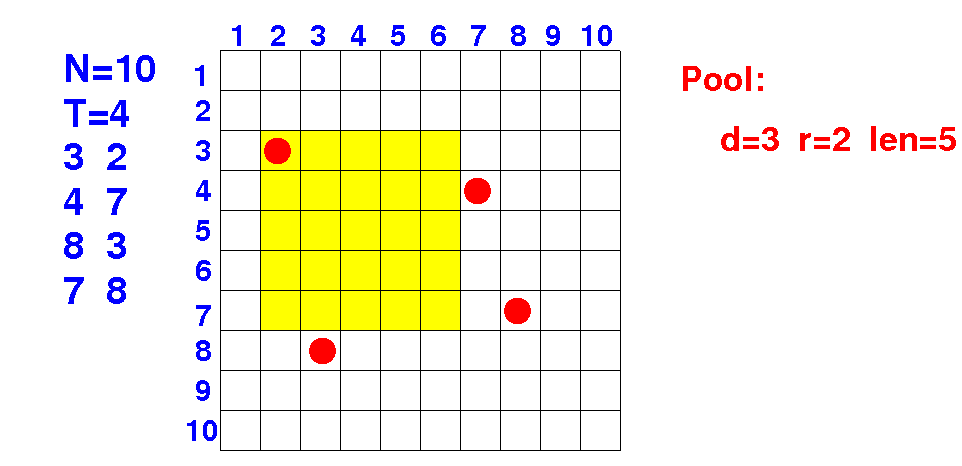
|
|
My own example to explain the solution
How can you test if the tree at coordinate 3 2 is inside the pool ???
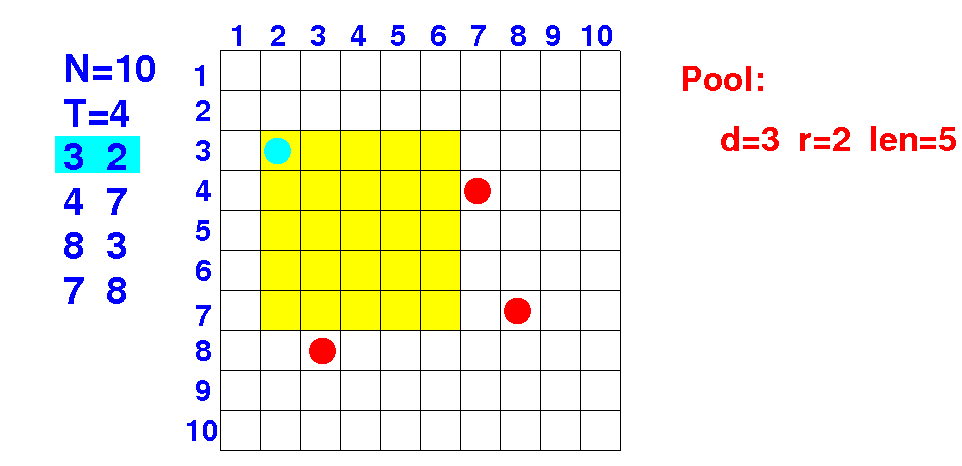
|
|
My own example to explain the solution
The coordinates of the tree must lie within the square
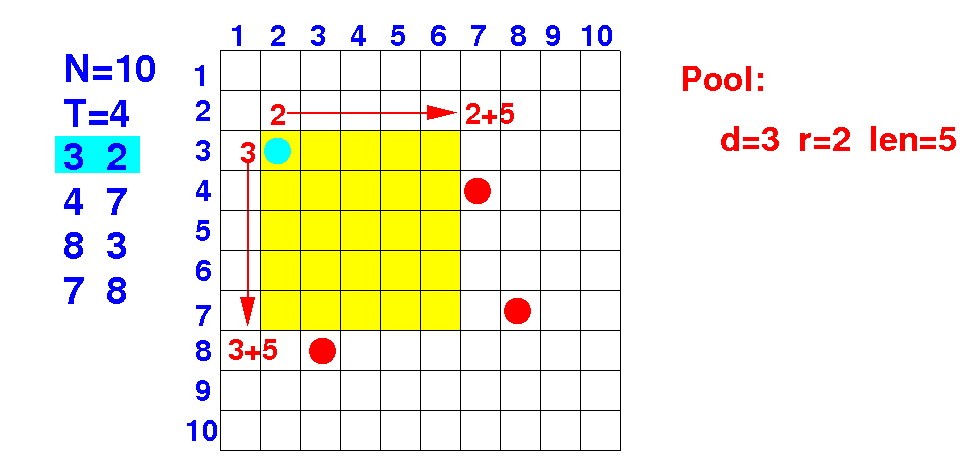
Down direction: 3 ≤ 3 < 3+5 ---> true Right direction: 2 ≤ 2 < 2+5 ---> true |
My own example to explain the solution
Verify that the test can tell that the tree at coordinate 4 7 is outside the pool:
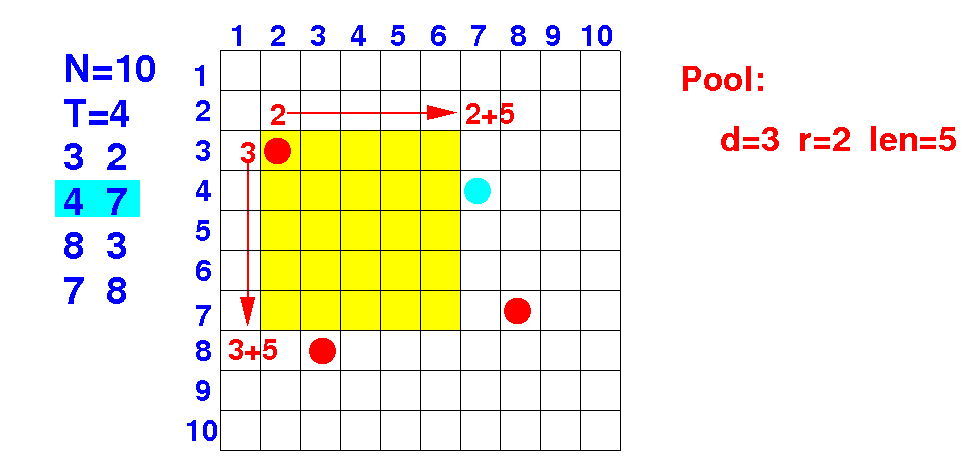
Down direction: 3 ≤ 4 < 3+5 ---> true Right direction: 2 ≤ 7 < 2+5 ---> false |
The brute force search
problem solving paradigm
|
Use the brute force seacrh method
to find a solution
Consider the following input:
 First thing you must do to apply brute force search:

    How do I generate every possible solution ? (including incorrect ones)
|
Use the brute force seacrh method
to find a solution
Generating every possible pool:
(1) Consider every possible placement of a pool |
Use the brute force seacrh method
to find a solution
Generating every possible pool:
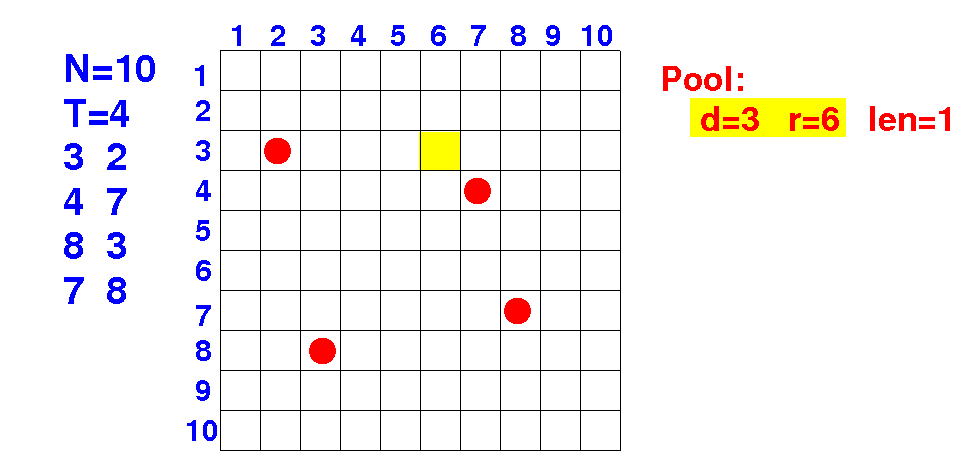
  (1) Consider every possible placement of a pool

      for (d = 1; d <= 10; d++)
         for (r = 1; r <= 10; r++)
|
Use the brute force seacrh method
to find a solution
Generating every possible pool:
  (1) Consider every possible placement of a pool

      (2) For each placement, try all possible sizes
         --> len = 1
|
Use the brute force seacrh method
to find a solution
Generating every possible pool:
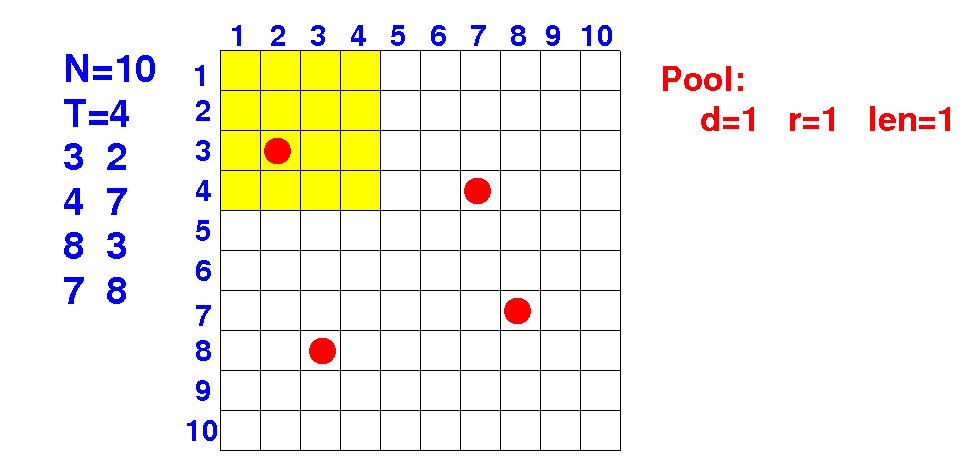
  (1) Consider every possible placement of a pool

      (2) For each placement, try all possible sizes
         --> len = 1, 2, 3, 4, 5, 6, 7, 8, 9, 10
|
Use the brute force seacrh method
to find a solution
What are all the possible lengths for a pool placed at coordinate 5 8 ?
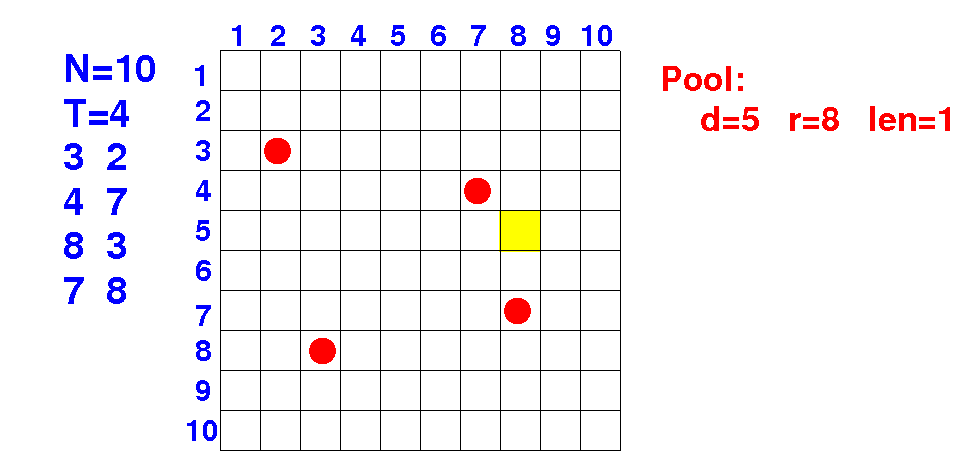
  (1) Consider every possible placement of a pool

      (2) For each placement, try all possible sizes
         --> len = 1, ... ???
|
Use the brute force seacrh method
to find a solution
What are all the possible lengths for a pool placed at coordinate 5 8 ? Answer: 1, 2, 3
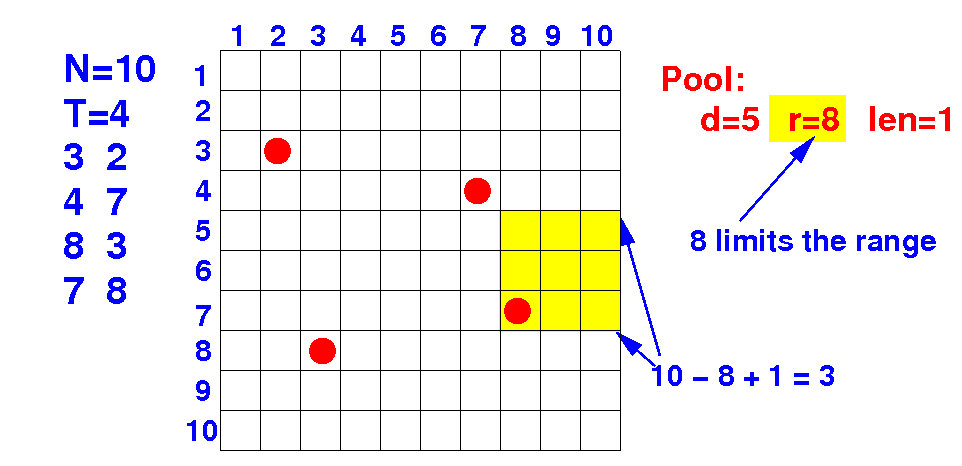
  (1) Consider every possible placement of a pool

      (2) For each placement, try all possible sizes
         --> len = 1, 2, 3
|
Use the brute force seacrh method
to find a solution
What are all the possible lengths for a pool placed at coordinate 7 3 ?
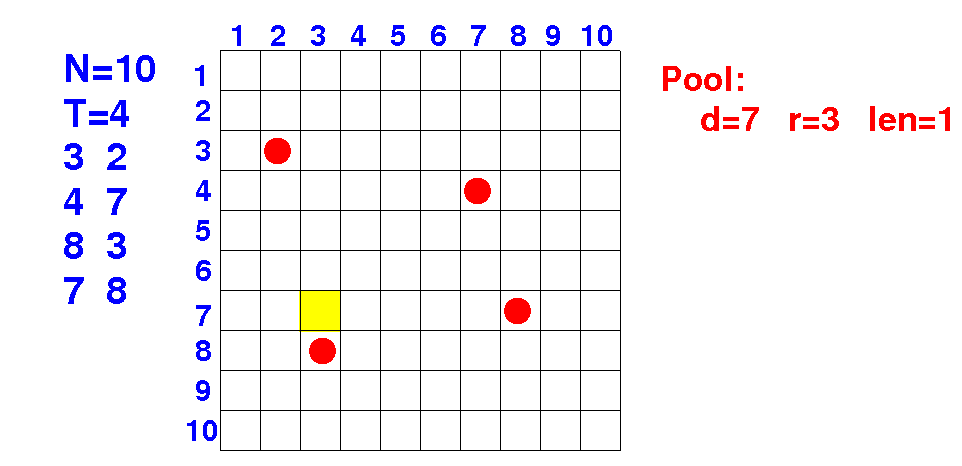
  (1) Consider every possible placement of a pool

      (2) For each placement, try all possible sizes
         --> len = 1, ... ???
|
Use the brute force seacrh method
to find a solution
What are all the possible lengths for a pool placed at coordinate 5 8 ? Answer: 1, 2, 3, 4
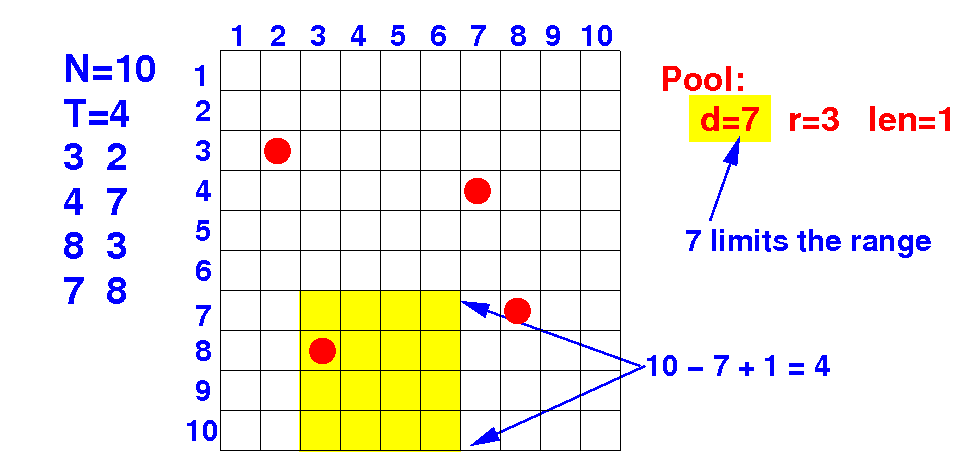
  (1) Consider every possible placement of a pool

      (2) For each placement, try all possible sizes
         --> len = 1, 2, 3, 4
|
Use the brute force seacrh method
to find a solution
How to generate all the possible pools:
  for (d = 1; d <= 10; d++)
     for (r = 1; r <= 10; r++)
        range = min( 10-d+1, 10-r+1);
        for (len = 1; len < range; len++)
|
The brute force search method
to find the largest pool
  d_best = -1; r_best = -1; len_best = 0;

  for (d = 1; d <= N; d++)
     for (r = 1; r <= N; r++)
     {
        range = min( N-d+1, N-r+1);
        for (len = 1; len < range; len++)
        {  // Check if there is a tree inside the pool

           isSolution = true;

           for (i = 0; i < T; i++) // Exercise:translate this into code
              if ( tree i inside pool(d, r, len) ) // See notes...
              {
                 isSolution = false;
                 break;
              }

           if ( isSolution )
              if ( len > len_best )
              {
                 d_best = d; r_best = r; len_best = len;
              }
        }
     }
|
Demo: CCC/2022/Progs/j5.cc