Data representation
The reachability of pages can be represented as a graph:
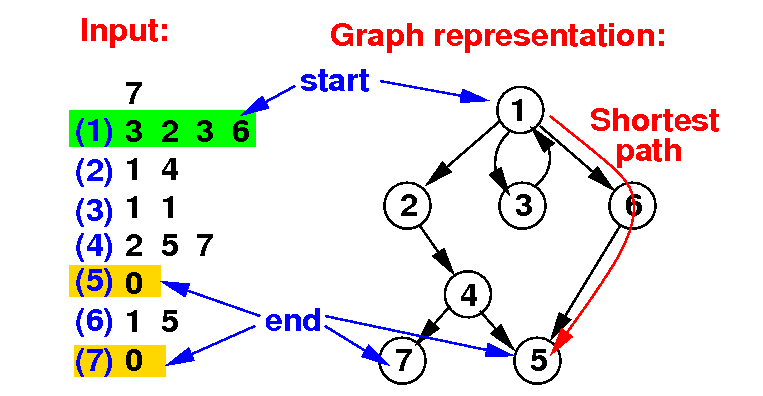
We always start at page 1 We end on a page with 0 entry. This is a classic shortest path problem. It is solved using the breath first search graph traversal algorithm |
Data representation
The graph can be represented by an adjacency list:
 page[1] = {2, 3, 6}  // page[i] = vector of pages reachable from page i
 page[2] = {4}
 page[3] = {1}
 page[4] = {5, 7}
 page[5] = {}
 page[6] = {5}
 page[7] = {}
|
Data representation
C++ code to read in the input:
   vector<int> page[10001];  // page[i] = list of reachable pages

   for ( int i = 1; i <= N; i++ )
   {
      int K;
      cin >> K;

      for ( int j = 0; j < K; j++ )
      {
          cin >> x;
          page[i].push_back(x);
      }
   }
|
Breadth First Search Algorithm
This is the generic breath first search algorithm:
   void bfs()
   {
      int i, j;

      while ( myQueue != empty )
      {
         i = myQueue.remove();  // Get next node to visit

   	 visited[i] = true;  // Mark node i as "visited"

   	 /* ----------------------------------------------------------
   	    We reached node i... Something wonderful may happen at i
   	    ---------------------------------------------------------- */
   	 cout << i << endl;  // Change accordingly

   	 /* -------------------------------------------------------------
   	    How you find nodes j will depend on how you represent the graph
   	    ------------------------------------------------------------- */
   	 for ( each node j that can be reached from node i )
   	 {
   	    if ( ! visited[j] )
   	    {
   	       myQueue.push(j);  // Visit node j
   	    }  // When you loop back up, myQueue.pop() will visit the node!
   	 }
      }
   }
|
Breadth First Search Algorithm
Adapt the queue operations to C++ syntax:
   void bfs()
   {
      int i, j;

      while ( ! myQueue.empty() )
      {
         i = myQueue.front();  myQueue.pop();

   	 visited[i] = true;  // Mark node i as "visited"

   	 /* ----------------------------------------------------------
   	    We reached node i... Something wonderful may happen at i
   	    ---------------------------------------------------------- */
   	 cout << i << endl;  // Change accordingly

   	 /* -------------------------------------------------------------
   	    How you find nodes j will depend on how you represent the graph
   	    ------------------------------------------------------------- */
   	 for ( each node j that can be reached from node i )
   	 {
   	    if ( ! visited[j] )
   	    {
   	       myQueue.push(j);  // Visit node j
   	    }  // When you loop back up, myQueue.pop() will visit the node!
   	 }
      }
   }
|
Breadth First Search Algorithm
How do we visit the neighbors ??
   void bfs()
   {
      int i, j;

      while ( ! myQueue.empty() )
      {
         i = myQueue.front();  myQueue.pop();

   	 visited[i] = true;  // Mark node i as "visited"

   	 /* ----------------------------------------------------------
   	    We reached node i... Something wonderful may happen at i
   	    ---------------------------------------------------------- */
   	 cout << i << endl;  // Change accordingly

   	 /* -------------------------------------------------------------
   	    How you find nodes j will depend on how you represent the graph
   	    ------------------------------------------------------------- */
   	 for ( each node j that can be reached from node i )
   	 {
   	    if ( ! visited[j] )
   	    {
   	       myQueue.push(j);  // Visit node j
   	    }  // When you loop back up, myQueue.pop() will visit the node!
   	 }
      }
   }
|
Breadth First Search Algorithm
Use the nodes listed in the adjacency list for page[i]:
   void bfs()
   {
      int i, j;

      while ( ! myQueue.empty() )
      {
         i = myQueue.front();  myQueue.pop();

   	 visited[i] = true;  // Mark node i as "visited"

   	 /* ----------------------------------------------------------
   	    We reached node i... Something wonderful may happen at i
   	    ---------------------------------------------------------- */
   	 cout << i << endl;  // Change accordingly

   	 /* -------------------------------------------------------------
   	    How you find nodes j will depend on how you represent the graph
   	    ------------------------------------------------------------- */
   	 for ( int j = 0; j < page[i].size(); j++ )
   	 {
   	    if ( ! visited[ page[i][j] ] )
   	    {
   	       myQueue.push( page[i][j] );  // Visit page  page[i][j]
   	    }  // When you loop back up, myQueue.pop() will visit the node!
   	 }
      }
   }
|
Demo: CCC/2018/j5-ver1.cc
Output of j5-ver1.cc
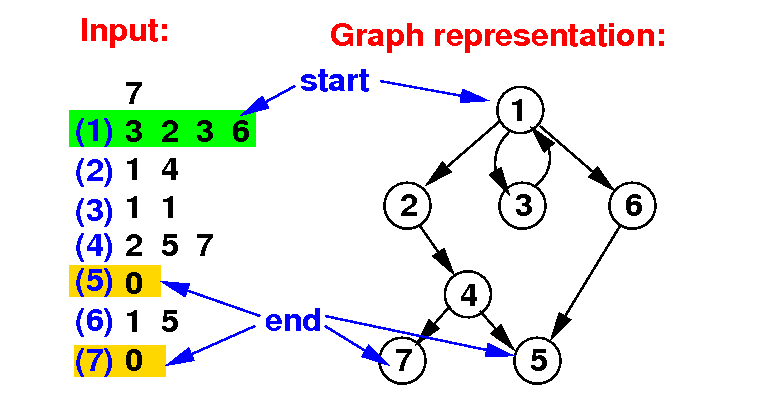
The output printed by j5-ver1.cc:
|
  1
    Push(2)
    Push(3)
    Push(6)
  2
    Push(4)
  3
  6
    Push(5)
  4
    Push(5)
    Push(7)
  5
  5
  7
|
Output of j5-ver1.cc
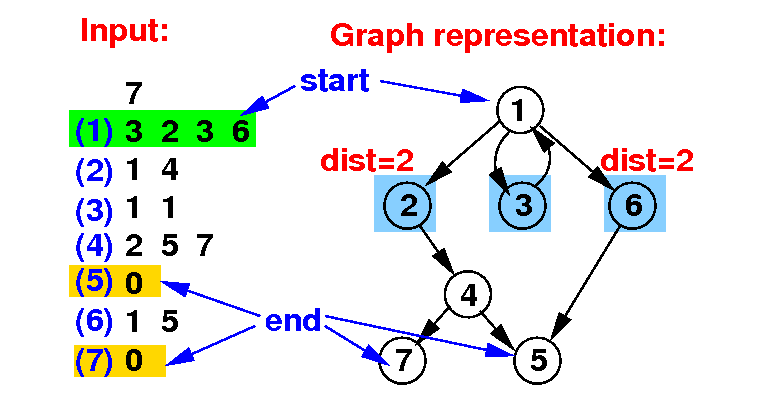
First, the closest nodes will be visited:
|
  1
    Push(2)
    Push(3)
    Push(6)
  2
    Push(4)
  3
  6
    Push(5)
  4
    Push(5)
    Push(7)
  5
  5
  7
|
Output of j5-ver1.cc
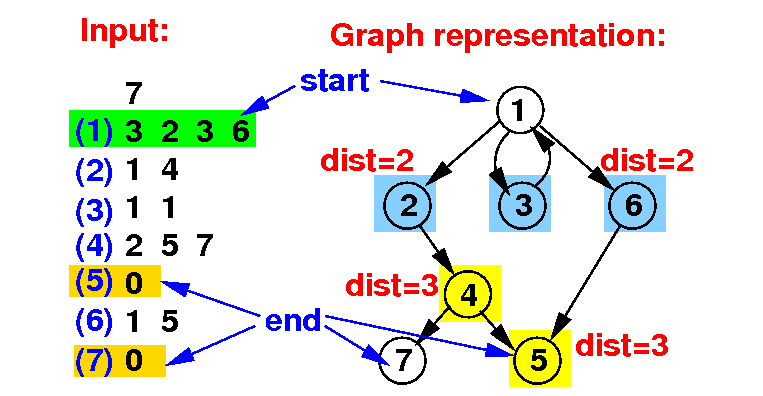
First, the next layer of nodes will be visited:
|
  1
    Push(2)
    Push(3)
    Push(6)
  2
    Push(4)
  3
  6
    Push(5)
  4
    Push(5)
    Push(7)
  5
  5
  7
|
We visit
node 5 with
distance = 3
That is the shortest path !!!
We need to maintain
distance information
with each page !!!
Breadth First Search Algorithm
with distance information
Version 2: store page distance in another (parallel) queue distances:
   void bfs()
   {
      int i, j, dist;

      while ( ! myQueue.empty() )
      {
         i = myQueue.front();  myQueue.pop();
         dist = distances.front();  distances.pop();

   	 visited[i] = true;  // Mark node i as "visited"

   	 /* ----------------------------------------------------------
   	    We reached node i... Something wonderful may happen at i
   	    ---------------------------------------------------------- */
   	 cout << i << dist << endl;  // Change accordingly

   	 for ( int j = 0; j < page[i].size(); j++ )
   	 {
   	    if ( ! visited[ page[i][j] ] )
   	    {
   	       myQueue.push( page[i][j] );  // Visit page  page[i][j]
	       distances.push(  dist + 1 );
   	    }  // When you loop back up, myQueue.pop() will visit the node!
   	 }
      }
   }
|
Demo: CCC/2018/j5-ver2.cc
Output of j5-ver2.cc
The output printed by j5-ver2.cc:
|
|
  1(dist = 1)
     push(2) 2
     push(3) 2
     push(6) 2
  2(dist = 2)
     push(4) 3
  3(dist = 2)
  6(dist = 2)
     push(5) 3
  4(dist = 3)
     push(5) 4
     push(7) 4
  5(dist = 3)
  5(dist = 4)
  7(dist = 4)
|
Notice that the algorithm has found the shortest path length = 3 !!!
J5 solution in C++
void bfs()
{
   int j;

   while ( ! myQueue.empty() )
   {
      int i;
      int dist;

      /* ----------------------------------
         Visit next node
         ---------------------------------- */
      i = myQueue.front();        myQueue.pop();
      dist = distances.front(); distances.pop();

      visited[i] = true; // Mark node i as "visited"

      /* ---------------------------------------------------------------
         We reached node i... Something wonderful may happen at i
         I print node i out - Replace with code that solves your problem
         --------------------------------------------------------------- */
      cout << ">> " << i << endl;  // Debug use

      /* --------------------------------------------
         Check if page is terminal
         -------------------------------------------- */
      if ( page[i].size() == 0 ) // Terminal page
      {
         if ( dist < minPathLen )
         {
            minPathLen = dist ;
            cout << "   ** new shortest path length: " << minPathLen << endl;
         }
      }

      /* ---------------------------------------------------------------
         Visit pages reachable from page[i] that you have NOT visited
         --------------------------------------------------------------- */
      for ( int j = 0; j < page[i].size(); j++ )
      {
         if ( ! visited[ page[i][j] ] )
         {
            cout << "   push(" << page[i][j] << ") " << dist+1 << endl;
            myQueue.push(  page[i][j] );
            distances.push(  dist + 1 );
         }
      }
   }
}
|
Demo: CCC/2018/j5.cc