Original table
Properties
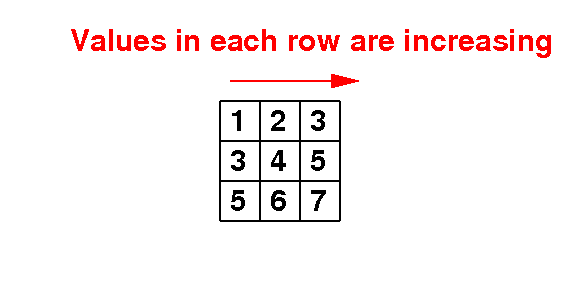
Each day, all of her flowers grow taller than they were the day before. |
Original table
Properties
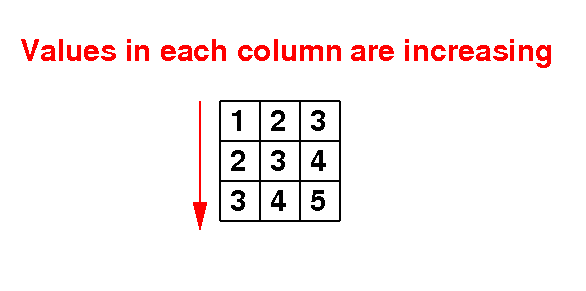
.... first row recording the shortest sunflower's growth and the last row recording the tallest sunflower's growth If a sunflower was smaller than another when initially planted, it remains smaller for every measurement. |
Original table
Properties
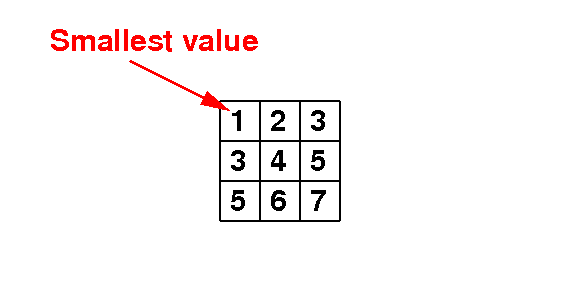
  Key:

      The smallest value is originally in the upper-left corner !
|
Final table
Properties
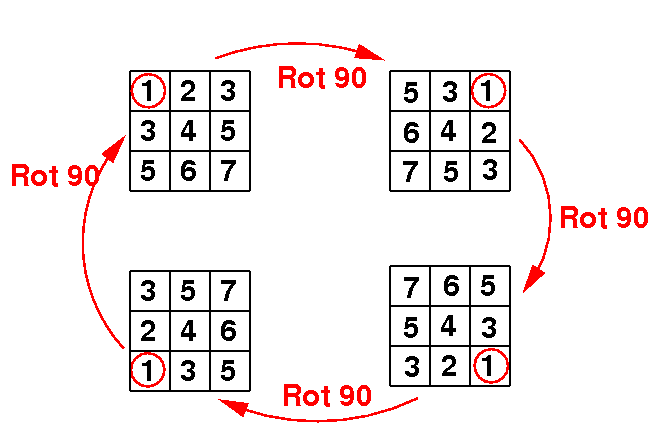
  The final table can be in

        one of 4 possible states

  Each state can be idenitified by the location of the smallest value !!
|
Final table
Properties
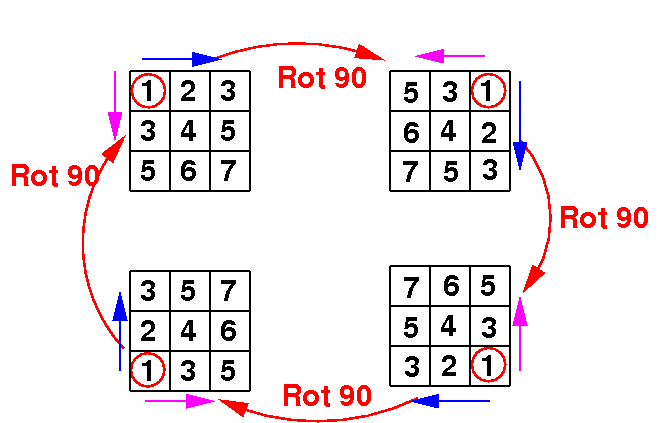
  The final table can be mapped back to the original table by:

        reading the columns and rows in a specific order !
|
Final table
Properties
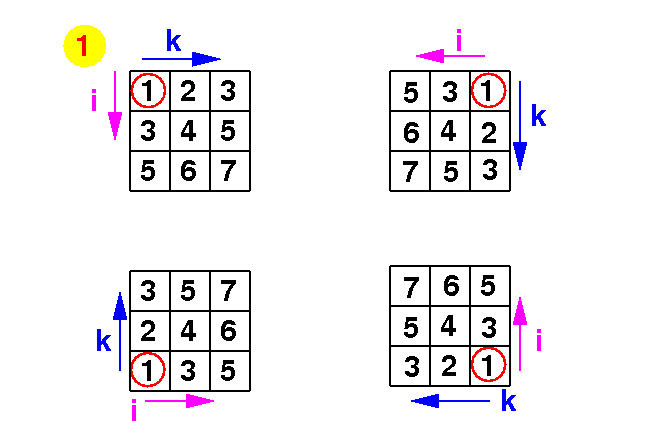
  Case 1: (a[0][0] is smallest value)

      for ( i = 0; i < N; i++ )
         for ( k = 0; k < N; k++ )
cout << grid[i][k]; |
Final table
Properties
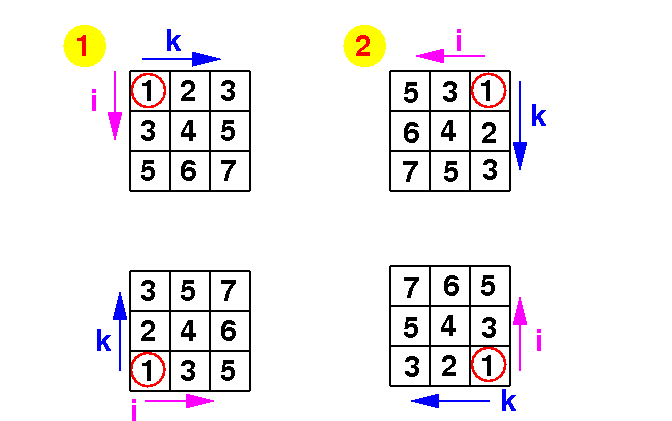
  Case 2: (a[0][N-1] is smallest value)

      for ( i = N-1; i >= 0; i-- )
         for ( k = 0; k < N; k++ )
cout << a[k][i] |
Final table
Properties
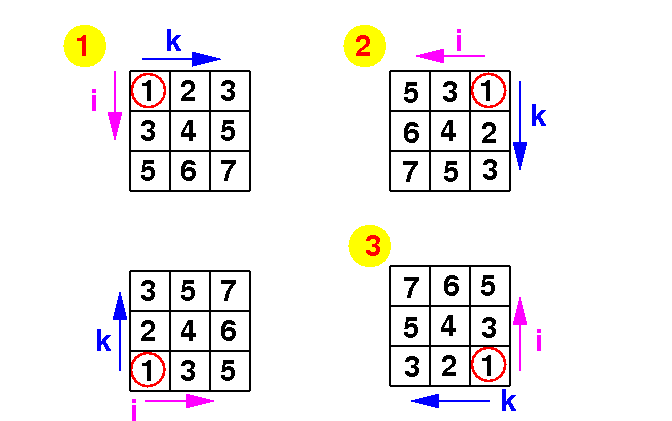
  Case 3: (a[N-1][N-1] is smallest value)

      for ( i = N-1; i >= 0; i-- )
         for ( k = N-1; k >= 0; k-- )
cout << a[i][k] |
Final table
Properties
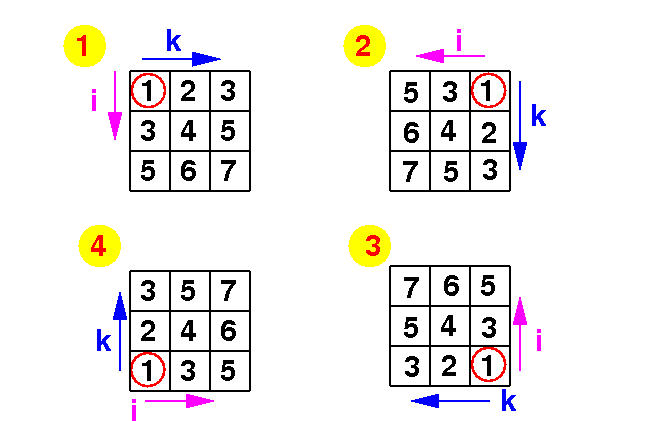
  Case 4: (a[N-1][0] is smallest value)

      for ( i = 0; i < N; i++ )
         for ( k = N-1; k >= 0; k-- )
cout << a[k][i] |
J4 solution
In C++
   /* --------------------------
      Determine configuration
      -------------------------- */
   int min, iMin, kMin;

   iMin = 0; kMin = 0;   // Assume grid[0][0] is min
   min = grid[0][0];

   if ( grid[0][N-1] < min )
   {
      iMin = 0; kMin = N-1; min = grid[0][N-1];
   };

   if ( grid[N-1][N-1] < min )
   {
      iMin = N-1; kMin = N-1; min = grid[N-1][N-1];
   };
   if ( grid[N-1][0] < min )
   {
      iMin = N-1; kMin = 0; min = grid[N-1][0];
   };

   /* --------------------------------------
      Print grid according to configuration
      -------------------------------------- */
   if ( iMin == 0 && kMin == 0 )
   {
      ... (see explanation in previous pages)
   }

   etc
|