Data representation
Slow periods:
07:00 - 10:00
15:00 - 19:00
Input: (sample):
05:00
|
Problem analysis
 This is a Math problem.

 Speed graph over time:
|
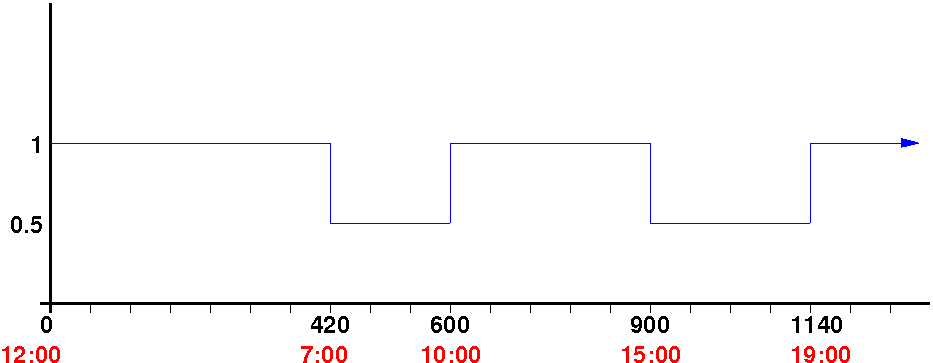
Problem analysis
The distance travelled per min outside congestion = 1 In T min, distance travelled = T |
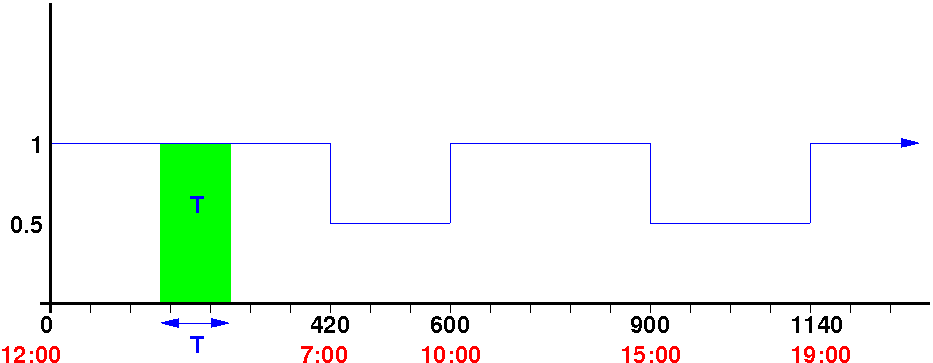
Problem analysis
The distance travelled per min inside congestion = 0.5 In T min, distance travelled = 0.5×T |
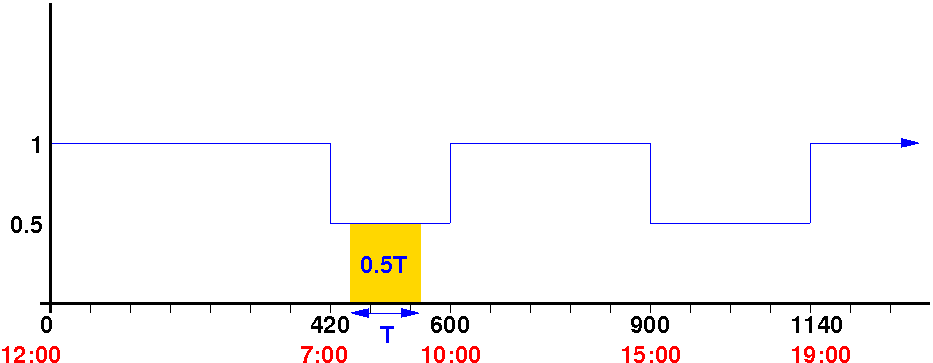
Problem analysis
The question ask to find Tend where:
Area from Tstart to Tend = 120 min (= 2 hrs)
|
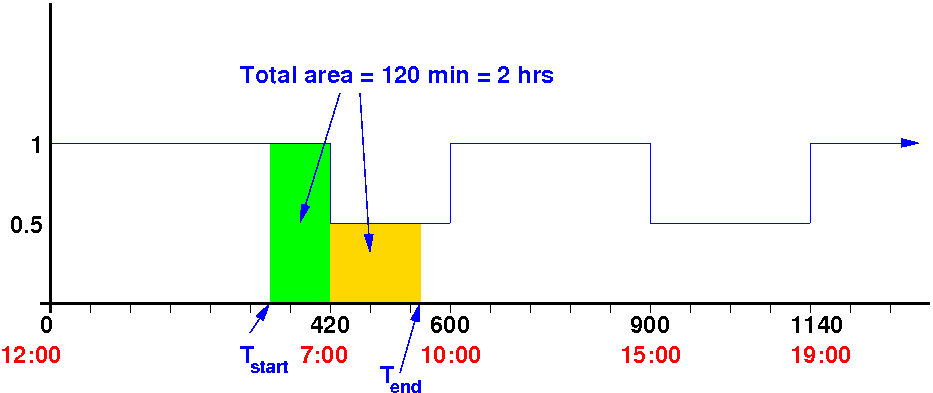 I.e.: Tstart∫Tend T(t) dt = 120
Problem analysis
You can technically solve this problem analytically But this is Computer Science... So we do it algorithmically |
Solution
in pseudo code
   double totCommTime = 2*60;   // 2 hrs

   int startHr, startMin;
   scanf("%d:%d", &startHr, &startMin);

   int now = startHr*60 + startMin;  // Current time in #minutes

   while ( totCommTime > 0.0 )
   {
      Simulate commute travel for 1 min


      now++;
   }

  (Print now in HH:MM format for answer)
|
Solution
in (almost) C++
   double totCommTime = 2*60;   // 2 hrs

   int startHr, startMin;
   scanf("%d:%d", &startHr, &startMin);

   int now = startHr*60 + startMin;  // Current time in #minutes

   while ( totCommTime > 0.0 )
   {
      if ( now is OUTSIDE the slow periods )
         totCommTime -= 1.0; // Each passing min cuts commute time by 1 min
      else
         totCommTime -= 0.5; // We make 1/2 the progress in slow periods...

      now++;
   }

  (Print now in HH:MM format for answer)
|
DEMO: CCC/2016/Progs/j4.cc
Better solution
integer solution
(in case there is
round off errors)
   int totCommTime = 2*2*60;   // We use 0.5 min as time unit !

   int startHr, startMin;
   scanf("%d:%d", &startHr, &startMin);

   int now = startHr*60 + startMin;  // Current time in #minutes

   while ( totCommTime > 0 )
   {
      if ( now is OUTSIDE the slow periods )
         totCommTime -= 2; // 2 half min = 1 min
      else
         totCommTime -= 1; // 1 half min...

      now++;
   }

  (Print now in HH:MM format for answer)
|
DEMO: CCC/2016/Progs/j4-int.cc