Overview
|
State representation
the state of a board
The problem starts with start with 1 coin in each spot of the board:
3 2 1 (3 coins)
Number of spots on the board is variable:
2 1 (2 coins)
So we must use a variable length array (= vector) to represent
the spots on the board:
vector< ??? > board;
where ??? represents the state in 1 spot on the board.
|
State representation
the state of a spot (on a board)
 We start with 1 coin in each spot of the board:

             3   2   1         (3 coins)

 But: we can move a smaller coin "on top" on a larger coin:

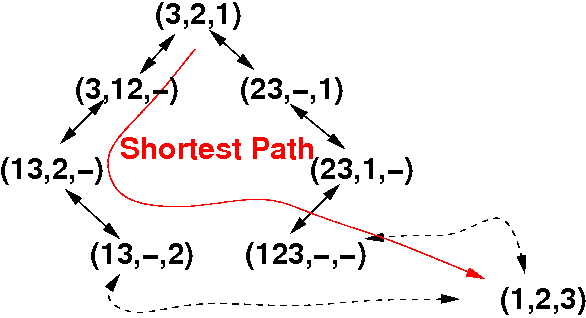
              3   2   1    --->    3   12   -
                  ^   |
                  |   |
		  +---+

 Therefore: each spot can contain a variable number of coins !!!

 So we must use a variable length array (= vector) to represent
 the state of a spot on the board:

 --->  vector< vector < int > > board;  !!!
|
Data structure used for BFS
The queues:
queue< vector< vector
|
Initialization
queue< vector< vector
|
Breadth First Search Algorithm
   void bfs()
   {
      int i, j;

      while ( myQueue != empty )
      {
         i = myQueue.remove();  // Get next node to visit

   	 visited[i] = true;  // Mark node i as "visited"

   	 /* ----------------------------------------------------------
   	    We reached node i... Something wonderful may happen at i
   	    ---------------------------------------------------------- */
   	 cout << i << endl;  // Change accordingly

   	 /* -------------------------------------------------------------
   	    How you find nodes j will depend on how you represent the graph
   	    ------------------------------------------------------------- */
   	 for ( each node j that can be reached from node i )
   	 {
   	    if ( ! visited[j] )
   	    {
   	       myQueue.push(j);  // Visit node j
   	    }  // When you loop back up, myQueue.pop() will visit the node!
   	 }
      }
   }
|
BFS:
processing a board (we reached node i...)
 /* ----------------------------------------------------------
    We reached node i... Something wonderful may happen at i
    ---------------------------------------------------------- */

    board = q.front(); q.pop();
    dist = d.front();  d.pop();

    visited[board] = true;

    if ( finished(board) )
    {
        cout << "\nAnswer: " << dist << endl;
        exit(0);
    }
|
How do we tell if the state of the board is the end state ?
How to test for a solution ?
/* --------------------------------------------------
   Check is board is done:  1 2 3 4 ... N

   Check for:

       (1) Each spot has 1 coin
       (2) Spot i has coin i+1
   -------------------------------------------------- */

bool finished( vector< vector< int> > board )
{
   for ( int i = 0; i < board.size(); i++)
   {
      if ( board[i].size() != 1 )       // more than 1 coin in a spot
         return false;
      else if ( board[i][0] != i+1 )    // coin i is not in its position
         return false;
   }
   return true;
}
|
Breadth First Search Algorithm
   void bfs()
   {
      int i, j;

      while ( myQueue != empty )
      {
         i = myQueue.remove();  // Get next node to visit

   	 visited[i] = true;  // Mark node i as "visited"

   	 /* ----------------------------------------------------------
   	    We reached node i... Something wonderful may happen at i
   	    ---------------------------------------------------------- */
   	 cout << i << endl;  // Change accordingly

   	 /* -------------------------------------------------------------
   	    How you find nodes j will depend on how you represent the graph
   	    ------------------------------------------------------------- */
   	 for ( each node j that can be reached from node i )
   	 {
   	    if ( ! visited[j] )
   	    {
   	       myQueue.push(j);  // Visit node j
   	    }  // When you loop back up, myQueue.pop() will visit the node!
   	 }
      }
   }
|
BFS:
making the next step
on the board
|



BFS:
moving a coin to the
right spot
on the board
  /* ---------------------------------------------------------
     Check if we can move a coin from slot i --> i+1
     --------------------------------------------------------- */
  for ( int i = 0; i < board.size()-1; i++ )
  {
     // Make sure there is some coin in slot i for you to move !
     if ( board[i].size() == 0 )
         continue;

     if (    board[i+1].size() == 0      // slot i empty --> move OK
          || board[i][0] < board[i+1][0] // coin in slot i is SMALLER --> OK
        )
     {
        Make newBoard by moving top coin in slot i to slot i+1

        if ( !visited[newBoard] )
        {
            q.push( newBoard );
            d.push( dist+1 );
         }
     }
|
Do the same for a left move and we are done !
Sample output for J5
      3 : 2 : 1 :  ---> 0   (Initial state)

 <--  3 : 12 :  :  ---> 1
 <--  23 :  : 1 :  ---> 1
 <--   13 : 2 :  :  ---> 2
 <--   23 : 1 :  :  ---> 2
 -->    13 :  : 2 :  ---> 3
 <--    123 :  :  :  ---> 3
 -->     3 : 1 : 2 :  ---> 4
 -->      3 :  : 12 :  ---> 5
 -->        : 3 : 12 :  ---> 6
 <--         : 13 : 2 :  ---> 7
 <--         1 : 3 : 2 :  ---> 8
 <--          1 : 23 :  :  ---> 9
 -->            : 123 :  :  ---> 10
 -->             : 23 : 1 :  ---> 11
 <--             2 : 3 : 1 :  ---> 12
 <--              2 : 13 :  :  ---> 13
 <--               12 : 3 :  :  ---> 14
 -->                12 :  : 3 :  ---> 15
 -->                 2 : 1 : 3 :  ---> 16
 -->                  2 :  : 13 :  ---> 17
 -->                    : 2 : 13 :  ---> 18
 <--                     : 12 : 3 :  ---> 19
 <--                     1 : 2 : 3 :  ---> 20

Answer: 20
|