Data representation
|
Problem analysis
|
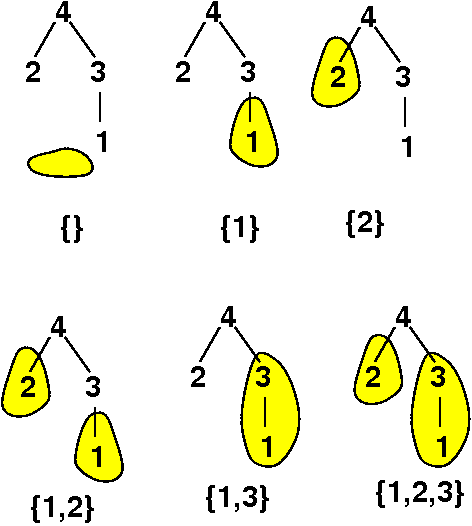
Problem analysis
why is this counting problem recursive
|
Finding the recursive relationship
|
Finding the recursive relationship
|
(I included the universe set in red because it will be important as shown next)
Finding the recursive relationship
|
Finding the recursive relationship
|
Finding the recursive relationship
|
Finding the recursive relationship
|
Finding the recursive relationship
|
Finding the recursive relationship
|
Finding the recursive relationship
|
A larger example to show the recursive relationship of subsets
# subsets (including the universe set) = k1*k2*...*kN + 1
                           Sets to remove                        How to form
                          ====================================  ==============
              7            {} {1} {2} {12} {126}                (R1=T(6)+{ }+{  })
         /    |    \       {5} {15} {25} {125} {1265}           (R2=T(6)+{5}+{  })
        6     5     4      {3} {13} {23} {123} {1263}           (R3=T(6)+{ }+{3 })
       / \          |      {53} {153} {253} {1253} {12653}      (R4=T(6)+{5}+{3 })
      1   2         3      {34} {134} {234} {1234} {12634}      (R5=T(6)+{ }+{34})
                           {534} {1534} {2534} {12534} {126534} (R6=T(6)+{5}+{34})
			   {1234567}
                           Total = 5 * 2 * 3 + 1

        6      {} {1} {2}         5   {}            4    {} {3}
       / \     {12}                   {5}           |    {34}
      1   2    {126}                                3
               Total = 2*2+1 = 5      Total = 2          Total = 2+1 = 3

      1  {}     2  {}                               3  {}
         {1}       {2}                                 {3}
         Total = 2 Total = 2                           Total = 2
|
where: k1, k2, k3 are the size of the subsets in the subtrees
Data representation
   4  <---- Mark = 4                     4
   3  <---- 3 invited 1                 / \
   4  <---- 4 invited 2                2   3
   4  <---- 4 invited 3                     \
                                             1

 Data repr:

        invited[4] = {2,3}
        invited[3] = {1}
        invited[2] = {}
        invited[1] = {}

 Use: (variable length array)

      vector<int> invited[10];   // Because N <= 6
|
Data representation
4 <---- Mark = 4 4
3 <---- 3 invited 1 / \
4 <---- 4 invited 2 2 3
4 <---- 4 invited 3 \
1
Data repr:
invited[4] = {2,3}
invited[3] = {1}
invited[2] = {}
invited[1] = {}
|
J5 solution
int countComb( vector |