When can we use
recursion ?
Suppose we need to solve some problem of size n:
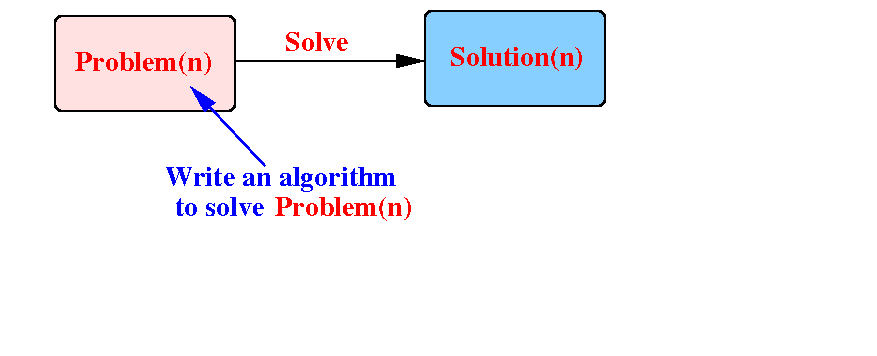
When can we use
recursion ?
Consider the other identical (but) smaller problems:
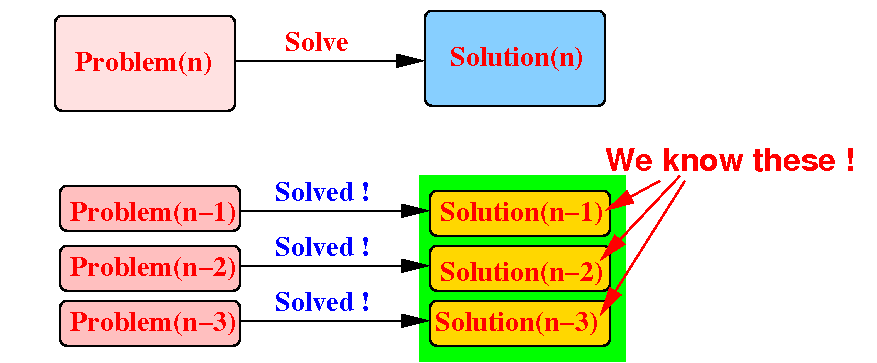
Suppose that we (already) have the solutions for all the smaller problems, i.e.: we do not need to solve them
When can we use
recursion ?
If we can use the solutions of the smaller problems to find Solution(n):
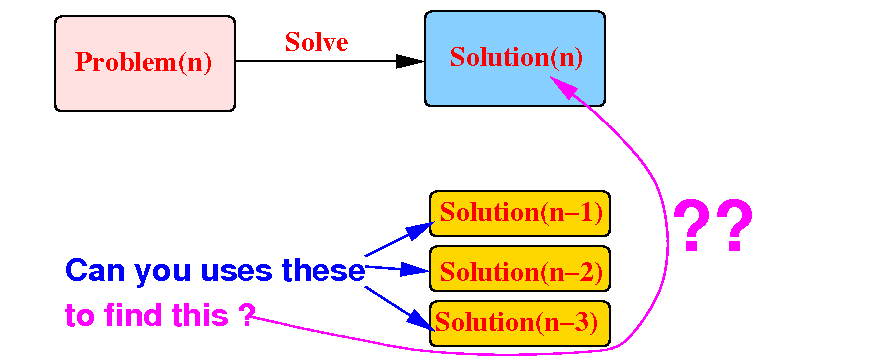
Then: we can use recursion to solve the Problem(n)
The difficulty
in using
recursion
The main difficulty of using recursion is to find a way to use the smaller solutions to find Solution(n):
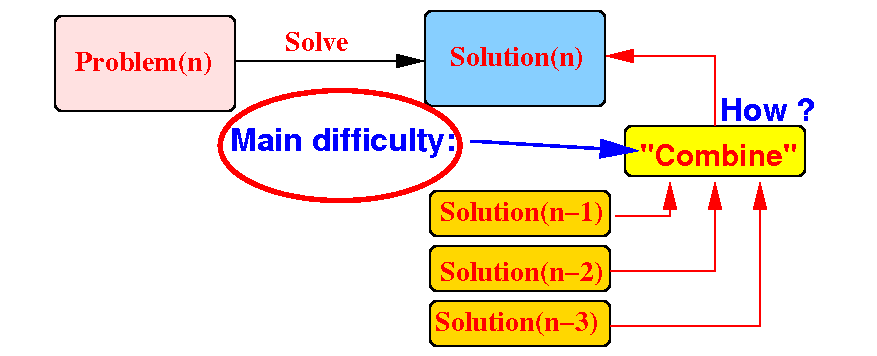
This step is problem-dependent !
Example: why we can use
recursion to compute the
factorial function
Suppose we need to compute fac(10):
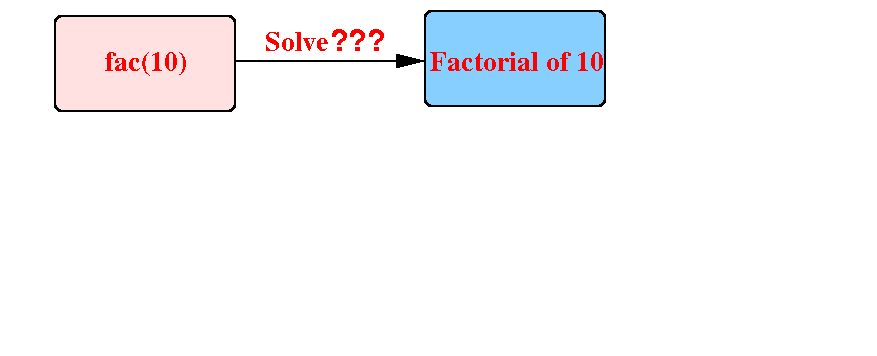
Recursion = a divide and conquer algorithm
Consider the smaller problem of fac(9):
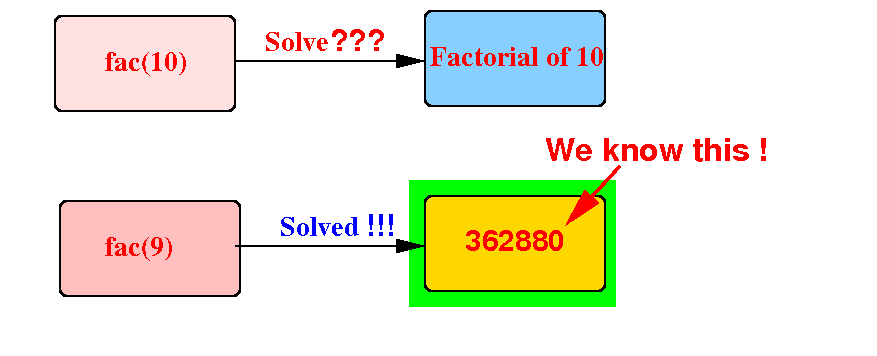
Question: can we solve fac(10) using the value 362880 ?
Recursion = a divide and conquer algorithm
We can compute fac(10) using the value 362880 as follows:
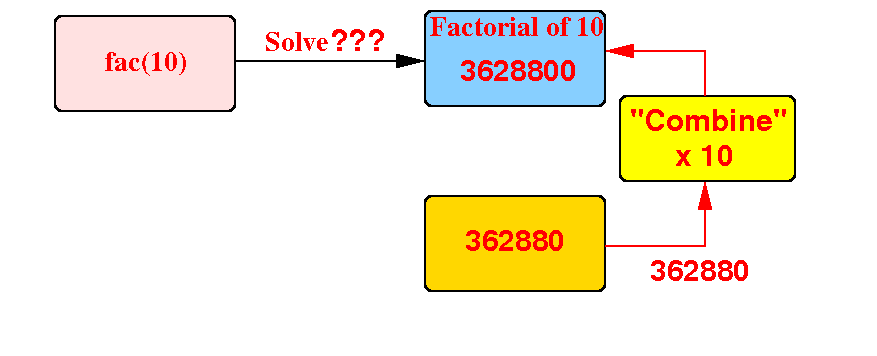
Therefore: we can write factorial as a recursive function !
How recursion actually works (hint: it's not
calling yourself !)
Why you can use recursion to compute 10!:
Situation: I have an idea how to do it....
How recursion actually works (hint: it's not
calling yourself !)
Situation: I know that 10! = 10 × 9!
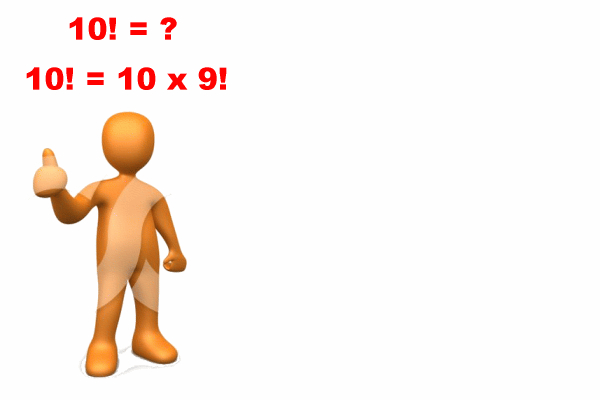
However: I will need the solution for 9!...
How recursion actually works (hint: it's not
calling yourself !)
I will delegate the 9! problem to a helper (someone else):
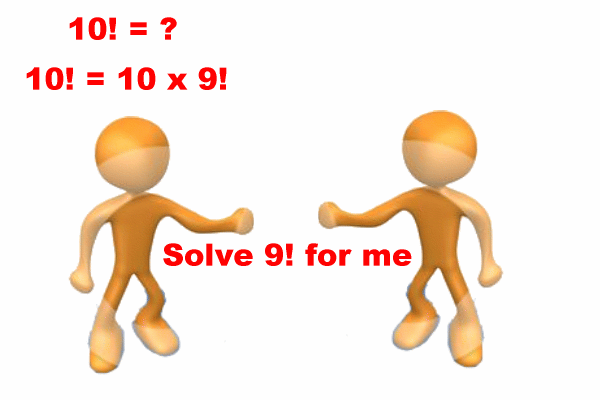
This technique is called divide and conquer and another process will solve the smaller problem
How recursion actually works (hint: it's not
calling yourself !)
After I delegated the problem 9! to a helper (another person), I will wait for an answer
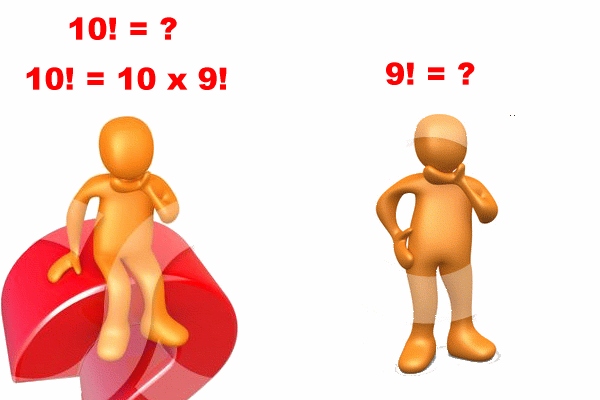
BTW: the helper that solves 9! is not the original person !!
How recursion actually works (hint: it's not
calling yourself !)
Eventually (sooner or later), that helper (= another person) will be done:
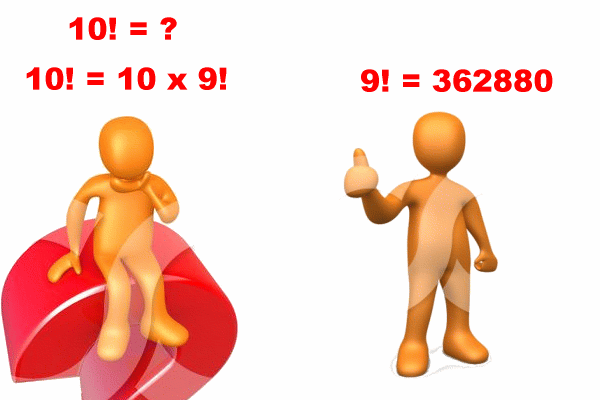
Meanwhile, I (= the original person) am still waiting for the answer...
How recursion actually works (hint: it's not
calling yourself !)
The helper (= other person) give the answer 362880 to me (= original person):
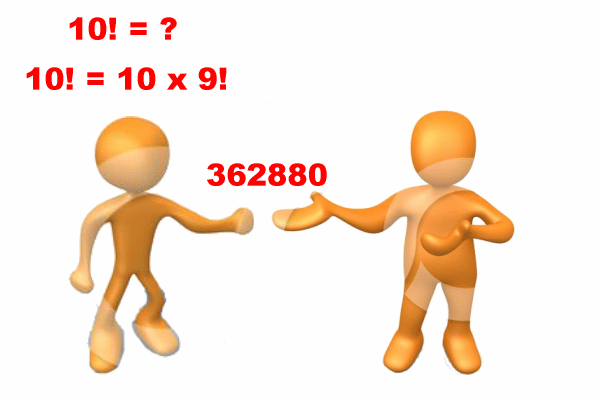
Notice: I (= original person) only need the answer 362880. I don't need to know how he solved it !
How recursion actually works (hint: it's not
calling yourself !)
I (= original person) can solve my problem 10!:
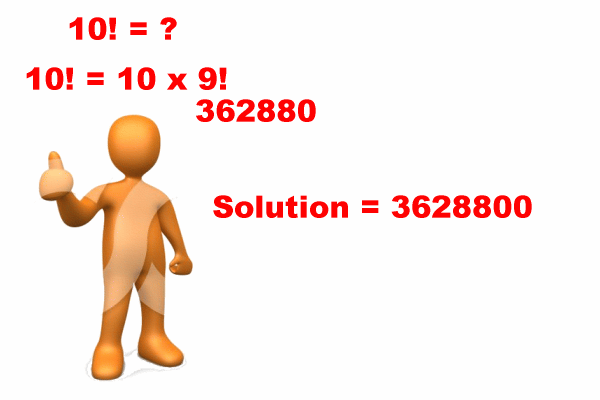
So: recursion is a divide and conquer problem solving technique !
The fac( ) function
revisited
Students are usually taught the following fac( ) function:
   int fac(int n)
   {
      if ( n == 0 )
         return 1;
      else
         return (n * fac(n-1));
   }
|
This form does not reveal how the divide-and-conquer technique was used...
The fac( ) function
revisited
I teach students the following function in my intro CS class (Java):
   int fac(int n)
   {
      int helpSol;     // Solution to the smaller problem
      int mySol;       // Solution to my problem

      if ( n == 0 )
         return 1;
      else
      {
         helpSol = fac(n-1); // Delegate a smaller problem to someone
                             // (helpSol will receive the solution)
	 mySol = n*helpSol;  // Solve my problem using the
                             // solution of the smaller problem
         return (mySol);
      }
   }
|
This form reveals how the divide-and-conquer technique was used !
Important insight to help you understand and write recursive
functions
You must distinguish between fac( ) that solves your problem and fac( ) that solves a smaller problem:
int fac(int n) <--- This fac( ) represents "YOU" (solves your problem) { int helpSol; int mySol; if ( n == 0 ) return 1; else { helpSol = fac(n-1); <--- This fac( ) your "helper" ! This fac( ) solves a smaller problem mySol = n*helpSol; return (mySol); } } |
So recursion will run another (copy of the) function