The
Tower of Hanoi
problem/game
|
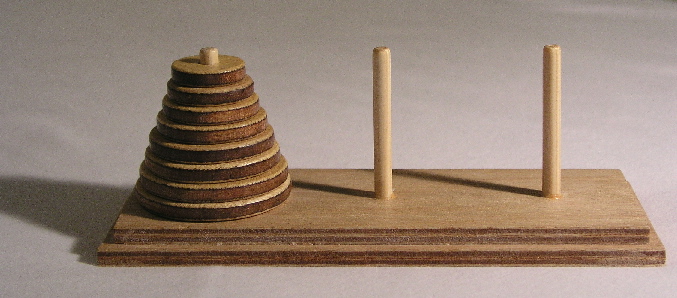
The
Tower of Hanoi
problem/game
|

Try it yourself: https://www.mathsisfun.com/games/towerofhanoi.html
Review:
When can we use
recursion to
solve a problem ?
If we can use the solutions of some smaller problems to find Solution(n) (= solution of original problem):
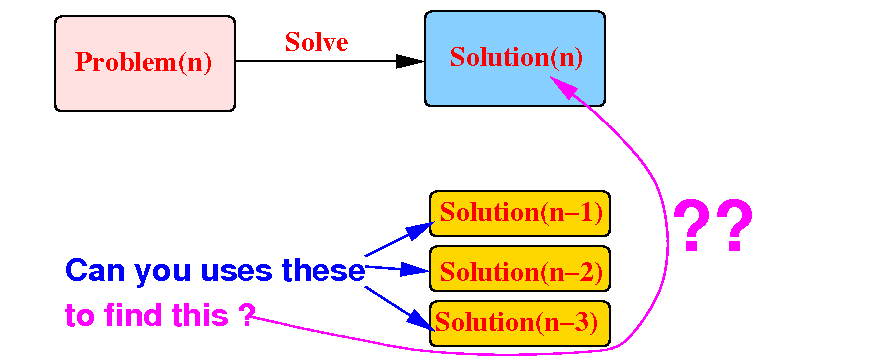
Then: we can use recursion to solve the Problem(n)
Finding
smaller
Hanoi problems
to help solve a
bigger
Hanoi problem
Problem(n, 1, 3, 2) = moving n disks from peg 1 to peg 3 with the help of peg 2:
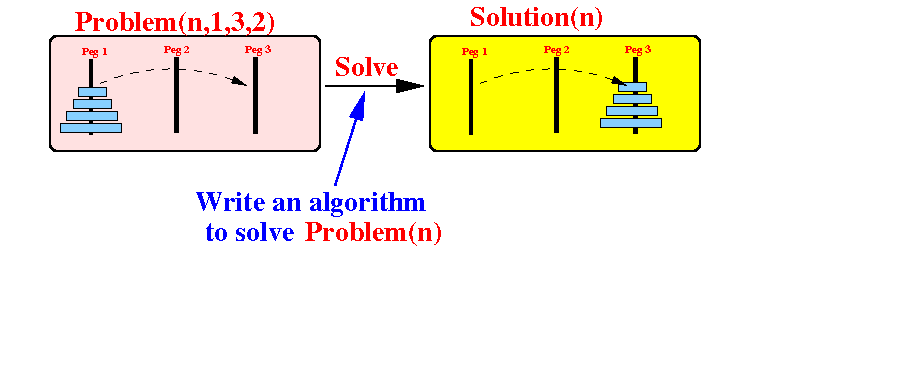
Question: which smaller Hanoi problem(s) can be used to solve the Problem(n, 1, 3, 2)?
Finding
smaller
Hanoi problems
to help solve a
bigger
Hanoi problem
Problem(n, 1, 3, 2) = moving n disks from peg 1 to peg 3 with the help of peg 2:
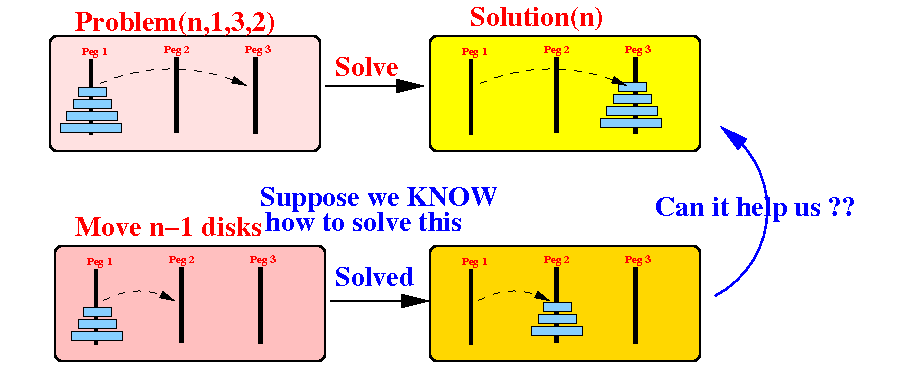
Suppose: we can move (n−1) disks from any peg to any other peg
Can we use this knowledge to solve the original problem (that has n disks)?
Solving
Hanoi(4 disks)
using
Hanoi(3 disks)
Consider moving 4 disks from peg 1 to peg 3 with the help of peg 2:
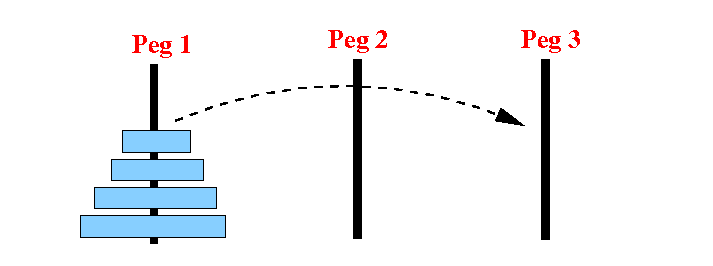
Suppose: we can move 3 disks from any peg to any other peg
Can we use this knowledge to solve the original problem (that has 4 disks)?
Solving
Hanoi(4 disks)
using
Hanoi(3 disks)
Step 1: move 3 disks from peg 1 to peg 2 with the help of peg 3:
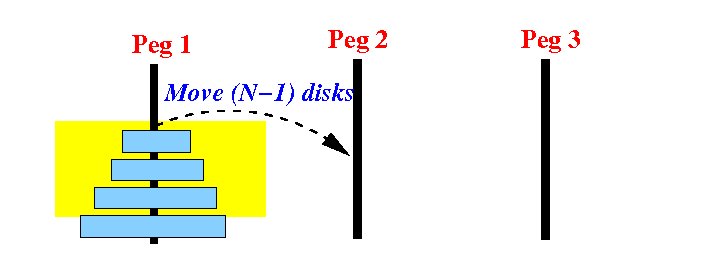
Note: do not overthink and try to find this solution (don't worry about how to move the 3 disks)
Remember: in recursion, we assume that we know/have the solution already
Solving
Hanoi(4 disks)
using
Hanoi(3 disks)
Result:
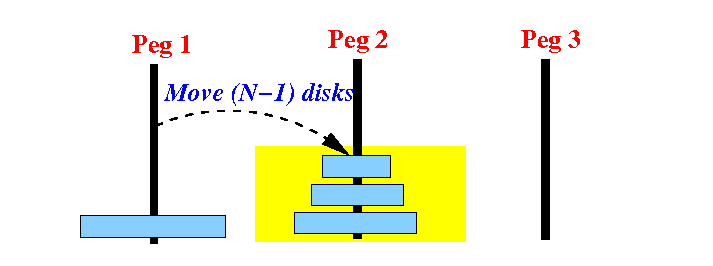
Can you see what we must do next ???
Solving
Hanoi(4 disks)
using
Hanoi(3 disks)
Step 2: move 1 disk from peg 1 to peg 3 directly:
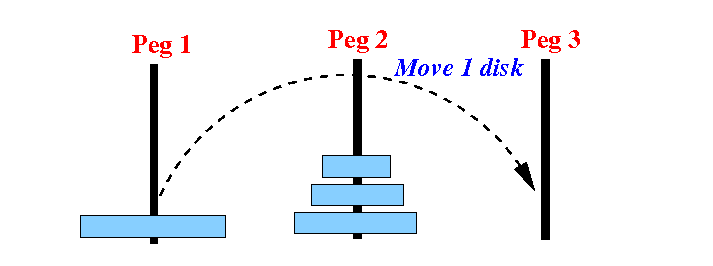
Note: this step is easy (= a base case) because there is no disk on top of the last disk
Solving
Hanoi(4 disks)
using
Hanoi(3 disks)
Result:
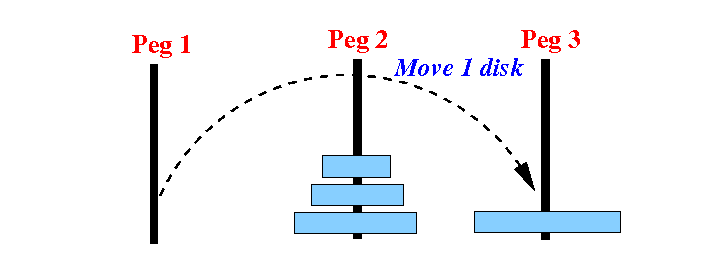
Can you see what we must do next ???
Solving
Hanoi(4 disks)
using
Hanoi(3 disks)
Step 3: move 3 disks from peg 2 to peg 3 with the help of peg 1:
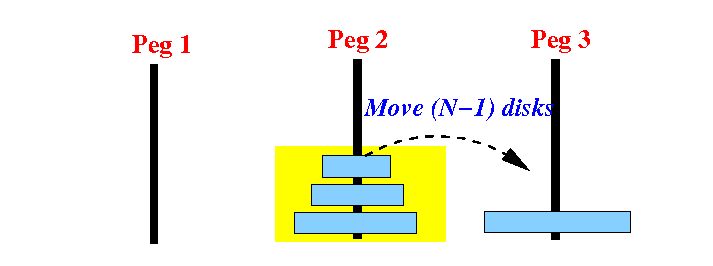
Again: do not overthink and try to find this solution (don't worry about how to move the 3 disks)
Remember: in recursion, we assume that we know/have the solution already
Solving
Hanoi(4 disks)
using
Hanoi(3 disks)
Final result:
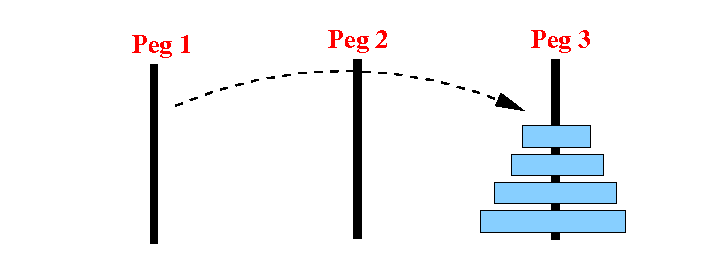
Solved ! all 4 disks have been moved from peg 1 to peg 3
Finding
smaller Hanoi problems
revisited
Problem(n, 1, 3, 2) = moving n disk from peg 1 to peg 3 with the help of peg 2:
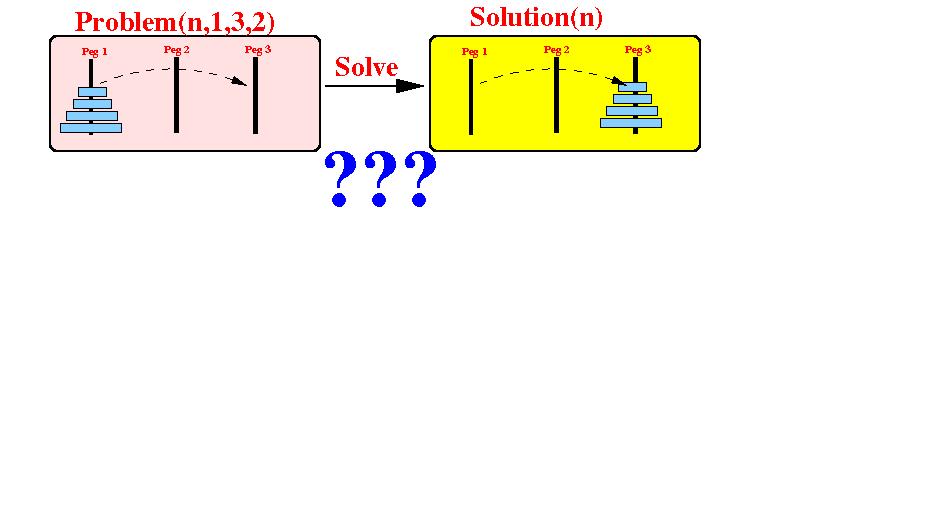
Question: which smaller Hanoi problem(s) did we use to solve the Problem(n, 1, 3, 2)?
Finding
smaller Hanoi problems
revisited
Problem(n, 1, 3, 2) = moving n disk from peg 1 to peg 3 with the help of peg 2:
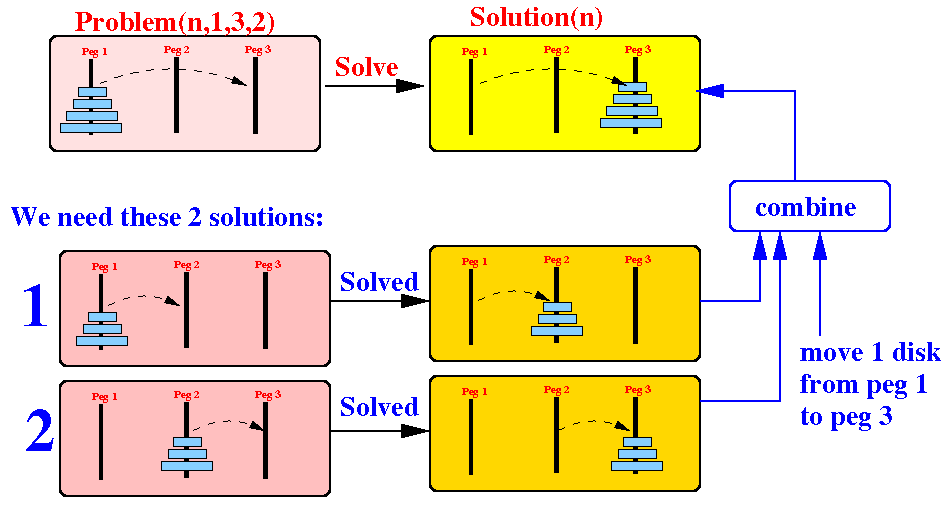
Answer: Problem(n−1, 1, 2, 3) and the Problem(n−1, 2, 3, 1)
The
hanoi(n, fr, to, h)
method
The hanoi(n, fr, to, h) method will return instructions (as text) to move n disks from starting peg fr to destination peg to using help peg h
    // Move n disks from peg fr to peg to with help of peg h

    public static String hanoi(int n, int fr, int to, int h)
    {
        if ( n == 1 )
	{  // base case
	   return fr + " --> " + to + "\n";
	}
	Returns instructions on how to move n disks
	from peg fr to peg to with the help of peg h

	    String helpSol1 = hanoi(n-1, fr, h, to);
	    String helpSol2 = hanoi(n-1, h, to, fr);
	    String myMove = fr + " --> " + to + "\n";

	    String mySol = helpSol1 + myMove + helpSol2;
	    return mySol;
        }
    }
|
The
hanoi(n, fr, to, h)
method
Base case:
moving
1 disk
(from any peg to
any other peg) is
easy
Returns:
the text
"from peg # --> to peg #"
    // Move n disks from peg fr to peg to with help of peg h

    public static String hanoi(int n, int fr, int to, int h)
    {
        if ( n == 1 )
	{  // base case
	   return fr + " --> " + to + "\n";
	}
	else
	{
	    String helpSol1 = hanoi(n-1, fr, h, to);
	    String helpSol2 = hanoi(n-1, h, to, fr);
	    String myMove = fr + " --> " + to + "\n";

	    String mySol = helpSol1 + myMove + helpSol2;

	    return mySol;
        }
    }
|
The
hanoi(n, fr, to, h)
method
Recursive case:
moving
n disk
will use the
solutions from
2 smaller
Hanoi problems:
    // Move n disks from peg fr to peg to with help of peg h

    public static String hanoi(int n, int fr, int to, int h)
    {
        if ( n == 1 )
	{  // base case
	   return fr + " --> " + to + "\n";
	}
	else
	{
	    String helpSol1 = hanoi(n-1, fr, h, to);
	    String helpSol2 = hanoi(n-1, h, to, fr);
	    String myMove = fr + " --> " + to + "\n";

	    String mySol = helpSol1 + myMove + helpSol2;

	    return mySol;
        }
    }
|
The
hanoi(n, fr, to, h)
method
In addition,
we need to
move a
disk from
fr peg
to
to peg:
    // Move n disks from peg fr to peg to with help of peg h

    public static String hanoi(int n, int fr, int to, int h)
    {
        if ( n == 1 )
	{  // base case
	   return fr + " --> " + to + "\n";
	}
	else
	{
	    String helpSol1 = hanoi(n-1, fr, h, to);
	    String helpSol2 = hanoi(n-1, h, to, fr);
	    String myMove = fr + " --> " + to + "\n";

	    String mySol = helpSol1 + myMove + helpSol2;

	    return mySol;
        }
    }
|
The
hanoi(n, fr, to, h)
method
Put all instructions in the
correct order:
(1) do steps in
helpSol1,
then (2) do myMove and
finally (3) do steps in
helpSol2
    // Move n disks from peg fr to peg to with help of peg h

    public static String hanoi(int n, int fr, int to, int h)
    {
        if ( n == 1 )
	{  // base case
	   return fr + " --> " + to + "\n";
	}
	else
	{
	    String helpSol1 = hanoi(n-1, fr, h, to);
	    String helpSol2 = hanoi(n-1, h, to, fr);
	    String myMove = fr + " --> " + to + "\n";

	    String mySol = helpSol1 + myMove + helpSol2;

	    return mySol;
        }
    }
|
The
hanoi(n, fr, to, h)
method
Return the
instructions in
mySol:
    // Move n disks from peg fr to peg to with help of peg h

    public static String hanoi(int n, int fr, int to, int h)
    {
        if ( n == 1 )
	{  // base case
	   return fr + " --> " + to + "\n";
	}
	else
	{
	    String helpSol1 = hanoi(n-1, fr, h, to);
	    String helpSol2 = hanoi(n-1, h, to, fr);
	    String myMove = fr + " --> " + to + "\n";

	    String mySol = helpSol1 + myMove + helpSol2;

	    return mySol;
        }
    }
|
The
hanoi(n, fr, to, h)
method
Demo program with
main( )
We can invoke the Hanoi( ) method with any number of disks we like, e.g. using 4 disks:
    public static void main(String[] args)
    {
        String ans = hanoi( 4 , 1, 3, 2);
        System.out.println(ans);
    }

    public static String hanoi(int n, int fr, int to, int h)
    {
        if ( n == 1 )
	{  // base case
	   return fr + " --> " + to + "\n";
	}
	else
	{
	    String helpSol1 = hanoi(n-1, fr, h, to);
	    String helpSol2 = hanoi(n-1, h, to, fr);
	    String myMove = fr + " --> " + to + "\n";

	    String mySol = helpSol1 + myMove + helpSol2;

	    return mySol;
        }
    }
|
DEMO: demo/07-recursion/05-hanoi/Hanoi.java