Review:
When can we use
recursion ?
If we can use the solutions of the smaller problems to find Solution(n) (= solution of the original problem):
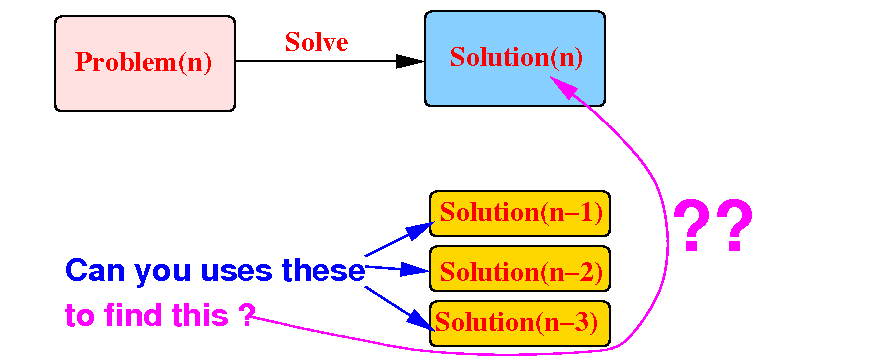
Then: we can use recursion to solve the Problem(n)
Palindromes
|
Can we use recursion to
check for palindromes ?
Original problem: is some string w a palindrome ?
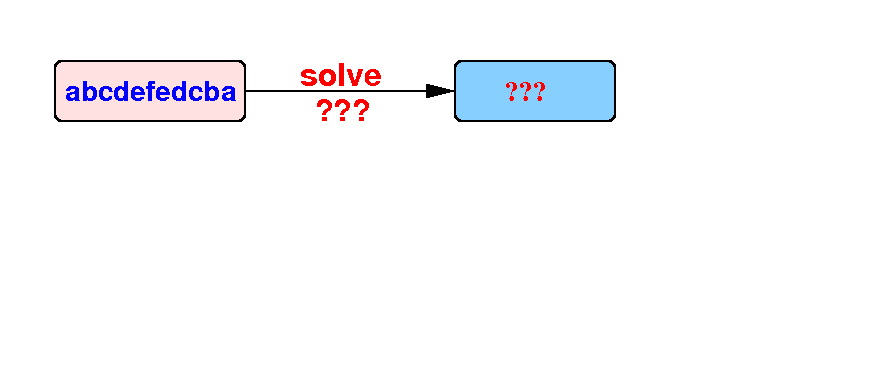
 Question: Can we use the solution of some smaller palindrome problem
           to solve this problem
??? |
Can we use recursion to
check for palindromes ?
Yes, we can use the solution of this smaller problem:
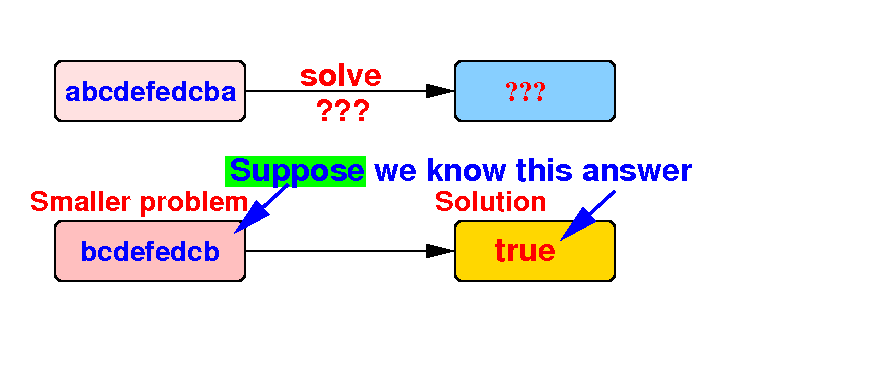
 Question:  how can we use the solution of this smaller problem
            to solve the original problem
??? |
Palindrome
The string is a palindrome if (A) first char == last char and (B) smaller substring is palindrome
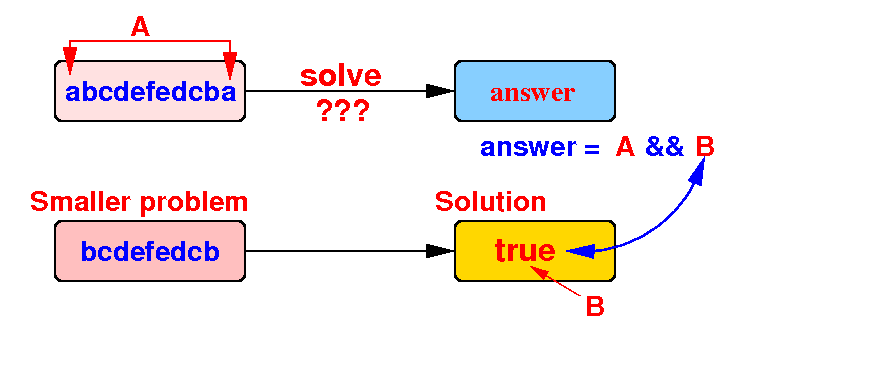
solution(orig problem) = w.charAt(0) == w.charAt(last) && solution(smaller prob) Therefore, we can use recursion to solve the palindrome problem |
Palindrome:
base cases
|
Recursive
isPalindrom( )
method
We now have all information needed to write the palindrome program:
    public static boolean isPalindrome(String w)
    {


        if ( w is one of the base cases )
        {  // base cases
           return true;
        }
        else
        {
           // Use recursion to solve the original problem

           helpSol = solve the smaller problem
           Use helpSol to solve original problem
	   Return solution

        }
    }
|
Recursive
isPalindrom( )
method
A word of length ≤ 1 is always a palindrome:
    public static boolean isPalindrome(String w)
    {
        boolean helpSol;
        boolean mySol;

        if ( w.length() <= 1 )
        {  // base cases
           return true;
        }
        else
        {
           // Use recursion to solve the original problem

           helpSol = solve the smaller problem
           Use helpSol to solve original problem
	   Return solution

        }
    }
|
In this problem, we must solve the smaller problem by removing the first and last character
Recursive
isPalindrom( )
method
Divide step: solve this smaller problem:
    public static boolean isPalindrome(String w)
    {
        boolean helpSol;
        boolean mySol;

        if ( w.length() <= 1 )
        {  // base cases
           return true;
        }
        else
        {
           int lastPos = w.length() - 1;
           helpSol = isPalindrome( w.substring(1, lastPos) );

	   mySol = (w.charAt(0) == w.charAt(lastPos)) && helpSol;

	   return mySol;
        }
    }
|
Next, we use the solution helpSol to solve the original problem
Recursive
isPalindrom( )
method
Conquer step: solve the original problem by using helpSol:
    public static boolean isPalindrome(String w)
    {
        boolean helpSol;
        boolean mySol;

        if ( w.length() <= 1 )
        {  // base cases
           return true;
        }
        else
        {
           int lastPos = w.length() - 1;
           helpSol = isPalindrome( w.substring(1, lastPos) );

	   mySol = (w.charAt(0) == w.charAt(lastPos)) && helpSol;

	   return mySol;
        }
    }
|
Final, we return the solution mySol....
Recursive
isPalindrom( )
method
The isPalindrome() method written using the divide-and-conquer technique:
    public static boolean isPalindrome(String w)
    {
        boolean helpSol;
        boolean mySol;

        if ( w.length() <= 1 )
        {  // base cases
           return true;
        }
        else
        {
           int lastPos = w.length() - 1;
           helpSol = isPalindrome( w.substring(1, lastPos) );

	   mySol = (w.charAt(0) == w.charAt(lastPos)) && helpSol;

	   return mySol;
        }
    }
|
DEMO: demo/07-recursion/02-palindrome/Palindrome.java
Recursive
isPalindrom( )
method
simplifying the
recursive code
Often, we can re-write the recursive code and make it simpler:
    public static boolean isPalindrome(String w)
    {
        boolean helpSol;
        boolean mySol;

        if ( w.length() <= 1 )
        {  // base cases
           return true;
        }
        else
        {
           int lastPos = w.length() - 1;
           helpSol = isPalindrome( w.substring(1, lastPos) );

	   mySol = (w.charAt(0) == w.charAt(lastPos)) && helpSol;

	   return mySol;
        }
    }
|
(1) Replace helpSol with isPalindrome( w.substring(1, lastPos) )
Recursive
isPalindrom( )
method
simplifying the
recursive code
After replacing helpSol with isPalindrome( w.substring(1, lastPos) ):
public static boolean isPalindrome(String w)
{
|
(2) Return the computated result without first storing in help variable mySol...
Recursive
isPalindrom( )
method
simplifying the
recursive code
After "short circuiting" the computation:
public static boolean isPalindrome(String w)
{
|
DEMO: demo/07-recursion/02-palindrome/Palindrome2.java