Review: the
selection sort
algorithm
Recall the selection sort algorithm for an array of integer: :
    public static void selectionSort(int[] list)
    {
        for (int i = 0; i < list.length-1; i++)
        {
            /* -----------------------------------------------
               Find the minimum in the list[i..list.length-1]
               ----------------------------------------------- */
           int min      = list[i];     // Assume first element is min
           int minIndex = i;           // Index where min is found

           for ( int k = minIndex+1; k < list.length; k++ )
               if ( list[k] < min ) // Found a smaller element
               {
                   min      = list[k]; // Update min value
                   minIndex = k;       // Update its index
               }

            /* ------------------------------------------------------
               Swap list[i] with list[minIndex] if necessary
               ------------------------------------------------------ */
            if ( minIndex != i )
            {   // Swap list[minIndex] and list[i]
                int help       = list[minIndex];  // Standard exchange alg
                list[minIndex] = list[i];
                list[i]        = help;
            }
        }
    }
|
Problem:
write a
selection sort algorithm to
sort and
array of
Circle objects
by their
area
In order to use the selectionSort algorithm to sort an array of Circle object, we must make some changes: :
    public static void selectionSort(int[] list)
    {
        for (int i = 0; i < list.length-1; i++)
        {
            /* -----------------------------------------------
               Find the minimum in the list[i..list.length-1]
               ----------------------------------------------- */
           int min      = list[i];     // Assume first element is min
           int minIndex = i;           // Index where min is found

           for ( int k = minIndex+1; k < list.length; k++ )
               if ( list[k] < min ) // Found a smaller element
               {
                   min      = list[k]; // Update min value
                   minIndex = k;       // Update its index
               }

            /* ------------------------------------------------------
               Swap list[i] with list[minIndex] if necessary
               ------------------------------------------------------ */
            if ( minIndex != i )
            {   // Swap list[minIndex] and list[i]
                int help       = list[minIndex];  // Standard exchange alg
                list[minIndex] = list[i];
                list[i]        = help;
            }
        }
    }
|
Problem:
write a
selection sort algorithm to
sort and
array of Circle objects
by their
area
(1) The data type of the elements used in selectionSort( ) (int) must be changed to Circle:
    public static void selectionSort(Circle[] list)
    {
        for (int i = 0; i < list.length-1; i++)
        {
            /* -----------------------------------------------
               Find the minimum in the list[i..list.length-1]
               ----------------------------------------------- */
           Circle min   = list[i];     // Assume first element is min
           int minIndex = i;           // Index where min is found

           for ( int k = minIndex+1; k < list.length; k++ )
               if ( list[k] < min ) // Found a smaller element
               {
                   min      = list[k]; // Update min value
                   minIndex = k;       // Update its index
               }

            /* ------------------------------------------------------
               Swap list[i] with list[minIndex] if necessary
               ------------------------------------------------------ */
            if ( minIndex != i )
            {   // Swap list[minIndex] and list[i]
                Circle help    = list[minIndex];  // Standard exchange alg
                list[minIndex] = list[i];
                list[i]        = help;
            }
        }
    }
|
Problem:
write a
selection sort algorithm to
sort and
array of Circle objects
by their
area
(2) The expression to compare Circles by their area is: list[k].getArea < min.getArea()
    public static void selectionSort(Circle[] list)
    {
        for (int i = 0; i < list.length-1; i++)
        {
            /* -----------------------------------------------
               Find the minimum in the list[i..list.length-1]
               ----------------------------------------------- */
           Circle min   = list[i];     // Assume first element is min
           int minIndex = i;           // Index where min is found

           for ( int k = minIndex+1; k < list.length; k++ )
               if ( list[k].getArea() < min.getArea() ) // Found a smaller area
               {
                   min      = list[k]; // Update min value
                   minIndex = k;       // Update its index
               }

            /* ------------------------------------------------------
               Swap list[i] with list[minIndex] if necessary
               ------------------------------------------------------ */
            if ( minIndex != i )
            {   // Swap list[minIndex] and list[i]
                Circle help    = list[minIndex];  // Standard exchange alg
                list[minIndex] = list[i];
                list[i]        = help;
            }
        }
    }
|
Problem:
write a
selection sort algorithm to
sort and
array of Circle objects
by their
area
Test program for the selection sort algorithm for an array of Circle objects:
public static void main(String[] args)
{
Circle[] myList = new Circle[4]; // Array of Circles objs
myList[0] = new Circle("red", 2);
myList[1] = new Circle("blue", 1);
myList[2] = new Circle("white", 5);
myList[3] = new Circle("black", 3);
selectionSort(myList);
for ( int i = 0; i < myList.length; i++)
System.out.println(myList[i]);
}
|
DEMO: 04-inheritance/20-sort-geom/Demo.java
Is that all there is ??? --- Wait... things will get more interesting soon 😅
Problem 2:
write a
selection sort algorithm to
sort and
array of
Rectangle objects
by their
area

|
Problem 2:
write a
selection sort algorithm to
sort and
array of
Rectangle objects
by their
area
In order to use the selectionSort algorithm to sort an array of Rectangle object, we must make some changes: :
    public static void selectionSort(Circle[] list)
    {
        for (int i = 0; i < list.length-1; i++)
        {
            /* -----------------------------------------------
               Find the minimum in the list[i..list.length-1]
               ----------------------------------------------- */
           Circle min   = list[i];     // Assume first element is min
           int minIndex = i;           // Index where min is found

           for ( int k = minIndex+1; k < list.length; k++ )
               if ( list[k].getArea() < min.getArea() ) // Found a smaller element
               {
                   min      = list[k]; // Update min value
                   minIndex = k;       // Update its index
               }

            /* ------------------------------------------------------
               Swap list[i] with list[minIndex] if necessary
               ------------------------------------------------------ */
            if ( minIndex != i )
            {   // Swap list[minIndex] and list[i]
                Circle help    = list[minIndex];  // Standard exchange alg
                list[minIndex] = list[i];
                list[i]        = help;
            }
        }
    }
|
Problem 2:
write a
selection sort algorithm to
sort and
array of
Rectangle objects
by their
area
(1) The data type of the elements used in sorting (Circle) must be changed to Rectangle:
    public static void selectionSort(Rectangle[] list)
    {
        for (int i = 0; i < list.length-1; i++)
        {
            /* -----------------------------------------------
               Find the minimum in the list[i..list.length-1]
               ----------------------------------------------- */
           Rectangle min = list[i];     // Assume first element is min
           int minIndex  = i;           // Index where min is found

           for ( int k = minIndex+1; k < list.length; k++ )
               if ( list[k].getArea() < min.getArea() ) // How about this expression?
               {
                   min      = list[k]; // Update min value
                   minIndex = k;       // Update its index
               }

            /* ------------------------------------------------------
               Swap list[i] with list[minIndex] if necessary
               ------------------------------------------------------ */
            if ( minIndex != i )
            {   // Swap list[minIndex] and list[i]
                Rectangle help = list[minIndex];  // Standard exchange alg
                list[minIndex] = list[i];
                list[i]        = help;
            }
        }
    }
|
Problem 2:
write a
selection sort algorithm to
sort and
array of
Rectangle objects
by their
area
Interestingly, the expression to compare Circles by their area is the same: list[k].getArea < min.getArea()
    public static void selectionSort(Rectangle[] list)
    {
        for (int i = 0; i < list.length-1; i++)
        {
            /* -----------------------------------------------
               Find the minimum in the list[i..list.length-1]
               ----------------------------------------------- */
           Rectangle min = list[i];     // Assume first element is min
           int minIndex  = i;           // Index where min is found

           for ( int k = minIndex+1; k < list.length; k++ )
               if ( list[k].getArea() < min.getArea() ) // Use the same expression !!
               {
                   min      = list[k]; // Update min value
                   minIndex = k;       // Update its index
               }

            /* ------------------------------------------------------
               Swap list[i] with list[minIndex] if necessary
               ------------------------------------------------------ */
            if ( minIndex != i )
            {   // Swap list[minIndex] and list[i]
                Rectangle help = list[minIndex];  // Standard exchange alg
                list[minIndex] = list[i];
                list[i]        = help;
            }
        }
    }
|
Problem 2:
write a
selection sort algorithm to
sort and
array of
Rectangle objects
by their
area
Test program that sorts an array of Rectangle objects:
public static void main(String[] args)
{
Rectangle[] myList = new Rectangle[4]; // Array of Rectangles objs
myList[0] = new Rectangle("red", 2, 1);
myList[1] = new Rectangle("blue", 1, 1);
myList[2] = new Rectangle("white", 5, 1);
myList[3] = new Rectangle("black", 3, 2);
selectionSort(myList);
for ( int i = 0; i < myList.length; i++)
System.out.println(myList[i]);
}
|
DEMO: 04-inheritance/19-apply-polym/Demo2.java
Problem
with our solution
|
Problem
with our solution
|
Using
polymorphism
to make a method more general
Consider the selectionSort algorithm on an array of Rectangle objects: it requires the use of getArea():
    public static void selectionSort(Rectangle[] list)
    {
        for (int i = 0; i < list.length-1; i++)
        {
            /* -----------------------------------------------
               Find the minimum in the list[i..list.length-1]
               ----------------------------------------------- */
           Rectangle min = list[i];     // Assume first element is min
           int minIndex  = i;           // Index where min is found

           for ( int k = minIndex+1; k < list.length; k++ )
               if ( list[k].getArea() < min.getArea() ) // Required functionality to sort
               {
                   min      = list[k]; // Update min value
                   minIndex = k;       // Update its index
               }

            /* ------------------------------------------------------
               Swap list[i] with list[minIndex] if necessary
               ------------------------------------------------------ */
            if ( minIndex != i )
            {   // Swap list[minIndex] and list[i]
                Rectangle help = list[minIndex];  // Standard exchange alg
                list[minIndex] = list[i];
                list[i]        = help;
            }
        }
    }
|
Using
polymorphism
to make a method more general
Since the GeometricObject has the getArea() method, we can write insertionSort( ) for GeometricObject object:
    public static void selectionSort(GeometricObject[] list)
    {
        for (int i = 0; i < list.length-1; i++)
        {
            /* -----------------------------------------------
               Find the minimum in the list[i..list.length-1]
               ----------------------------------------------- */
           GeometricObject min = list[i];     // Assume first element is min
           int minIndex        = i;           // Index where min is found

           for ( int k = minIndex+1; k < list.length; k++ )
               if ( list[k].getArea() < min.getArea() ) // getArea() always returns 0 ??
               {                                           Is this useful in sorting ??
                   min      = list[k]; // Update min value
                   minIndex = k;       // Update its index
               }

            /* ------------------------------------------------------
               Swap list[i] with list[minIndex] if necessary
               ------------------------------------------------------ */
            if ( minIndex != i )
            {   // Swap list[minIndex] and list[i]
                GeometricObject help = list[minIndex];  // Standard exchange alg
                list[minIndex]       = list[i];
                list[i]              = help;
            }
        }
    }
|
However: the getArea( ) method in GeometricObject is a dummy method that always returns 0 (zero)...
Using
polymorphism
to make a method more general
Review: using a superclass variable to invoke methods in a subclass object:
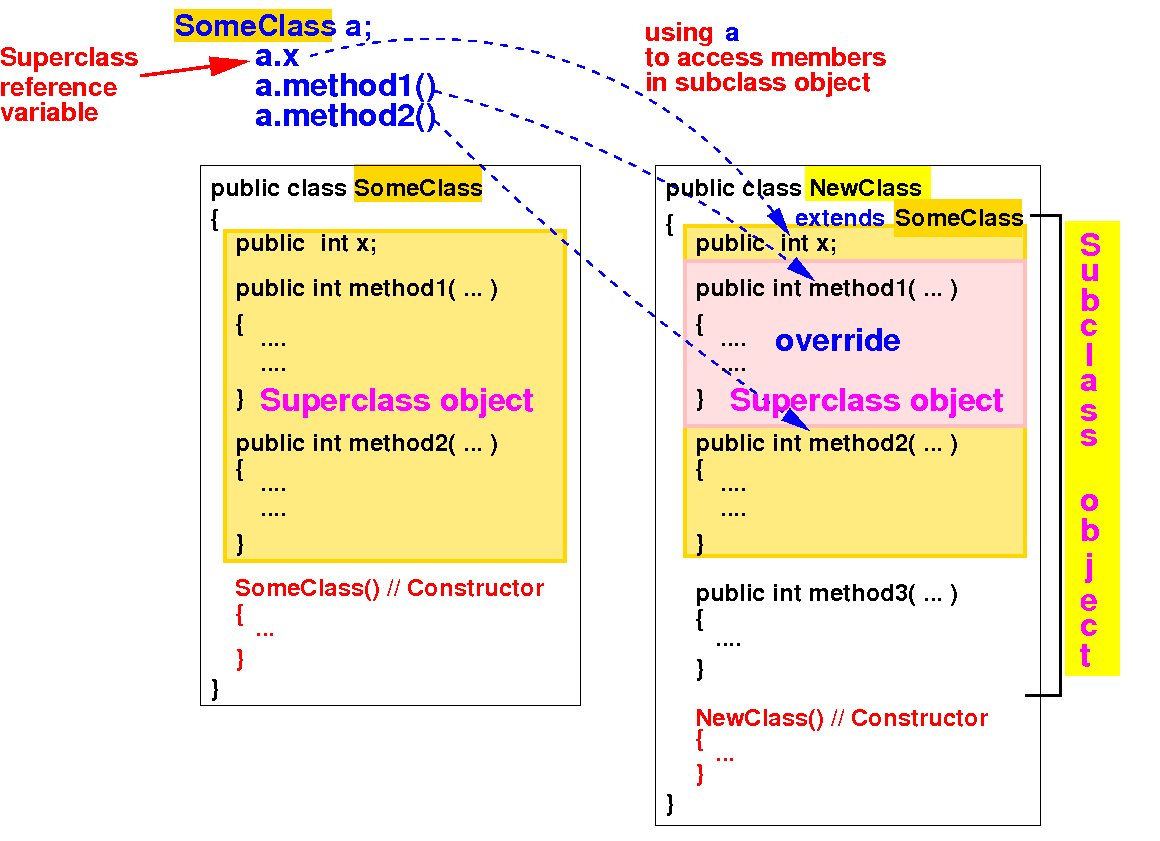
Java allows you to access members in a subclass (e.g.: Rectangle) using a superclass variable (e.g.: GeomObject)
Using
polymorphism
to make a method more general
This means: we can pass (= copy) an array of Rectangle objects to this selectionSort( ) method:
    public static void selectionSort(GeometricObject[] list) // list can be Rectangle[]
    {
        for (int i = 0; i < list.length-1; i++)
        {
            /* -----------------------------------------------
               Find the minimum in the list[i..list.length-1]
               ----------------------------------------------- */
           GeometricObject min = list[i];     // Assume first element is min
           int minIndex        = i;           // Index where min is found

           for ( int k = minIndex+1; k < list.length; k++ )
               if ( list[k].getArea() < min.getArea() ) // --> getArea() will return
               {                                        //     area of a Rectangle !!
                   min      = list[k]; // Update min value
                   minIndex = k;       // Update its index
               }

            /* ------------------------------------------------------
               Swap list[i] with list[minIndex] if necessary
               ------------------------------------------------------ */
            if ( minIndex != i )
            {   // Swap list[minIndex] and list[i]
                GeometricObject help = list[minIndex];  // Standard exchange alg
                list[minIndex]       = list[i];
                list[i]              = help;
            }
        }
    }
|
If was pass an array of Rectangle objects to selectionSort( ), the getArea( ) will area of the rectangle!
Using
polymorphism
to make a method more general
Test program to sort an array of Rectangle object:
public static void main(String[] args)
{
Rectangle[] myList = new Rectangle[4]; // Array of Rectangles objs
myList[0] = new Rectangle("red", 2, 1);
myList[1] = new Rectangle("blue", 1, 1);
myList[2] = new Rectangle("white", 5, 1);
myList[3] = new Rectangle("black", 3, 2);
// ******************************************************************
// We can pass an array of Rectangle to selectionSort
// because a Rectangle can fulfill requests made to a GeometricObject
// ******************************************************************
selectionSort(myList);
for ( int i = 0; i < myList.length; i++)
System.out.println(myList[i]);
}
|
DEMO: 04-inheritance/19-apply-polym/Demo3.java
Using
polymorphism
to make a method more general
Also: we can pass (= copy) an array of Circle objects to this selectionSort( ) method:
    public static void selectionSort(GeometricObject[] list) // list can be Circle[]
    {
        for (int i = 0; i < list.length-1; i++)
        {
            /* -----------------------------------------------
               Find the minimum in the list[i..list.length-1]
               ----------------------------------------------- */
           GeometricObject min = list[i];     // Assume first element is min
           int minIndex        = i;           // Index where min is found

           for ( int k = minIndex+1; k < list.length; k++ )
               if ( list[k].getArea() < min.getArea() ) // --> getArea() will return
               {                                        //     area of a Circle !!
                   min      = list[k]; // Update min value
                   minIndex = k;       // Update its index
               }

            /* ------------------------------------------------------
               Swap list[i] with list[minIndex] if necessary
               ------------------------------------------------------ */
            if ( minIndex != i )
            {   // Swap list[minIndex] and list[i]
                GeometricObject help = list[minIndex];  // Standard exchange alg
                list[minIndex]       = list[i];
                list[i]              = help;
            }
        }
    }
|
If was pass an array of Circle objects to selectionSort( ), the getArea( ) will area of the circle!
Using
polymorphism
to make a method more general
Demo program: pass an array of Circle object to this selectionSort( ) method:
public static void main(String[] args)
{
Circle[] myList = new Circle[4]; // Array of Circles objs
myList[0] = new Circle("red", 2);
myList[1] = new Circle("blue", 1);
myList[2] = new Circle("white", 5);
myList[3] = new Circle("black", 3);
// ******************************************************************
// We can pass an array of Rectangle to selectionSort
// because a Rectangle can fulfill requests made to a GeometricObject
// ******************************************************************
selectionSort(myList);
for ( int i = 0; i < myList.length; i++)
System.out.println(myList[i]);
}
|
DEMO: 04-inheritance/19-apply-polym/Demo4.java
Using
polymorphism
to make a method more general
We can even sort a mix of Circle and Rectangle objects:
public static void main(String[] args)
{
GeometricObject[] myList = new GeometricObject[4]; // Array of GeometricObject objs
myList[0] = new Circle("red", 2); // a Circle
myList[1] = new Rectangle("blue", 1, 1); // a Rectangle
myList[2] = new Circle("white", 5); // a Circle
myList[3] = new Rectangle("black", 4, 4); // a Rectangle
selectionSort(myList);
for ( int i = 0; i < myList.length; i++)
System.out.println(myList[i]);
}
|
DEMO: 04-inheritance/19-apply-polym/Demo5.java
Summary
and final comments
|