Re-using
existing software
$64,000 question: what is the easiest way to write programs to solve a problem:
|
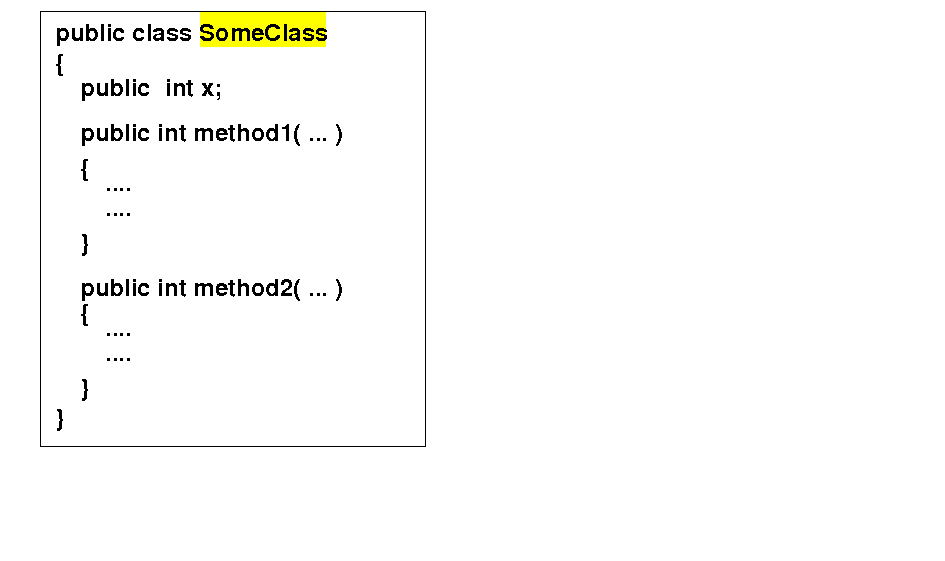
But things will change when you have programmed for many years and have written many programs
Re-using
existing software
Problem description: we need to write a program (software) to solve a new problem:
|
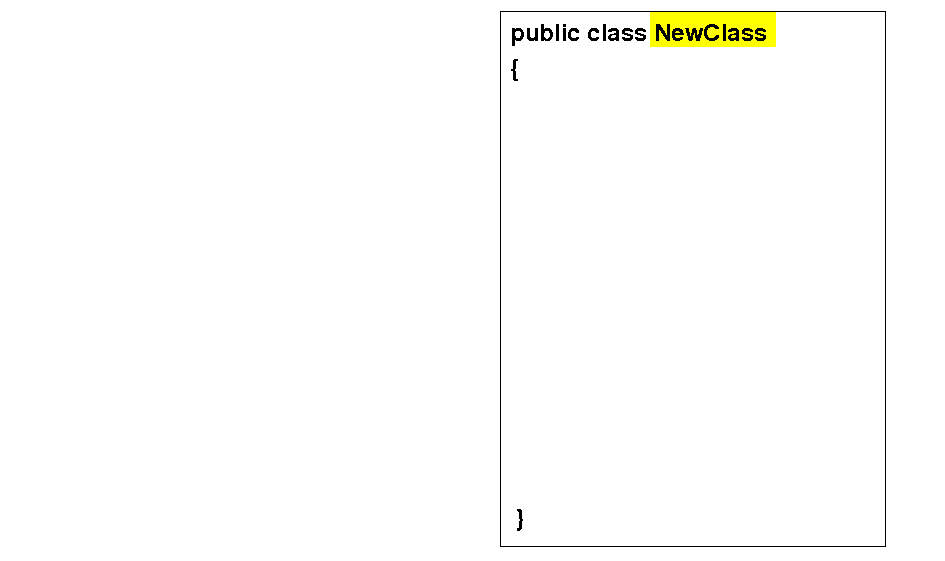
How can we write the NewClass class efficiently ? (i.e.: use the least effort as possible)
Re-using existing software
How to re-use existing sofware to build more complex software prior to ~1995
|
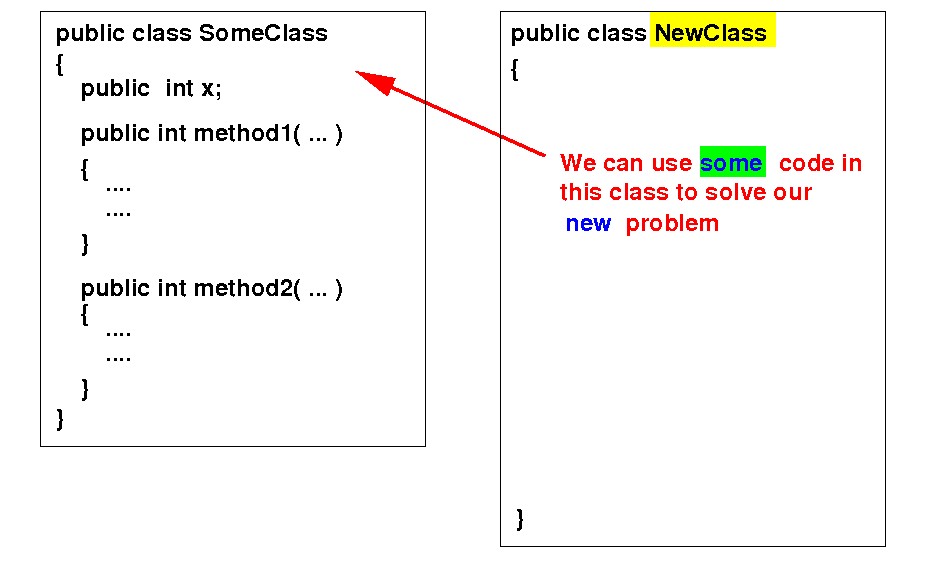
Before the invention of Object Oriented Programming (OOP)
Re-using existing software
How to re-use existing sofware to build more complex software prior to ~1995
|
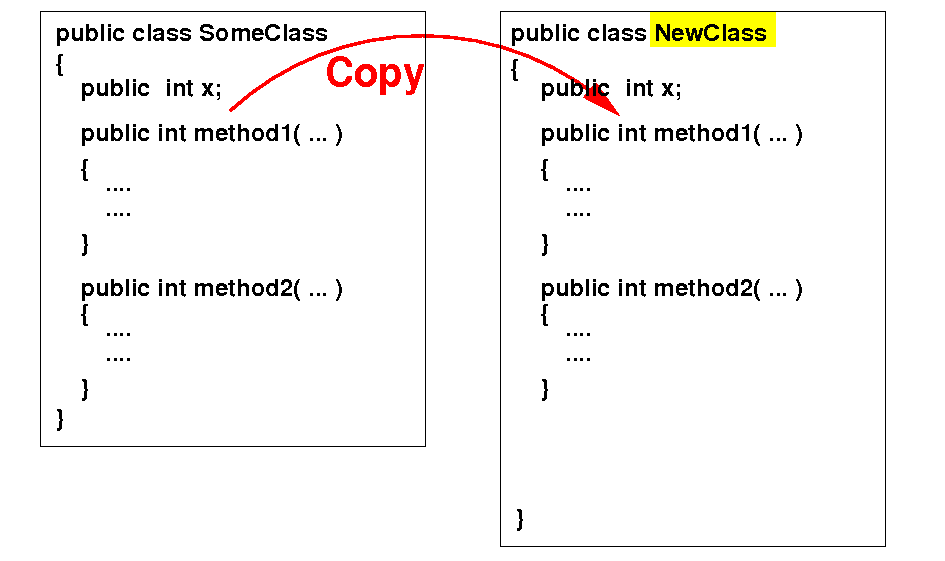
Before the invention of Object Oriented Programming (OOP)
Re-using existing software
How to re-use existing sofware to build more complex software prior to ~1995
|
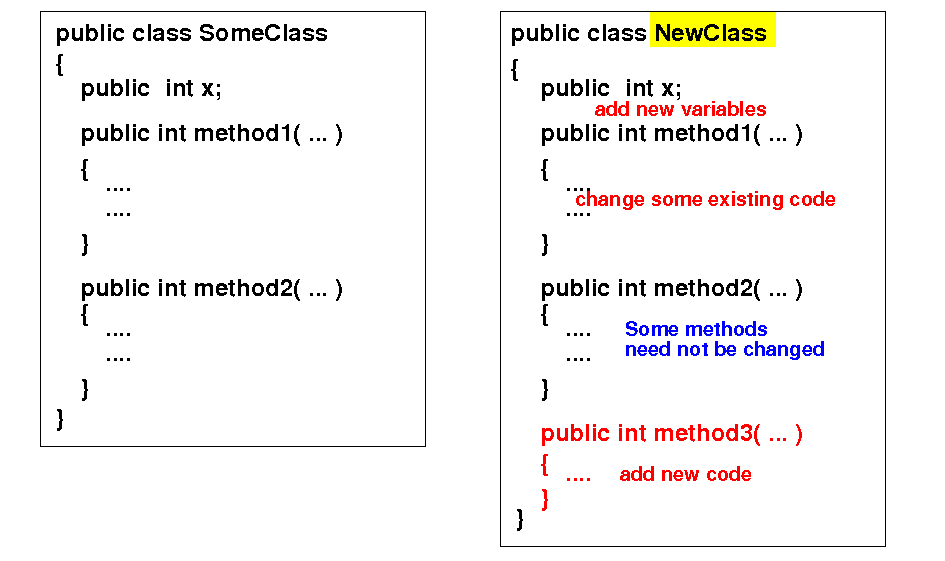
Before the invention of Object Oriented Programming (OOP)
Problems with this
technique for
re-using existing software
Redundancy:
|
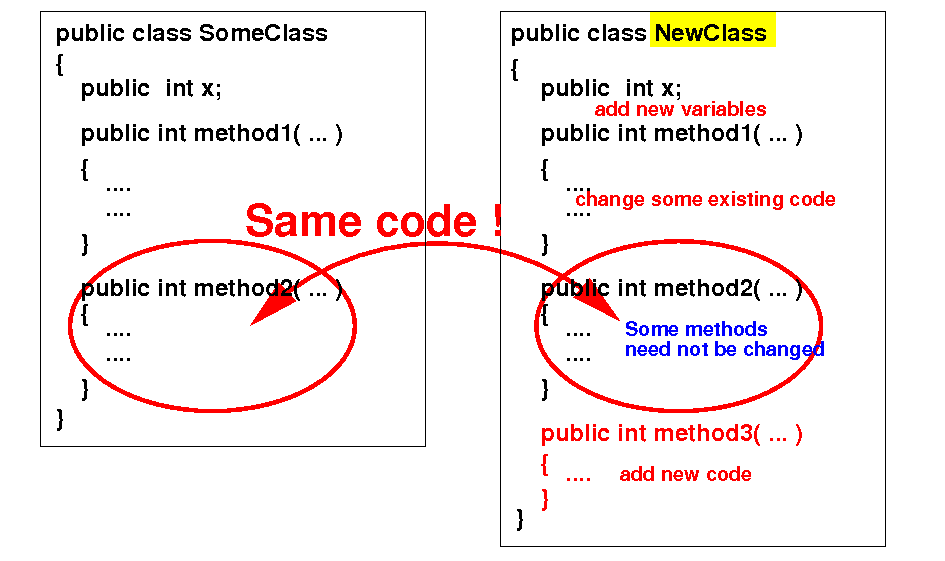
Problem: redundancy make maintenance very difficult (think: many copies, making a change is difficult)
Re-using existing software
How to re-use existing sofware to build more complex software with OOP
|
After the invention of Object Oriented Programming (OOP)
Re-using existing software
How to re-use existing sofware to build more complex software with OOP
|
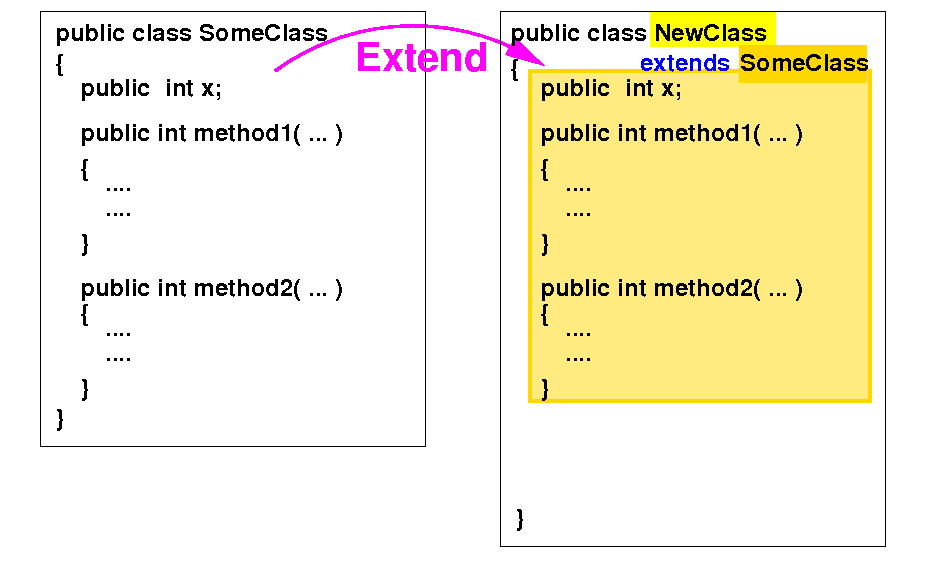
The new class (= software) will inherit (= "receive") all the variables and (normal) methods from an existing class
Experiment
Trace the execution of b.method1()
and b.method2()
DEMO: demo/13-inheritance/01-extends/Demo.java + SomeClass.java + NewClass.java
public class SomeClass
{
public int x;
public SomeClass()
{
x = 99;
}
public void method1( )
{
System.out.println("I am SomeClass.method1(). x = " + x);
}
public void method2( )
{
System.out.println("I am SomeClass.method2(). x = " + x);
}
}
|
What happens
when we modify
the existing software
after
inheritance
Advantage of re-using existing sofware with inheritance:
|
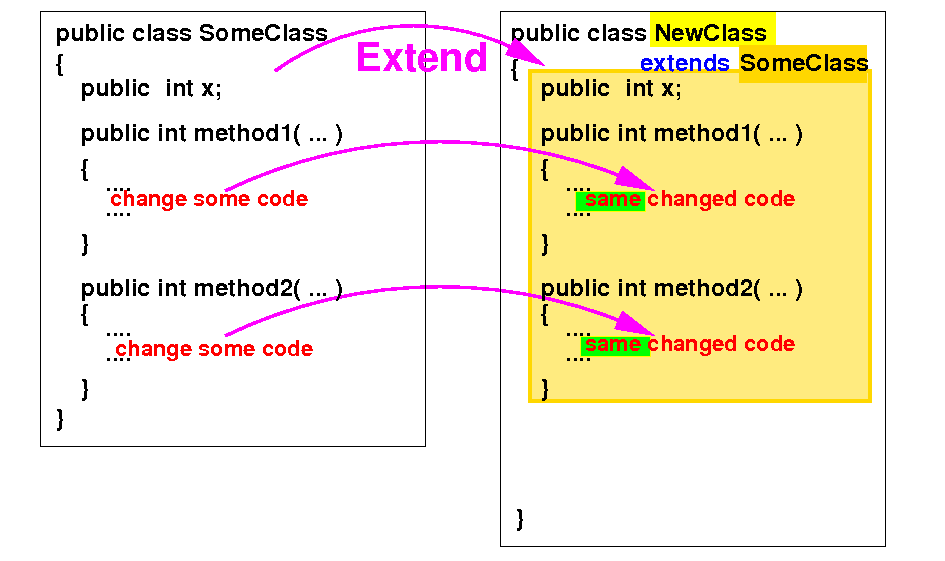
DEMO: 13-inheritance/01-extends/Demo.java + SomeClass.java + NewClass.java -- edit SomeClass.java
Re-using existing software
What if some method that was inherited does not work correctly for a NewClass object ?
|
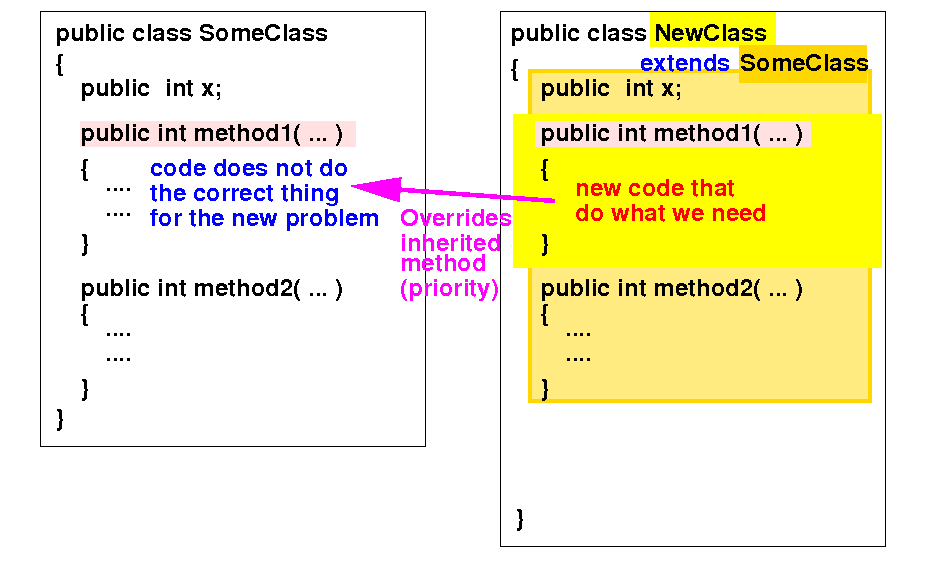
Rule:
methods
defined
inside
NewClass will
supersede
an inherited method
with the
same
method signature
(This mechanism is
called
overriding)
Experiment
Trace the execution of b.method1()
and b.method2()
DEMO: demo/13-inheritance/02-override/Demo.java + SomeClass.java + NewClass.java
public class SomeClass
{
public int x;
public SomeClass()
{
x = 99;
}
public void method1( )
{
System.out.println("I am SomeClass.method1(). x = " + x);
}
public void method2( )
{
System.out.println("I am SomeClass.method2(). x = " + x);
}
}
|
Re-using existing software
What if the original class does not have a method to perform some action in the NewClass object ?
|
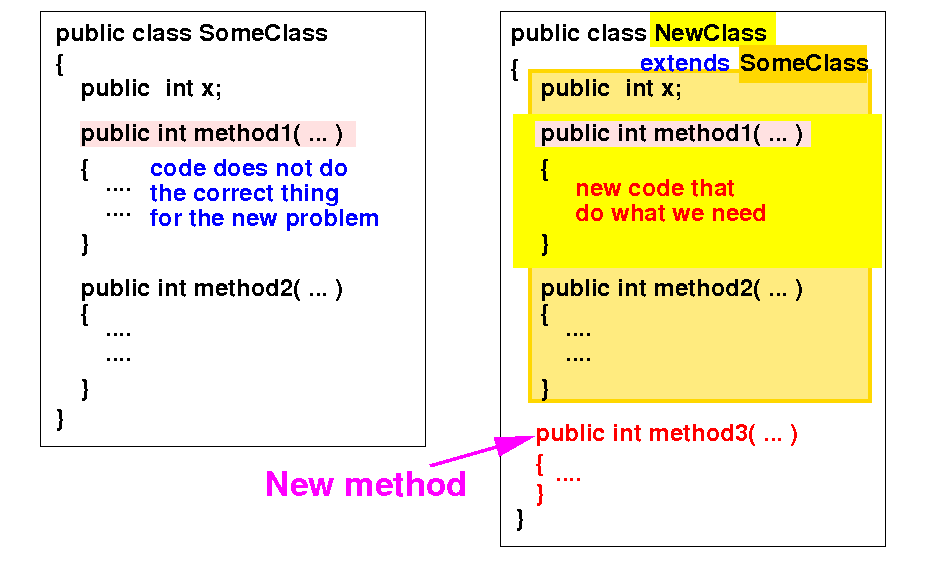
These new methods will only be available in a NewClass object (and will not be available in a SomeClass object)
Experiment
Trace the execution of b.method3()
DEMO: demo/13-inheritance/03-add/Demo.java + SomeClass.java + NewClass.java
public class SomeClass
{
public int x;
public SomeClass()
{
x = 99;
}
public void method1( )
{
System.out.println("I am SomeClass.method1(). x = " + x);
}
public void method2( )
{
System.out.println("I am SomeClass.method2(). x = " + x);
}
}
|
Accessing an
overridden method
and an
overriding method
Note: a NewClass object has two (different) methods named method1(...) with the same signature:
|
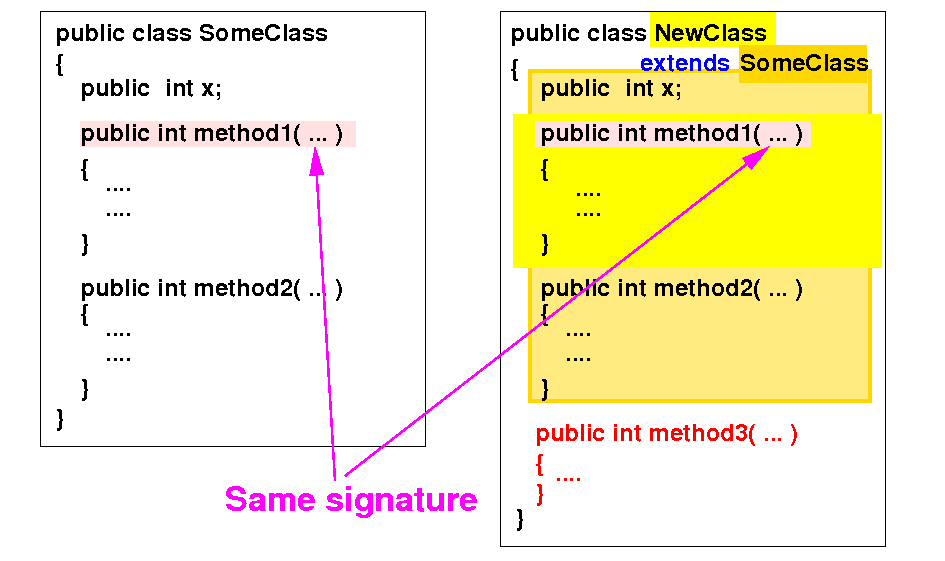
When writing code in NewClass, both methods are available for use (= accessible) !
Accessing an
overridden method
and an
overriding method
How to invoke the two (different) methods named method1(...) inside NewClass:
|
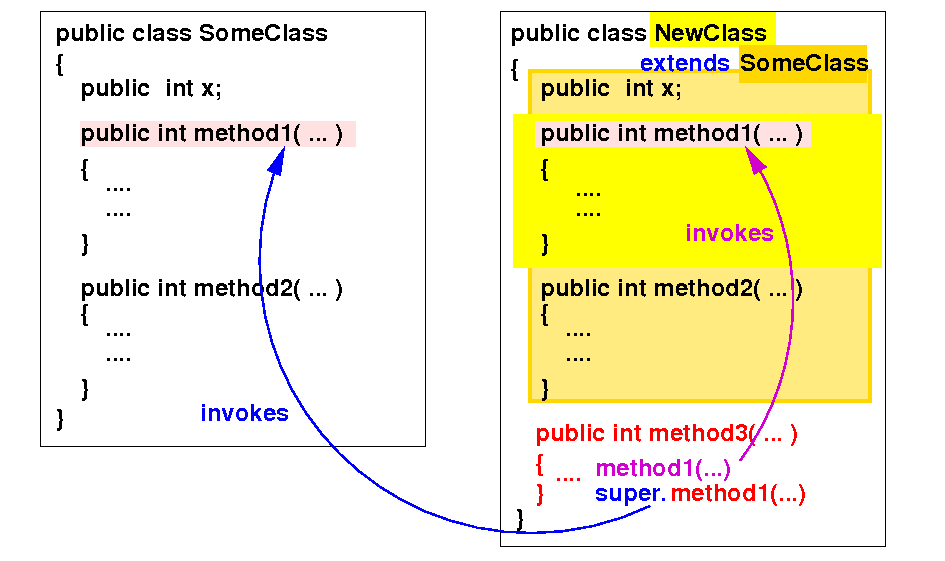
The
super keyword
always
refers to
members in the
super class
DEMO:
demo/13-inheritance/03a-super/Demo.java +
NewClass.java
Summary:
re-using existing software
How to re-use existing sofware to build more complex software using OOP
|
Important note:
Accessibility modifiers
are enforced on
inherited members !
|
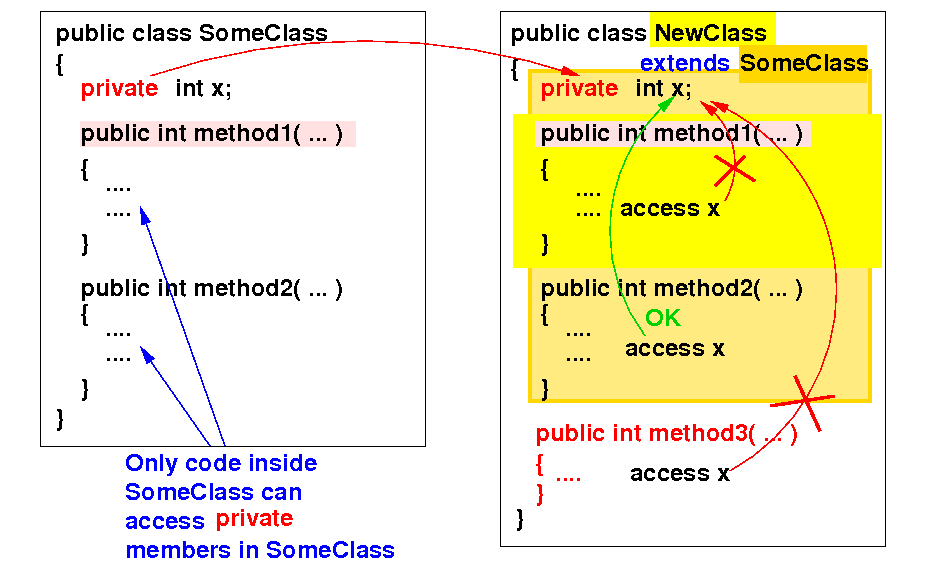
DEMO: demo/13-inheritance/03a-super/Demo.java + NewClass.java -- change x from public to private
Object Oriented Thinking
|