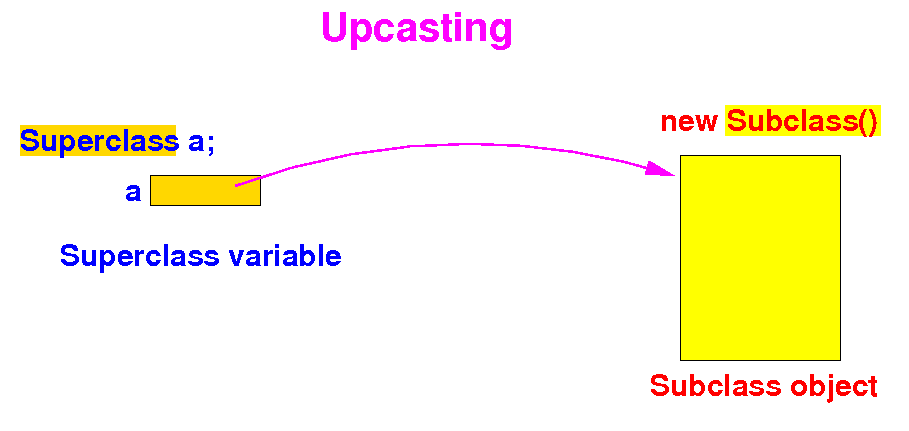
Upcasting:
assigning an
instance of a subclass to
a
variable of a superclass
|
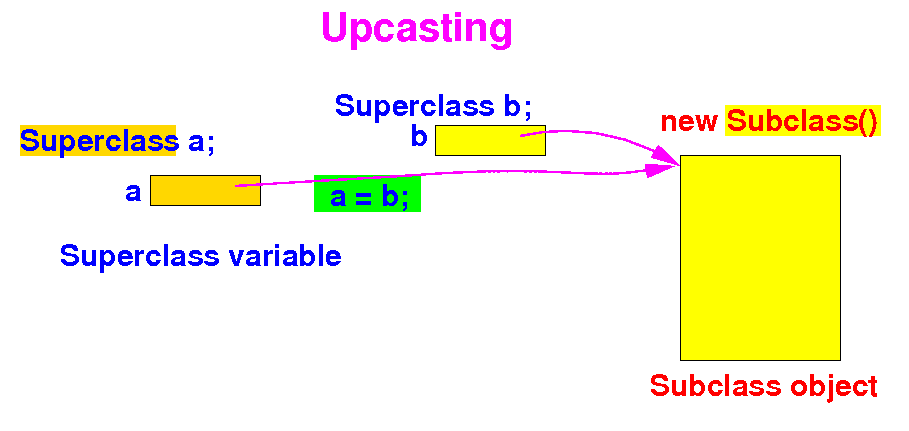
Upcasting:
assigning an
instance of a subclass to
a
variable of a superclass
|
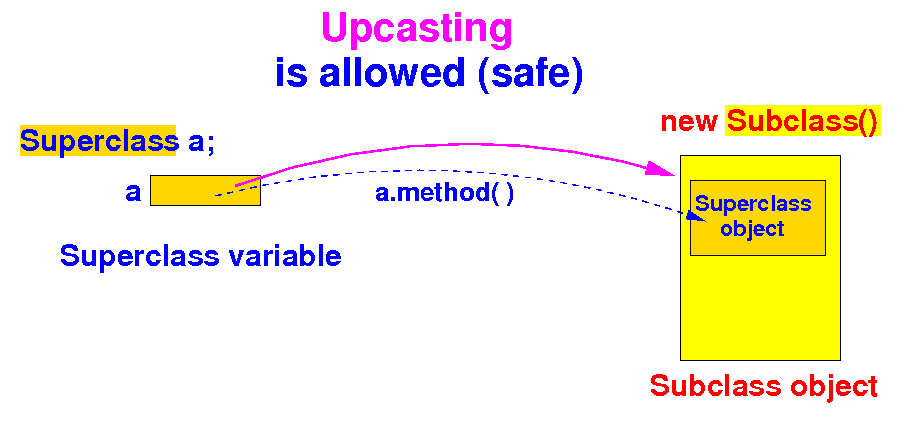
Upcasting:
assigning an
instance of a subclass to
a
variable of a superclass
|
Upcasting
example and demo
compile and run
in BlueJ
public class myProg
{
    public static void main(String[] args)
    {
        GeometricObject a;
        Circle b = new Circle("red", 1);

        a = b;  // Upcasting

        System.out.println(a.getArea());
    }
}
|
public class GeometricObject
{
    private String color;

    GeometricObject( String col )   // Constructor
    {
        color = col;
    }

    public String getColor()          { return color; }
    public void   setColor(String c)  { color = c; }

    public double getArea()  // Dummy method !!
    {
        return 0;  // Some default value
    }
}
|
public class Circle extends GeometricObject
{
    private double radius;


    Circle(String col, double r)
    {
        super(col);
        radius = r;
    }

    public double getRadius()
    {
        return radius;
    }

    public double getArea()
    {
        return 3.14159*radius*radius;
    }

    public String toString()
    {
        return "Color = " + getColor() + ":"
                + "radius = " + radius;
    }
}
|
public class Rectangle extends GeometricObject
{

    private double width;
    private double height;

    Rectangle(String col, double w, double h)
    {
        super(col); width = w; height = h;
    }

    public double getWidth()          { return width;}
    public void   setWidth(double r)  { width = r; }
    public double getHeight()         { return height;}
    public void   setHeight(double r) { height = r; }

    public double getArea()
    {
        return width*height;
    }

    public String toString()
    {
        return "Color = " + getColor() + ":"
                + "width = " + width
                + " height = " + height;
    }
}
|
Downcasting:
assigning an
instance of a
superclass to
a
variable of a
subclass
|
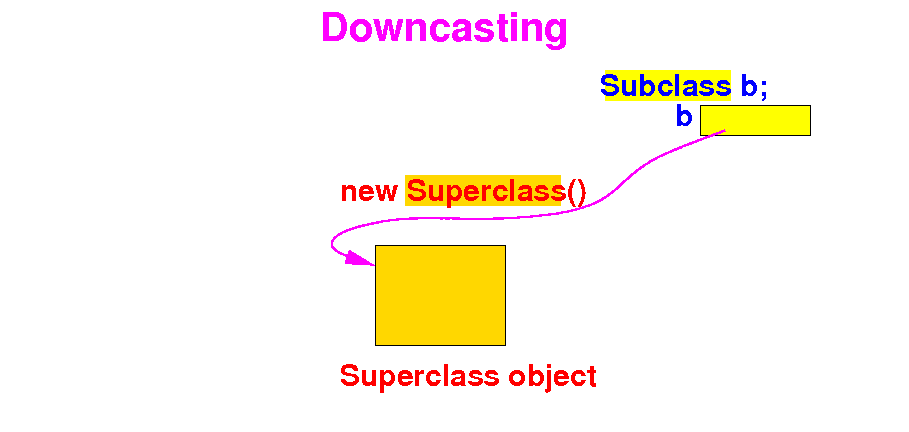
Downcasting:
assigning an
instance of a
superclass to
a
variable of a
subclass
|
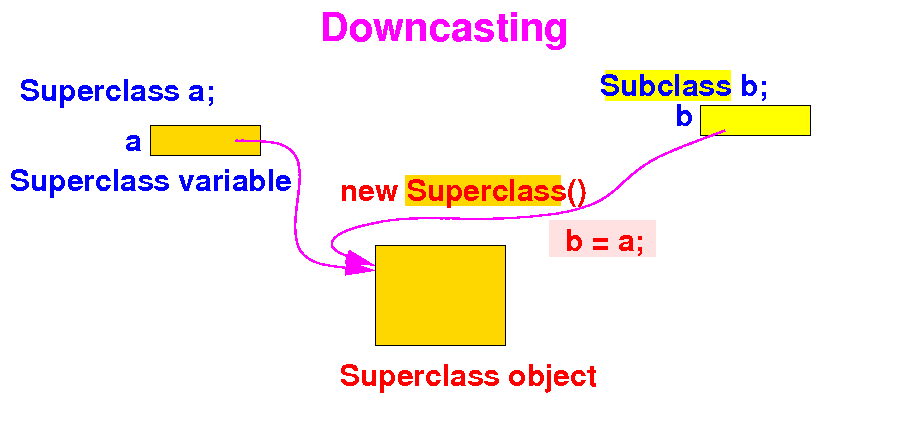
Downcasting:
assigning an
instance of a
superclass to
a
variable of a
subclass
|
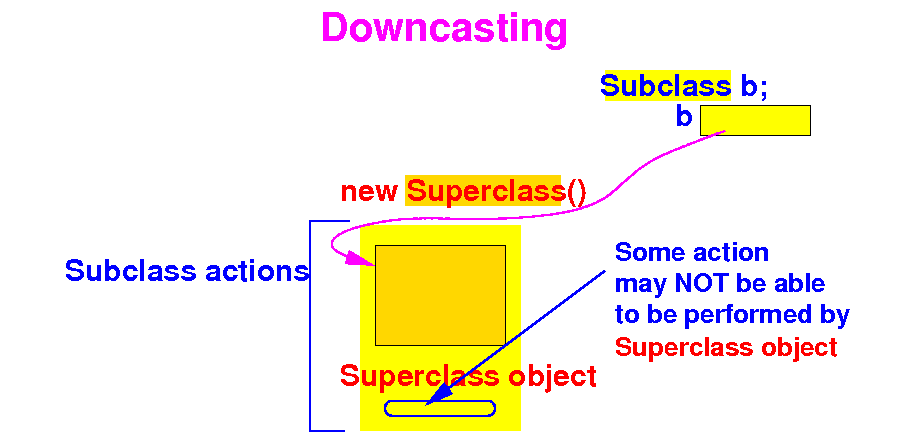
Downcasting
example and demo
compile and see error message
in BlueJ
public class myProg
{
    public static void main(String[] args)
    {
        GeometricObject a
                  = new GeometricObject("red");
        Circle b;

        b = a;  // Downcasting
                // Compile error !! (Illegal !)
    }
}
|
public class GeometricObject
{
    private String color;

    GeometricObject( String col )   // Constructor
    {
        color = col;
    }

    public String getColor()          { return color; }
    public void   setColor(String c)  { color = c; }

    public double getArea()  // Dummy method !!
    {
        return 0;  // Some default value
    }
}
|
public class Circle extends GeometricObject
{
    private double radius;


    Circle(String col, double r)
    {
        super(col);
        radius = r;
    }

    public double getRadius()
    {
        return radius;
    }

    public double getArea()
    {
        return 3.14159*radius*radius;
    }

    public String toString()
    {
        return "Color = " + getColor() + ":"
                + "radius = " + radius;
    }
}
|
public class Rectangle extends GeometricObject
{

    private double width;
    private double height;

    Rectangle(String col, double w, double h)
    {
        super(col); width = w; height = h;
    }

    public double getWidth()          { return width;}
    public void   setWidth(double r)  { width = r; }
    public double getHeight()         { return height;}
    public void   setHeight(double r) { height = r; }

    public double getArea()
    {
        return width*height;
    }

    public String toString()
    {
        return "Color = " + getColor() + ":"
                + "width = " + width
                + " height = " + height;
    }
}
|
Legal downcasting operations
|
Legal downcasting operations
|
Legal downcasting operations
|
Legal downcasting operations
|
Downcasting operation
depends
on the
subclass type object
|
Downcasting a subtype object of
unknown subclass type
|
The
instanceof
boolean condition
|
How to
downcasting a subtype object of
unknown subclass type
We can perform the correct downcast operation based on the subclass type of the object referenced by a:
    public static void main(String[] args)
    {
        GeometricObject a = (can be  a Circle or Rectangle object)
                            // Upcasting

        if ( a is a Circle )
	{


	    print its radius
	}
	else if ( a is a Rectangle )
	{


	    print its width and height

	}
        else
	    print "invalid subclass type"
    }
|
How to
downcasting a subtype object of
unknown subclass type
If a references to a Circle object, then downcast (convert) to a Circle variable:
    public static void main(String[] args)
    {
        GeometricObject a = (can be  a Circle or Rectangle object)
                            // Upcasting

        if ( a instanceof Circle )
	{
	    Circle b = (Circle) a; // Downcast to a Circle

	    System.out.println(b.getRadius());
	}
	else if ( a is a Rectangle )
	{


	    print its width and height

	}
        else
	    print "invalid subclass type"
    }
|
How to
downcasting a subtype object of
unknown subclass type
If a references to a Rectangle object, then downcast (convert) to a Rectangle variable:
    public static void main(String[] args)
    {
        GeometricObject a = (can be  a Circle or Rectangle object)
                            // Upcasting

        if ( a instanceof Circle )
	{
	    Circle b = (Circle) a; // Downcast to a Circle

	    System.out.println(b.getRadius());
	}
	else if ( a instanceof Rectangle  )
	{
	    Rectangle b = (Rectangle) a; // Downcast to a Rectangle

	    System.out.println(b.getWidth());
	    System.out.println(b.getHeight());
	}
        else
	    print "invalid subclass type"
    }
|
How to
downcasting a subtype object of
unknown subclass type
Otherwise (it can be a GeometricObject !), print the warning message:
    public static void main(String[] args)
    {
        GeometricObject a = (can be  a Circle or Rectangle object)
                            // Upcasting

        if ( a instanceof Circle )
	{
	    Circle b = (Circle) a; // Downcast to a Circle

	    System.out.println(b.getRadius());
	}
	else if ( a instanceof Rectangle  )
	{
	    Rectangle b = (Rectangle) a; // Downcast to a Rectangle

	    System.out.println(b.getWidth());
	    System.out.println(b.getHeight());
	}
        else
	    System.out.println("Invalid subclass type");
    }
|
Demo