Review:
What happens when
NewClass
inherits from
SomeClass
The NewClass inherits (= receives) all normal members from its superclass:
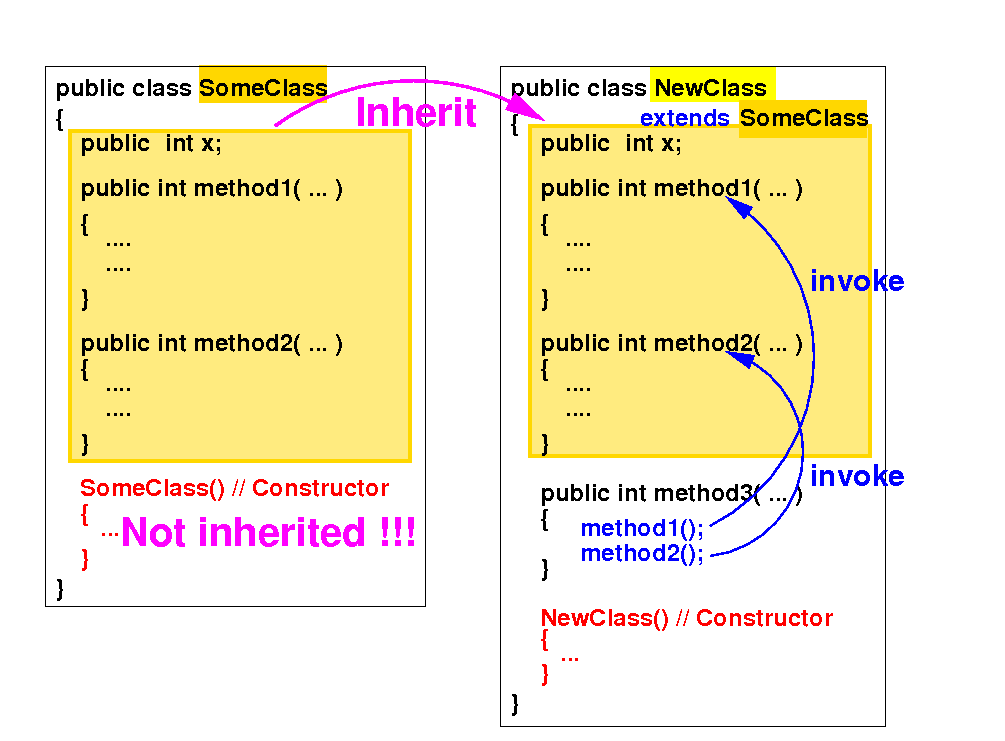
All inherited members are now defined inside NewClass and you can use the public members directly
Demo
program showing how to
use (call) inherited
public members
public class NewClass extends SomeClass
{
    public NewClass(int a)
    {
        super(a);
    }

    // Inherits method1() and method2()

    public void method3()
    {
        // use inherited methods
	method1();
	method2();
    }
}
|
public class SomeClass
{
    public int x;

    public SomeClass()
    {
        x = 99;
    }

    public SomeClass(int a)
    {
        x = a;
    }

    public void method1( )
    {
        System.out.println("SomeClass.method1(). x = " + x);
    }

    public void method2( )
    {
        System.out.println("SomeClass.method2(). x = " + x);
    }
}
|
    public static void main(String[] args)
    {
        NewClass a = new NewClass(44);
        a.method3();
    }
|
Review:
an overriding method will
overshadow its
inherited method
When you override an inherited method, a method call will invoke the overriding method:
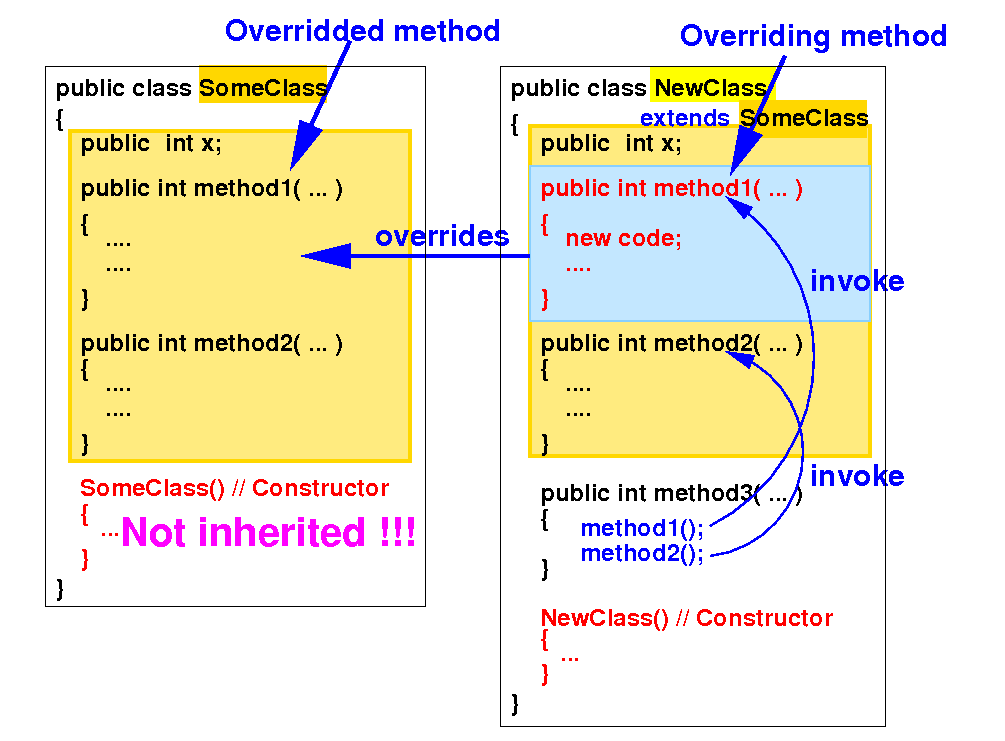
Note: overriding an inherited method does not change the method in the super class !
Demo
program showing
the call method1()
will invoke a
overriding method
public class NewClass extends SomeClass
{
    public NewClass(int a)
    {
        super(a);
    }

    // Inherits method1() and method2()

    public void method1( ) // Overrides method1()
    {
        System.out.println("NewClass.m1(): x = " + x);
    }

    public void method3()
    {
        // use inherited methods
	method1();  // Invokes overriding method
	method2();
    }
}
|
public class SomeClass
{
    public int x;

    public SomeClass()
    {
        x = 99;
    }

    public SomeClass(int a)
    {
        x = a;
    }

    public void method1( )
    {
        System.out.println("SomeClass.method1(). x = " + x);
    }

    public void method2( )
    {
        System.out.println("SomeClass.method2(). x = " + x);
    }
}
|
    public static void main(String[] args)
    {
        NewClass a = new NewClass(44);
        a.method3();
    }
|
Calling
an overridden method
from within the
subclass
You can invoke an overridden method from within a subclass method using super.methodName(...)
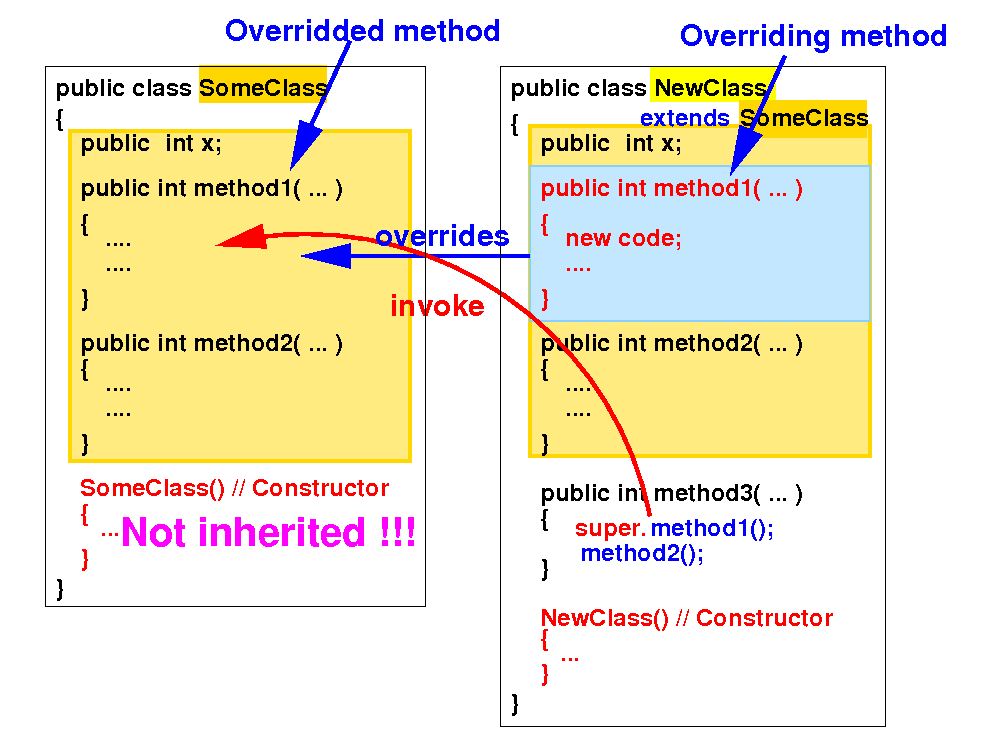
Note: overriding an inherited method does not change the method in the super class !
Demo
program showing
super.method1()
will invoke a
overridden method
public class NewClass extends SomeClass
{
    public NewClass(int a)
    {
        super(a);
    }

    // Inherits method1() and method2()

    public void method1( ) // Overrides method1()
    {
        System.out.println("NewClass.m1(): x = " + x);
    }

    public void method3()
    {
        // use inherited methods
	super.method1();  // Invokes overridden method
	method2();
    }
}
|
public class SomeClass
{
    public int x;

    public SomeClass()
    {
        x = 99;
    }

    public SomeClass(int a)
    {
        x = a;
    }

    public void method1( )
    {
        System.out.println("SomeClass.method1(). x = " + x);
    }

    public void method2( )
    {
        System.out.println("SomeClass.method2(). x = " + x);
    }
}
|
    public static void main(String[] args)
    {
        NewClass a = new NewClass(44);
        a.method3();
    }
|
Example showing the need to use
super to
invoke a
overridded method
Consider the basic BankAccount class to store information on bank accounts:
public class SavingsAccount
       extends BankAccount
{
    private final static int MAXNUMFREE = 3;
    private final static double PENALTY = 1.0;

    private int numWithdrawals;

    public SavingsAccount(double x)
    {
        super(x);
    }

    public void withdraw(double amount)
    {
        super.withdraw(amount);

	numWithdrawals++;
	if ( numWithdrawals > MAXNUMFREE )
	    super.withdraw(PENALTY);
    }

    public void monthlyReset()
    {
        numWithdrawals = 0;
    }
}
|
public class BankAccount
{
    private double balance;

    public BankAccount(double x)
    {
        balance = x;
    }

    public double getBalance()
    {
        return balance;
    }

    public void deposit(double amount)
    {
        balance = balance + amount;
    }

    public void withdraw(double amount)
    {
        balance = balance - amount;
    }
}
|
The BankAccount support the basic operations: getBalance(), deposit() and withdraw()
Example showing the need to use
super to
invoke a
overridded method
The bank also has a special SavingsAccount specially for people who want to save money:
public class SavingsAccount
       extends BankAccount
{
    private double interestRate = 0.05;
    private final static int MAXNUMFREE = 3;
    private final static double PENALTY = 1.0;
    private int numWithdrawals;

    public SavingsAccount(double x)
    {
        super(x);
    }

    public void withdraw(double amount)
    {
        super.withdraw(amount);

	numWithdrawals++;
	if ( numWithdrawals > MAXNUMFREE )
	    super.withdraw(PENALTY);
    }

    public void addInterest()
    {
        balance += interestRate/12*balance;
    }
}
|
public class BankAccount
{
    private double balance;

    public BankAccount(double x)
    {
        balance = x;
    }

    public double getBalance()
    {
        return balance;
    }

    public void deposit(double amount)
    {
        balance = balance + amount;
    }

    public void withdraw(double amount)
    {
        balance = balance - amount;
    }
}
|
The SavingsAccount offers in addition to the basic operations, a monthly interest for savers
Example showing the need to use
super to
invoke a
overridded method
The bank discourage frequent withdrawal from a SavingsAccount and will allow 3 free withdrawals per month:
public class SavingsAccount
       extends BankAccount
{
    private double interestRate = 0.05;
    private final static int MAXNUMFREE = 3;
    private final static double PENALTY = 1.0;
    private int numWithdrawals;

    public SavingsAccount(double x)
    {
        super(x);
    }

    public void withdraw(double amount)
    {
        super.withdraw(amount);

	numWithdrawals++;
	if ( numWithdrawals > MAXNUMFREE )
	    super.withdraw(PENALTY);
    }

    public void addInterest()
    {
        balance += interestRate/12*balance;
    }
}
|
public class BankAccount
{
    private double balance;

    public BankAccount(double x)
    {
        balance = x;
    }

    public double getBalance()
    {
        return balance;
    }

    public void deposit(double amount)
    {
        balance = balance + amount;
    }

    public void withdraw(double amount)
    {
        balance = balance - amount;
    }
}
|
After the 3 free withdrawals, each additional withdrawal will incur a $1.00 penalty
Example showing the need to use
super to
invoke a
overridded method
Therefore, the inherited withdraw( ) method is inadequate and must be overridded:
public class SavingsAccount
       extends BankAccount
{
    private double interestRate = 0.05;
    private final static int MAXNUMFREE = 3;
    private final static double PENALTY = 1.0;
    private int numWithdrawals;

    public SavingsAccount(double x)
    {
        super(x);
    }

    public void withdraw(double amount)
    {
        super.withdraw(amount);

	numWithdrawals++;
	if ( numWithdrawals > MAXNUMFREE )
	    super.withdraw(PENALTY);
    }

    public void addInterest()
    {
        balance += interestRate/12*balance;
    }
}
|
public class BankAccount
{
    private double balance;

    public BankAccount(double x)
    {
        balance = x;
    }

    public double getBalance()
    {
        return balance;
    }

    public void deposit(double amount)
    {
        balance = balance + amount;
    }

    public void withdraw(double amount)
    {
        balance = balance - amount;
    }
}
|
Because the variable balance is private, we must use the withdraw( ) method in the superclass to update balance
Example showing the need to use
super to
invoke a
overridded method
When we withdraw from a SavingsAccount, we first perform the withdrawal:
public class SavingsAccount
       extends BankAccount
{
    private double interestRate = 0.05;
    private final static int MAXNUMFREE = 3;
    private final static double PENALTY = 1.0;
    private int numWithdrawals;

    public SavingsAccount(double x)
    {
        super(x);
    }

    public void withdraw(double amount)
    {
        super.withdraw(amount);

	numWithdrawals++;
	if ( numWithdrawals > MAXNUMFREE )
	    super.withdraw(PENALTY);
    }

    public void addInterest()
    {
        balance += interestRate/12*balance;
    }
}
|
public class BankAccount
{
    private double balance;

    public BankAccount(double x)
    {
        balance = x;
    }

    public double getBalance()
    {
        return balance;
    }

    public void deposit(double amount)
    {
        balance = balance + amount;
    }

    public void withdraw(double amount)
    {
        balance = balance - amount;
    }
}
|
Next, we must keep track of the number of withdrawals made...
Example showing the need to use
super to
invoke a
overridded method
We use the variable numWithdrawals to keep track of the number of withdrawals made:
public class SavingsAccount
       extends BankAccount
{
    private double interestRate = 0.05;
    private final static int MAXNUMFREE = 3;
    private final static double PENALTY = 1.0;
    private int numWithdrawals = 0;

    public SavingsAccount(double x)
    {
        super(x);
    }

    public void withdraw(double amount)
    {
        super.withdraw(amount);

	numWithdrawals++;
	if ( numWithdrawals > MAXNUMFREE )
	    super.withdraw(PENALTY);
    }

    public void addInterest()
    {
        balance += interestRate/12*balance;
    }
}
|
public class BankAccount
{
    private double balance;

    public BankAccount(double x)
    {
        balance = x;
    }

    public double getBalance()
    {
        return balance;
    }

    public void deposit(double amount)
    {
        balance = balance + amount;
    }

    public void withdraw(double amount)
    {
        balance = balance - amount;
    }
}
|
Finally, we check for penalties...
Example showing the need to use
super to
invoke a
overridded method
We deduct PENALTY when the number of withdrawals exceeds the # free withdrawals:
public class SavingsAccount
       extends BankAccount
{
    private double interestRate = 0.05;
    private final static int MAXNUMFREE = 3;
    private final static double PENALTY = 1.0;
    private int numWithdrawals = 0;

    public SavingsAccount(double x)
    {
        super(x);
    }

    public void withdraw(double amount)
    {
        super.withdraw(amount);

	numWithdrawals++;
	if ( numWithdrawals > MAXNUMFREE )
	    super.withdraw(PENALTY); // penalty
    }

    public void addInterest()
    {
        balance += interestRate/12*balance;
    }
}
|
public class BankAccount
{
    private double balance;

    public BankAccount(double x)
    {
        balance = x;
    }

    public double getBalance()
    {
        return balance;
    }

    public void deposit(double amount)
    {
        balance = balance + amount;
    }

    public void withdraw(double amount)
    {
        balance = balance - amount;
    }
}
|
I have a test program in the next slide....
Test program for
SavingsAccount
public class myProg
{
    public static void main(String[] args)
    {
        SavingsAccount a = new SavingsAccount(100);

        a.withdraw(10);
        System.out.println(a.getBalance());  // 90
        a.withdraw(10);
        System.out.println(a.getBalance());  // 80
        a.withdraw(10);
        System.out.println(a.getBalance());  // 70
        a.withdraw(10);
        System.out.println(a.getBalance());  // 59 ! ($1 penalty)
    }
}
|