Relationship between
a subclass and its
superclass
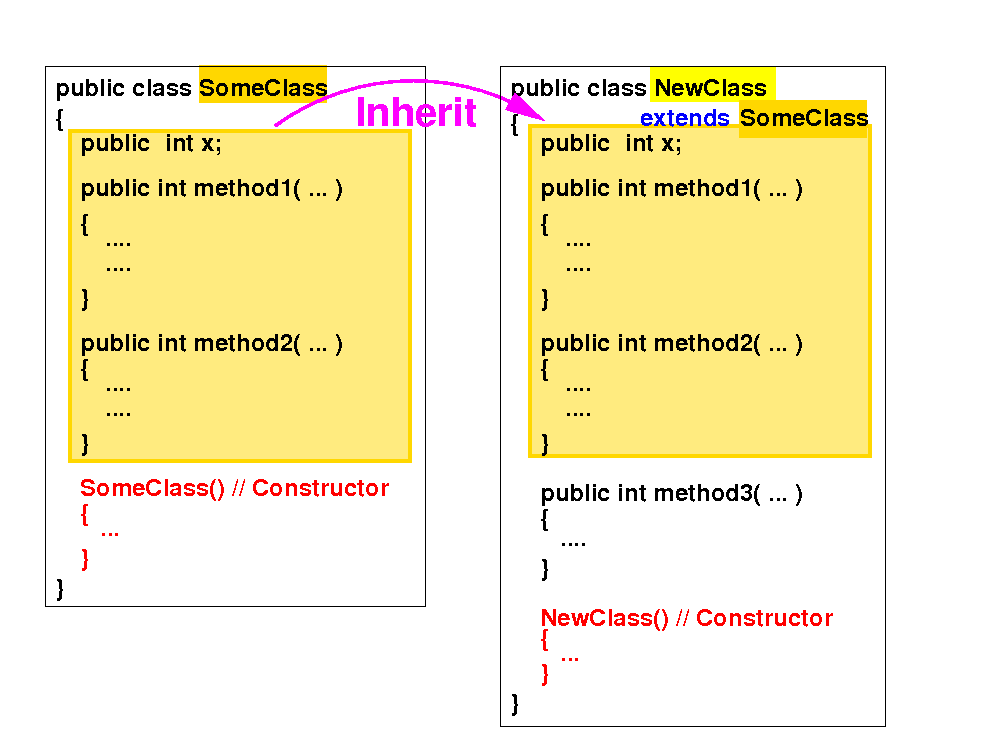
(1) A subclass inherits all variables and (normal) methods from its superclass:
Relationship between
a subclass and its
superclass
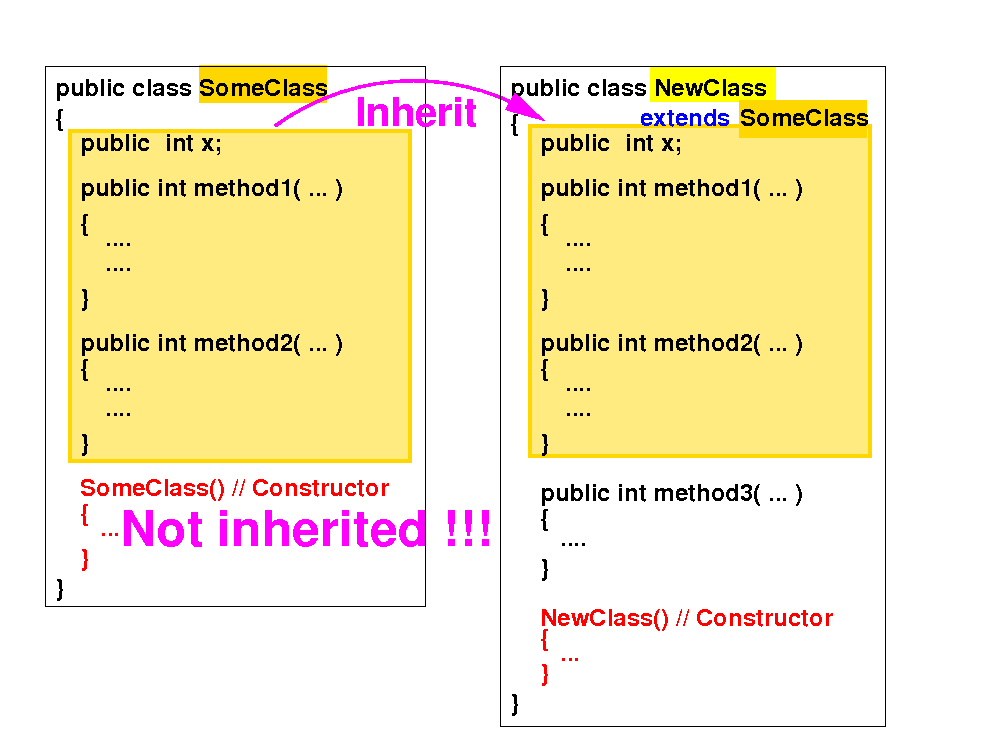
(2) A subclass do not inherit any constructor method from its superclass:
Relationship between
a subclass and its
superclass
Notice that a subclass object (always) contains a superclass object:
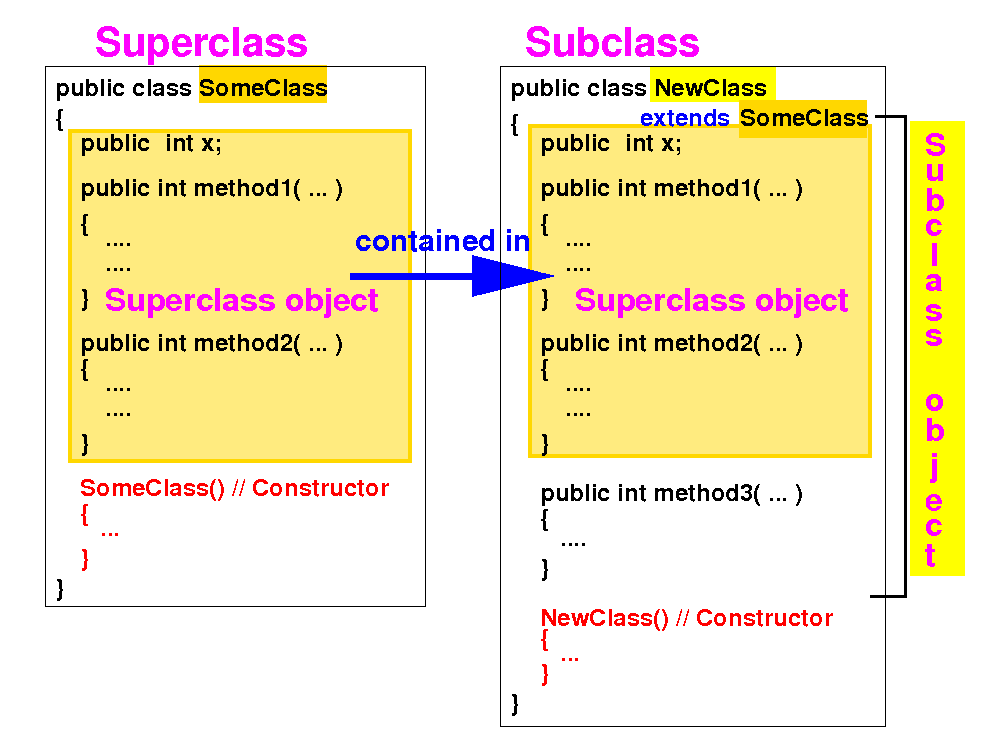
Recall: objects are initialized using its constructor
Relationship between
a subclass and its
superclass
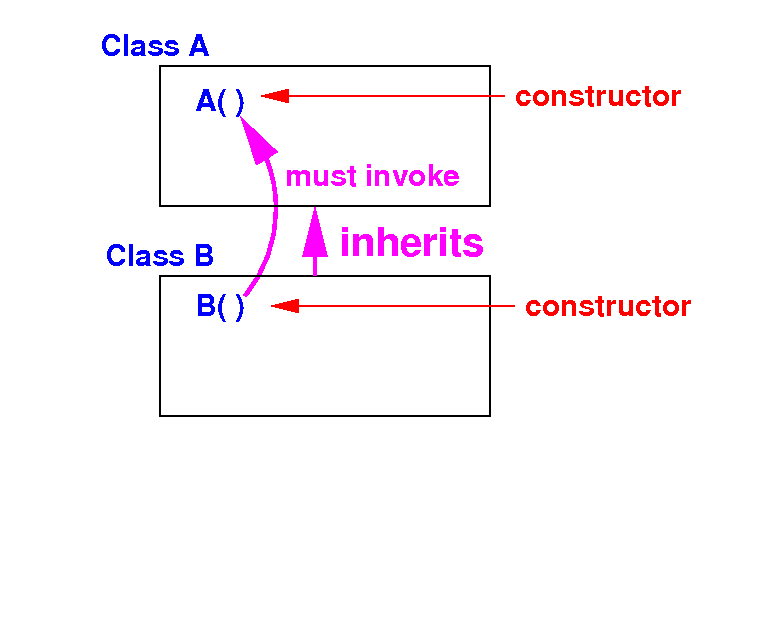
(3) A constructor in the subclass must invoke some constructor in its superclass as its first statement:
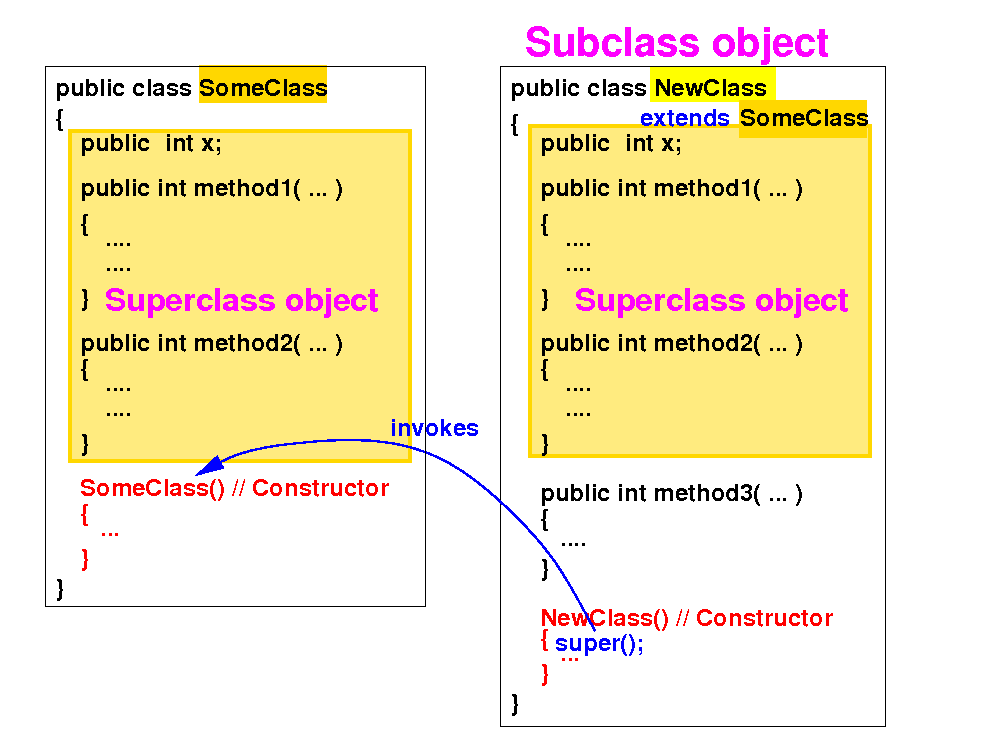
The keyword super( ... ) is used to invoke a constructor in its superclass
Demo:
using super(...)
to invoke constructor in
superclass
public class myProg
{
    public static void main()
    {
        NewClass a = new NewClass();
        NewClass b = new NewClass(44);
    }
}
|
public class NewClass
       extends SomeClass
{
    public int x;

    public NewClass()
    {
      super(); //Not:SomeClass()
    }

    public NewClass(int a)
    {
      super(a); //Not:SomeClass(a)
    }
}
|
public class SomeClass
{
    public int x;

    public SomeClass()
    {
        x = 99;
    }

    public SomeClass(int a)
    {
        x = a;
    }
}
|
DEMO: trace the execution in BlueJ
Relationship between
a subclass and its
superclass
(4a) If a constructor in the subclass does NOT invoke any constructor in its superclass as its first statement:
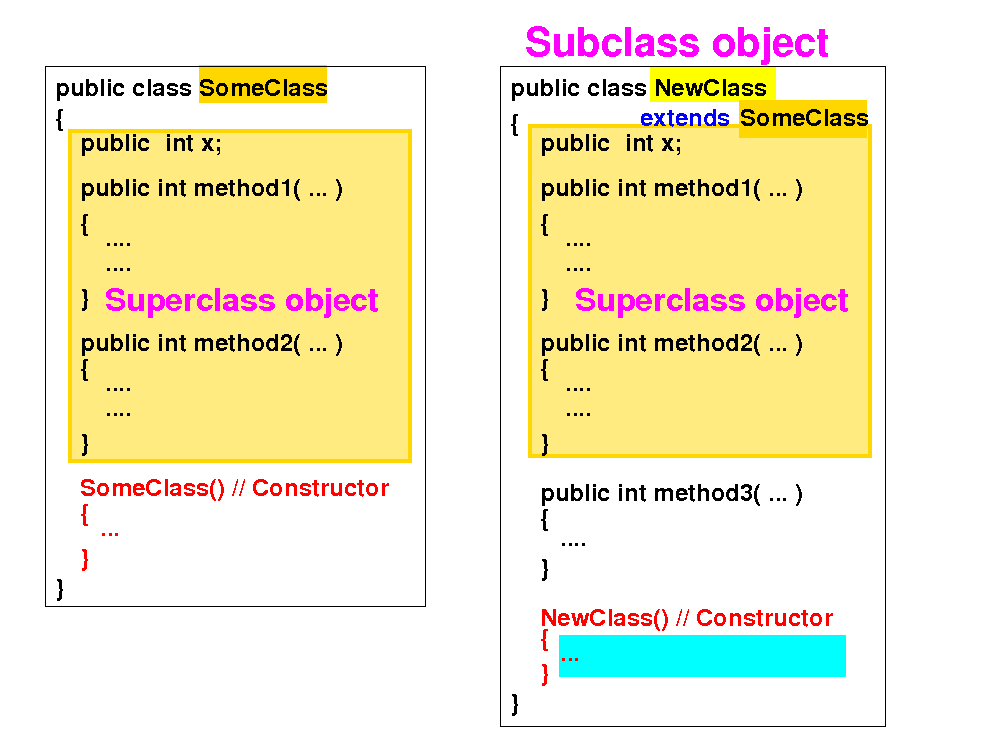
Then.... (can you guess what will happen ??? Remember the rules about default constructors ? )
Relationship between
a subclass and its
superclass
(4b) The Java compiler will automatically insert the call super( ) as the first statement:
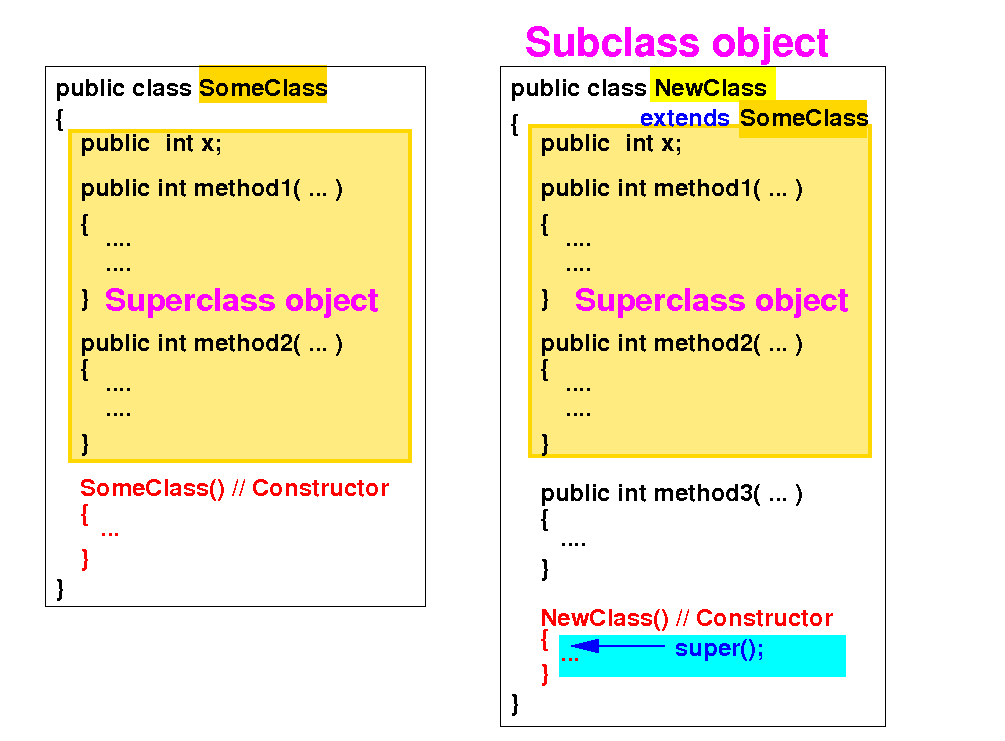
Demo:
shows Java compiler inserts
super( )
inside
NewClass( )
public class myProg
{
    public static void main()
    {
        NewClass a = new NewClass();
    }
}
|
public class NewClass
       extends SomeClass
{
    public int x;

    public NewClass()
    {
      // Java adds super()
    }

    public NewClass(int a)
    {
      super(a);
    }
}
|
public class SomeClass
{
    public int x;

    public SomeClass()
    {
        x = 99;
    }

    public SomeClass(int a)
    {
        x = a;
    }
}
|
DEMO: trace the execution in BlueJ
Quiz:
can you explain the
error in this
program ?
Explain the compile error in this program:
public class NewClass
       extends SomeClass
{
    NewClass()
    {
       // error
    }
}
|
public class SomeClass
{
    public int x;

    public SomeClass(int a)
    {
        x = a;
    }
}
|
Quiz:
explanation of the error
Because the constructor NewClass() does not contain any super(...) calls, Java compiler will insert super( ):
public class NewClass
       extends SomeClass
{
    NewClass()
    {
       super( )
    }
}
|
public class SomeClass
{
    public int x;

    public SomeClass(int a)
    {
        x = a;
    }
}
|
However: there is no matching constructor ( SomeClass( )) defined in the superclass SomeClass !!! ---> Error
Consequence
of the constructor invocation rule in Java
|
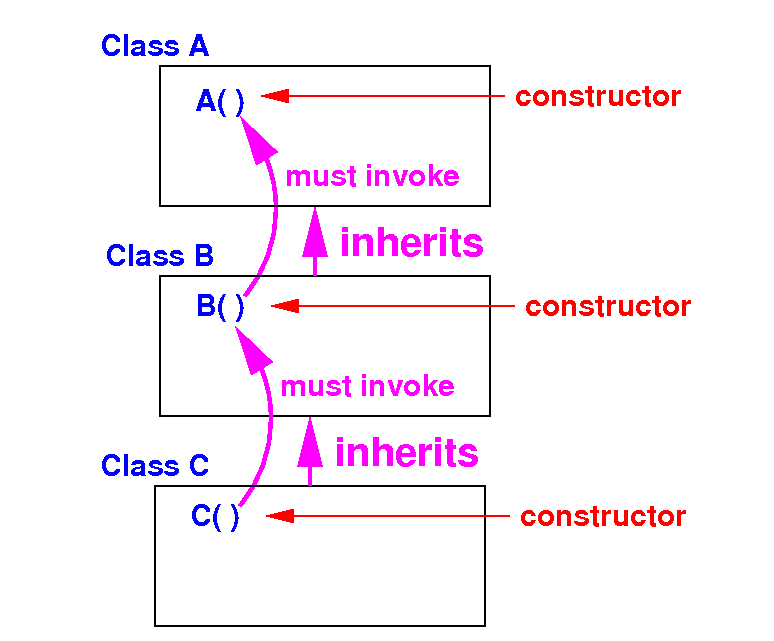
Consequence
of the constructor invocation rule in Java
|
Experiment to show
constructor chaining
public class SomeClass
{
public int x;
public SomeClass()
{
x = 99;
}
public void method1( )
{
System.out.println("I am SomeClass.method1(). x = " + x);
}
public void method2( )
{
System.out.println("I am SomeClass.method2(). x = " + x);
}
}
|
Summary
|