Review: class
|
Instance variables vs
static (class) variables
|
Experiment
Consider the following Circle class with a static variable
public class Circle
{
    public        double radius = 1;    /** An instance variable */
    public static int count;            /** A  "static" variable */

    public Circle() { }                 /** Constructor 1 for a circle object */

    public Circle(double newRadius) /** Constructor 2 for a circle object */
    {
        radius = newRadius;
    }

    public double getArea()      /** Return the area of this circle */
    {
        return 3.14159 * radius * radius;
    }

    public void setRadius(double newRadius) /** Set new radius for this circle */
    {
       radius = newRadius;
    }
}
|
Let's create 2 different Circle objects and examine the difference....
Experiment
When we update the instance variable radius in circle1, the radius in circle2 is not changed:
public class myProg
{
    public static void main(String[] args)
    {
        Circle circle1 = new Circle(2);
        Circle circle2 = new Circle(4);

        circle1.count = 99;

        System.out.println( circle1.radius );
        System.out.println( circle1.count );
        System.out.println( circle2.radius );
        System.out.println( circle2.count );
        System.out.println();

        circle1.radius++; // Updates an instance variable

        System.out.println( circle1.radius );  // Changed
        System.out.println( circle1.count );
        System.out.println( circle2.radius );  // Not changed --> not shared
        System.out.println( circle2.count );
    }
}
|
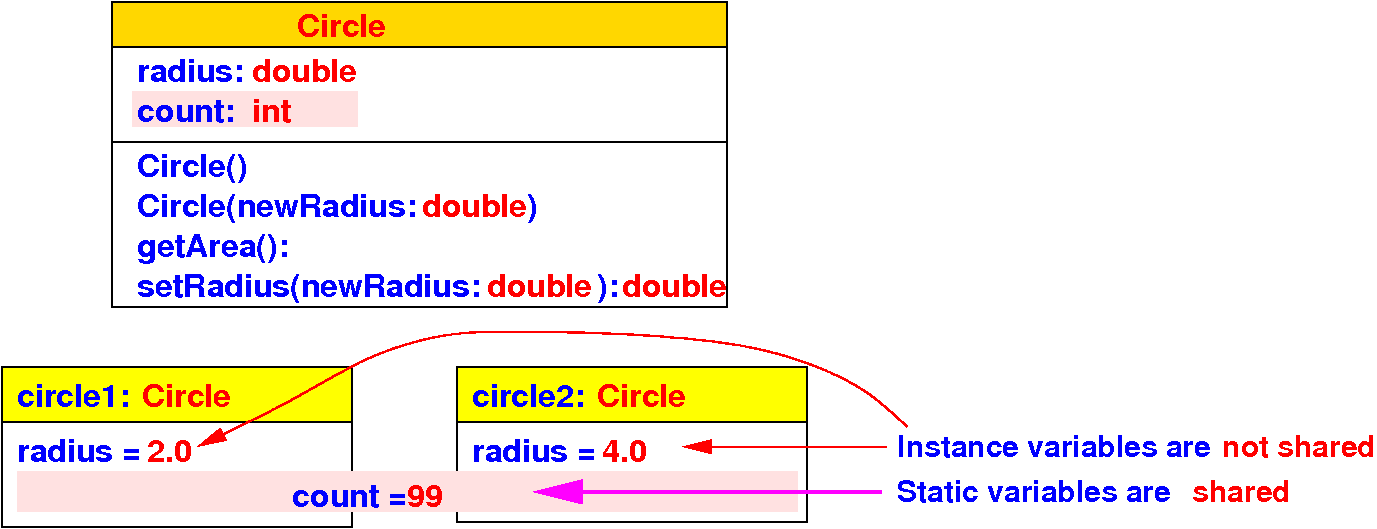
Reason: instance variables are not shared !
DEMO: demo/10-classes/21-static/Demo.java + Circle.java (run program)
Experiment
But if we update the static variable count in circle1, the radius in circle2 is also changed:
public class myProg
{
    public static void main(String[] args)
    {
        Circle circle1 = new Circle(2);
        Circle circle2 = new Circle(4);

	circle1.count = 99;

	System.out.println( circle1.radius );
	System.out.println( circle1.count );
	System.out.println( circle2.radius );
	System.out.println( circle2.count );
	System.out.println();

	circle1.count++;  // Updates a static variable

	System.out.println( circle1.radius );
	System.out.println( circle1.count );    // Changed
	System.out.println( circle2.radius );
	System.out.println( circle2.count );    // Also changed --> shared!
    }
}
|
Reason: static variables are shared !
DEMO: demo/10-classes/21-static/Demo2.java + Circle.java (run program)
Graphical representation of
instance and
static variables
|
When would you use a
static variable ?
|
Let's write the example code next...
How to keep track on the
number of object created
(1) define a static variable count and initialize it to zero:
public class Circle
{
    public double radius = 1;       /** An instance variable */
    public static int count = 0;    /** A  "static" variable */

    public Circle()                 /** Constructor 1 for a circle object */
    {

    }

    public Circle(double newRadius) /** Constructor 2 for a circle object */
    {
        radius = newRadius;

    }

    public double getArea()      /** Return the area of this circle */
    {
        return 3.14159 * radius * radius;
    }

    public void setRadius(double newRadius) /** Set new radius for this circle */
    {
       radius = newRadius;
    }
}
|
How to keep track on the
number of object created
(2) add 1 to the static variable count in every constructor:
public class Circle
{
    public double radius = 1;       /** An instance variable */
    public static int count = 0;    /** A  "static" variable */

    public Circle()                 /** Constructor 1 for a circle object */
    {
        count++;
    }

    public Circle(double newRadius) /** Constructor 2 for a circle object */
    {
        radius = newRadius;
        count++;
    }

    public double getArea()      /** Return the area of this circle */
    {
        return 3.14159 * radius * radius;
    }

    public void setRadius(double newRadius) /** Set new radius for this circle */
    {
       radius = newRadius;
    }
}
|
Let's create 2 Circle objects and examine the count....
Demo program showing the
shared property
count
Demo program that shows we can keep track of the number of Circle objects created:
public class myProg
{
    public static void main(String[] args)
    {
        Circle circle1 = new Circle(2);

	System.out.println( circle1.radius );
	System.out.println( circle1.count );  // 1
	System.out.println();

        Circle circle2 = new Circle(4);

	System.out.println( circle2.radius );
	System.out.println( circle2.count );  // 2
    }
}
|
DEMO: demo/10-classes/22-static/Demo.java + Circle.java
Comment: I define count as public to make the demo program short - otherwise, I will need accessor methods inside Circle...
Instance methods vs
static methods
|
Properties of
static methods
|
When do you use a
static method
and when do you use an
instance method ?
|
Invoking a
static method
|
Constants
defined inside a class
|
Summary
|