Simulating
a deck of cards
|
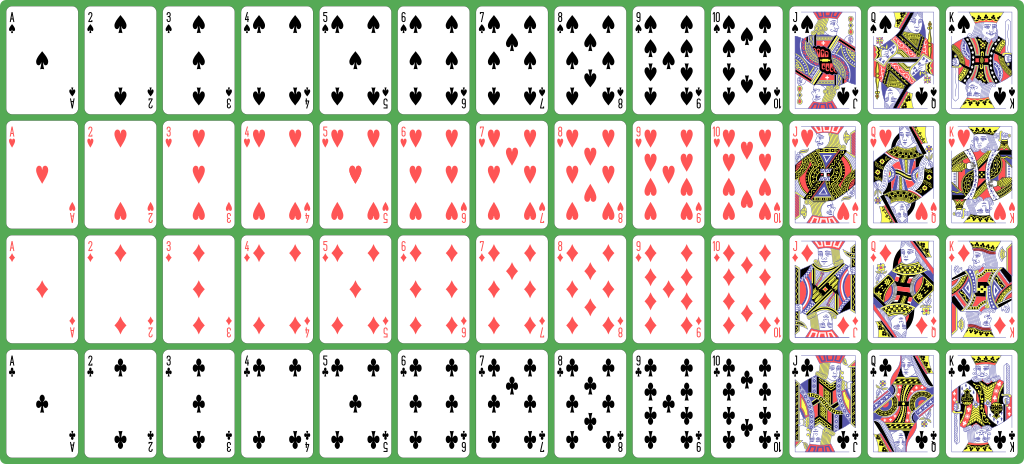
Essence
of representing
things in the real world using
programming objects
|
Defining
the Card class
to represent a
card
|
Defining
the Card class
to represent a
card
|
Defining
the Card class
to represent a
card
|
How to use the
Card class
to make card objects
|
DEMO: demo/10-classes/12-card/Demo.java + Card.java
The toString( ) method
to return
a String representation of
objects
|
Witness the
effect of the
toString
method
|
DEMO: demo/10-classes/13-card/Demo.java + Card.java
Representing a deck of card
|
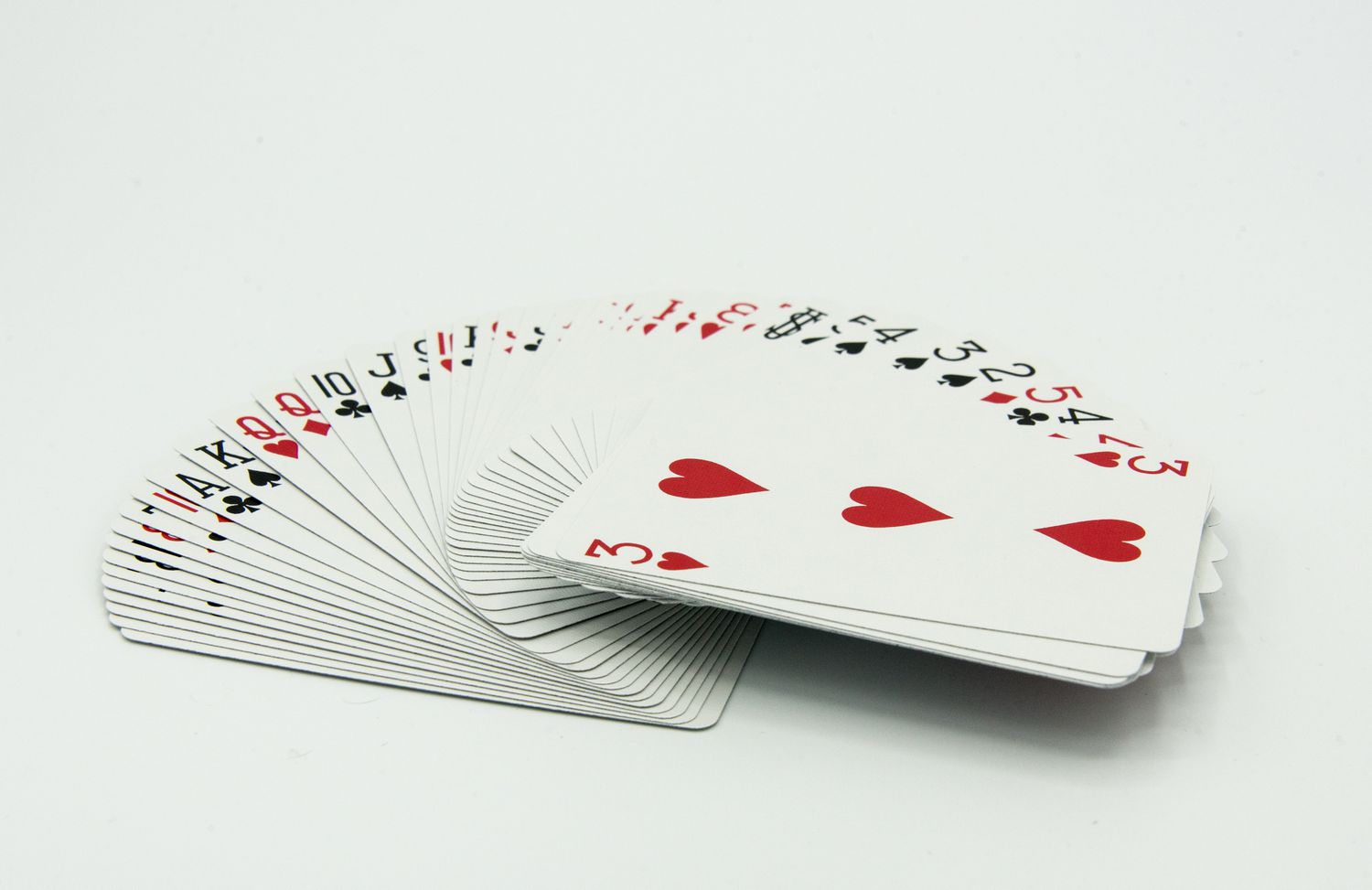
We must first define a class that represents a deck of cards...
Defining
the DeckOfCards class
to represent a
deck of cards
|
Scheletal class of
the DeckOfCard class
|
Defining
the DeckOfCards class
to represent a
deck of cards
|
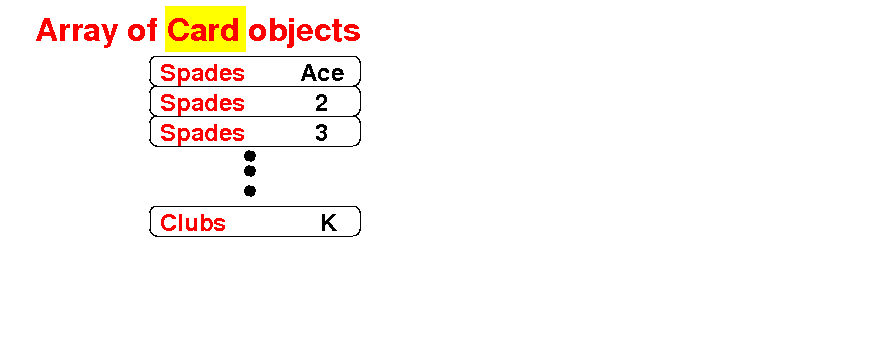
Defining
the DeckOfCards class
to represent a
deck of cards
|
 Use:
Use: 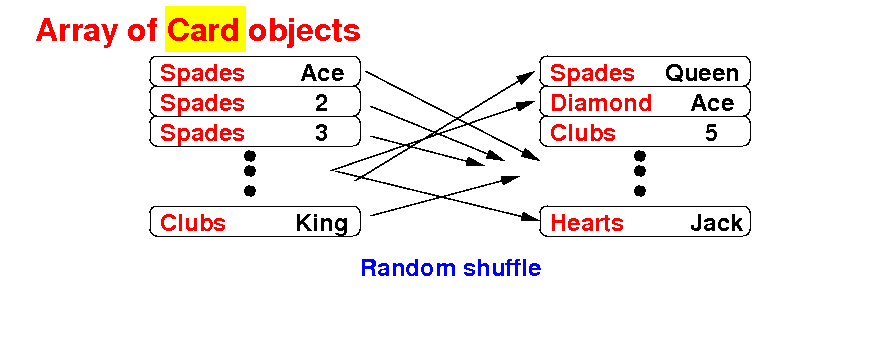
Defining
the DeckOfCards class
to represent a
deck of cards
|
 Use: variable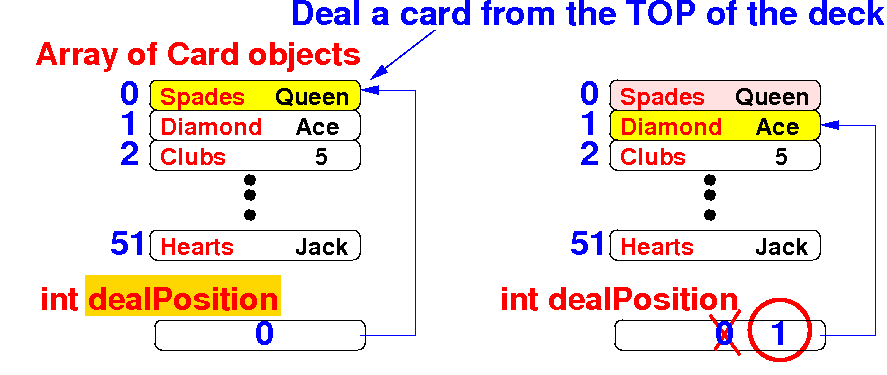
Refining the definition of
the DeckOfCards class
to represent a
deck of cards
Based on the properties and actions, we must add the variable dealPosition to the DeckOfCards class:
public class DeckOfCards
{
    private Card[] deck;  // Hold 52 cards (to be created)
    private int    dealPosition;  // Location of the top card in deck

    DeckOfCards()  // Constructor to make a deck of cards
    {
       ....
    }

    public void shuffle() // Shuffle this deck of cards
    {
       perform a shuffle on the deck of cards
    }

    public Card deal() // Deal the next card from this deck
    {
       returns the dealt card
    }
}
|
Next: implement the constructor(s) and methods...
The
constructor of
the DeckOfCards class
Constructor: making a deck of cards with 52 specific cards: ( naive approach)
public class DeckOfCards
{
    private Card[] deck;
    private int    dealPosition;

    DeckOfCards()  // Constructor to make a deck of cards
    {
        deck = new Card[52];    // Make a holder for 52 cards

        deck[0] = new Card( "Spades", "Ace");
        deck[1] = new Card( "Spades", "2");
        deck[2] = new Card( "Spades", "3");
        deck[3] = new Card( "Spades", "4");
        deck[4] = new Card( "Spades", "5");
        ...
        and so on

	Uses 52 assignment statements !!!


        How can we code this easier ??

    }
}
|
The naive approach is very tedious to code -- we can simplify the coding work with loops
The
constructor of
the DeckOfCards class
Constructor: making a deck of cards with 52 specific cards:
public class DeckOfCards
{
    private Card[] deck;
    private int    dealPosition;

    DeckOfCards()  // Constructor to make a deck of cards
    {
        deck = new Card[52];    // Make a holder for 52 cards

        // Define 2 arrays with all the suits and ranks
        String[] suit = {"Spades", "Hearts", "Diamonds", "Clubs"};
        String[] rank = {"Ace", "2", "3", "4", "5", "6", "7", "8",
                         "9", "10", "Jack", "Queen", "King"};


    }
}
|
The suit[] array contains all possible suits and The rank[] array contains all possible ranks of the cards
The
constructor of
the DeckOfCards class
Constructor: making a deck of cards with 52 specific cards:
public class DeckOfCards
{
    private Card[] deck;
    private int    dealPosition;

    DeckOfCards()  // Constructor to make a deck of cards
    {
        deck = new Card[52];    // Make a holder for 52 cards


        String[] suit = {"Spades", "Hearts", "Diamonds", "Clubs"};
        String[] rank = {"Ace", "2", "3", "4", "5", "6", "7", "8",
                         "9", "10", "Jack", "Queen", "King"};

        int k = 0;   // Index into deck[ ]
        // Use a nested loop to make all 52 cards and store it in deck[k]
        for ( int i = 0; i < suit.length; i++ )
            for (int j = 0; j < rank.length; j++ )
            {
                deck[k] = new Card( suit[i], rank[j] );
                k++;
            }
    }
}
|
The index i go through all the suits and the index j go through all the ranks
Prelude to shuffle()
swap value in 2 variables
Before we write the shuffle() method, we review how to swap 2 variables:
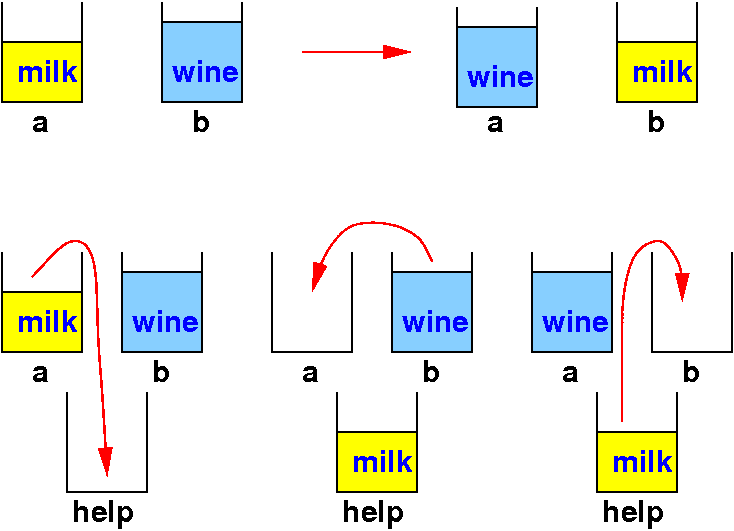
Prelude to shuffle()
swap value in 2 variables
Before we write the shuffle() method, we review how to swap 2 variables:
public class MyProg
{
   public static void main(String[] args)
   {
       int a = 1, b = 2;


       // Code to swap values in a and b


       // End result: a = 2, b = 1
   }
}
|
Prelude to shuffle()
swap value in 2 variables
The algorithm used to exchange the values in the variables a and b:
public class MyProg
{
   public static void main(String[] args)
   {
       int a = 1, b = 2;

       int help;

       // Code to swap values in a and b
       help = a;
       a = b;
       b = help;
   }
}
|
The shuffle() method
of the
DeckOfCards class
The shuffle() method will re-arrange the cards randomly and allow all cards to be dealt:
public class DeckOfCards
{
    private Card[] deck;
    private int    dealPosition;

    DeckOfCards() ...  // Done

    public void shuffle()  // Shuffle this deck of cards
    {
        for (int i = 0; i < deck.length; i++)
        { // Generate an index randomly
            int j = (int)(Math.random() * deck.length);

            Card temp = deck[i];   // Swap
            deck[i] = deck[j];
            deck[j] = temp;
        }

        dealPosition = 0;
    }
}
|
The shuffle() method
of the
DeckOfCards class
Go through every card i in the deck:
public class DeckOfCards
{
    private Card[] deck;
    private int    dealPosition;

    DeckOfCards() ...  // Done

    public void shuffle()  // Shuffle this deck of cards
    {
        for (int i = 0; i < deck.length; i++)
        {


        }

        dealPosition = 0;
    }
}
|
The shuffle() method
of the
DeckOfCards class
Pick a random card j to swap with the card i:
public class DeckOfCards
{
    private Card[] deck;
    private int    dealPosition;

    DeckOfCards() ...  // Done

    public void shuffle()  // Shuffle this deck of cards
    {
        for (int i = 0; i < deck.length; i++)
        {  // Generate an index j randomly
            int j = (int)(Math.random() * deck.length);


        }

        dealPosition = 0;
    }
}
|
The shuffle() method
of the
DeckOfCards class
Swap card[i] and card[j]:
public class DeckOfCards
{
    private Card[] deck;
    private int    dealPosition;

    DeckOfCards() ...  // Done

    public void shuffle()  // Shuffle this deck of cards
    {
        for (int i = 0; i < deck.length; i++)
        {  // Generate an index j randomly
            int j = (int)(Math.random() * deck.length);

            Card temp = deck[i];   // Swap card[i] and card[j]
            deck[i] = deck[j];
            deck[j] = temp;
        }

        dealPosition = 0;
    }
}
|
The shuffle() method
of the
DeckOfCards class
Reset dealPosition to point to the top card in the deck:
public class DeckOfCards
{
    private Card[] deck;
    private int    dealPosition; // Marks the position of next card

    DeckOfCards() ...  // Done

    public void shuffle()  // Shuffle this deck of cards
    {
        for (int i = 0; i < deck.length; i++)
        {  // Generate an index j randomly
            int j = (int)(Math.random() * deck.length);

            Card temp = deck[i];   // Swap card[i] and card[j]
            deck[i] = deck[j];
            deck[j] = temp;
        }

        dealPosition =  0 ; // Reset the next deal card position to the top
    }
}
|
The deal() method
of the
DeckOfCards class
The deal() method will deal out (= returns) the next card in the deck of cards
public class DeckOfCards
{
    private Card[] deck;
    private int    dealPosition; // Marks the position of next card

    DeckOfCards() ...  // Done

    public void shuffle() ...  // Done

    public Card deal()  // deals (= returns) the next card in this deck
    {
        Card nextCard;  // Variable to store the next card dealt


    }
}
|
The deal() method
of the
DeckOfCards class
If the deck has some cards left, (1) save the next card in nextCard and (2) advance dealPosition:
public class DeckOfCards
{
    private Card[] deck;
    private int    dealPosition; // Marks the position of next card

    DeckOfCards() ...  // Done

    public void shuffle() ...  // Done

    public Card deal()  // deals (= returns) the next card in this deck
    {
        Card nextCard;

        if ( dealPosition < deck.length )
        {
            nextCard = deck[dealPosition];   // (1) save the next card dealt
            dealPosition++;                  // (2) advance to next card in deck
        }


    }
}
|
The deal() method
of the
DeckOfCards class
Otherwise (the deck has no cards left), return null to indicate an error:
public class DeckOfCards
{
    private Card[] deck;
    private int    dealPosition; // Marks the position of next card

    DeckOfCards() ...  // Done

    public void shuffle() ...  // Done

    public Card deal()  // deals (= returns) the next card in this deck
    {
        Card nextCard;

        if ( dealPosition < deck.length )
        {
            nextCard = deck[dealPosition];   // (1) save the next card dealt
            dealPosition++;                  // (2) advance to next card in deck
        }
        else
            nextCard = null;    // null is a special value to indicate error in Java


    }
}
|
The deal() method
of the
DeckOfCards class
Return the saved next card:
public class DeckOfCards
{
    private Card[] deck;
    private int    dealPosition; // Marks the position of next card

    DeckOfCards() ...  // Done

    public void shuffle() ...  // Done

    public Card deal()  // deals (= returns) the next card in this deck
    {
        Card nextCard;

        if ( dealPosition < deck.length )
        {
            nextCard = deck[dealPosition];
            dealPosition++;
        }
        else
            nextCard = null;    // null is a special value to indicate error in Java

        return nextCard;
    }
}
|
How to use the
DeckOfCards class
This Java program shows how to create one deck of cards and deal out some cards:
public class myProg
{
    public static void main(String[] args)
    {
        DeckOfCards d = new DeckOfCards();   // Create 1 deck of cards

        for ( int i = 0; i < 53; i++ )
            System.out.println( d.deal() );  // Deal out 53 cards
        System.out.println();

        d.shuffle();                         // Shuffle the deck d

        for ( int i = 0; i < 5; i++ )
            System.out.println( d.deal() );  // Deal out 5 cards after shuffle
    }
}
|
DEMO: demo/10-classes/14-card/Demo.java + DeckOfCards.java + Card.java
We can use the
DeckOfCards class
to create
any number of
decks of cards
The DeckOfCards class
will help you write
Java program that
play
card games !!!