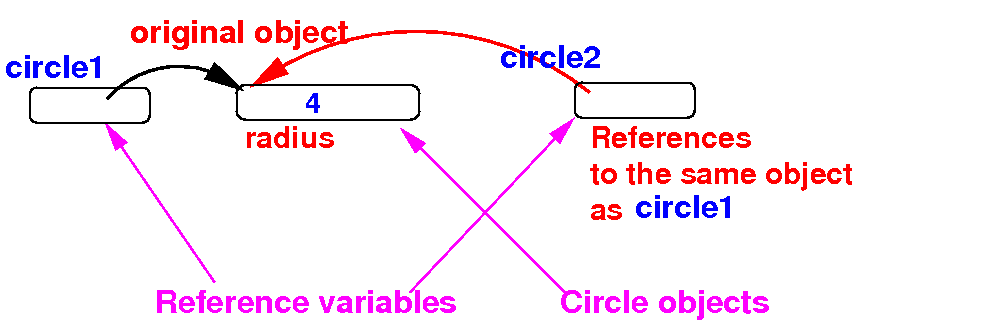
Review:
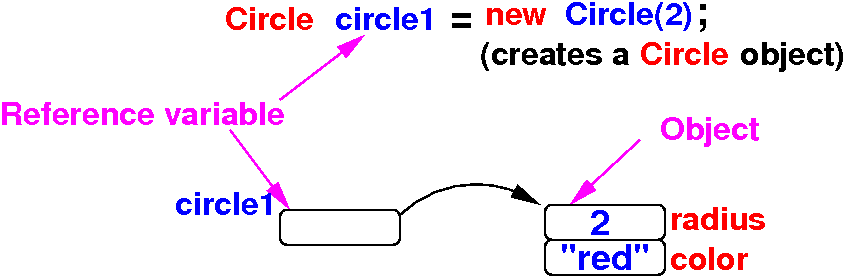
objects in Java
- In Java, an
object
consists of
2 components:
- An
object
reference
variable
(which is not an
object, but
references to
an object)
- The actual
object
which consists of a
number of
instance variables
|
- Schematically:
- This
storage structure
of objects makes it
a bit
complicated to
make a
copy of
an object
|
What does it
mean to
copy an
object
- To
copy an
object means:
- Make a
duplicate of
an object where
the duplicate object contains
the
same data as
the
original object
-
Furthermore:
updating
the instance variables
in the
duplicate
object
must not
affect
the values
in the
original object
|
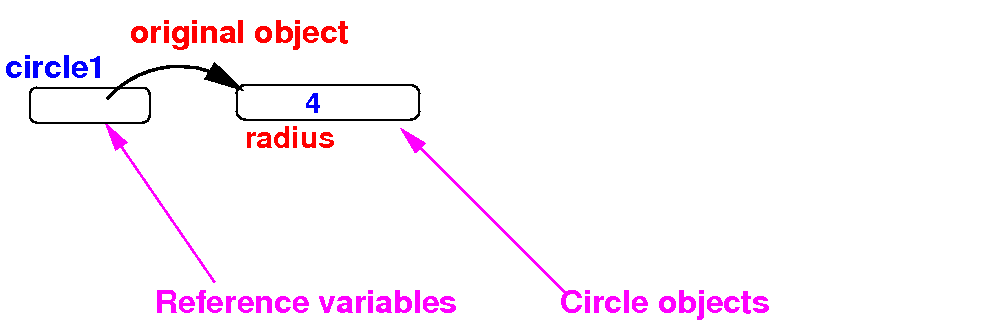
- Schematically:
before
making a copy of the
object circle1
|
What does it
mean to
copy an
object
- To
copy an
object means:
- Make a
duplicate of
an object where
the duplicate object contains
the
same data as
the
original object
-
Furthermore:
updating
the instance variables
in the
duplicate
object
must not
affect
the values
in the
original object
|
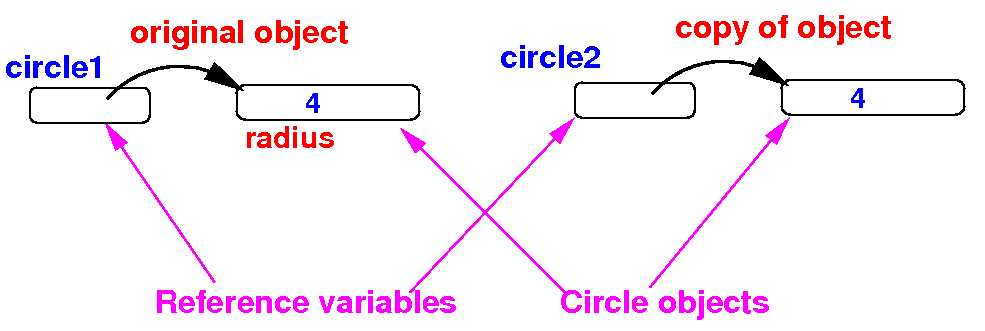
- Schematically:
after
making a copy of the
object circle1
|
How to
copy an object in
Java
step-by-step instructions
- Initial state:
    public static void main(String[] args)
    {
        Circle circle1 = new Circle(4);  // The original object


    }
|
|
How to
copy an object in
Java
step-by-step instructions
- Step 1:
create an
object to
store the
copy
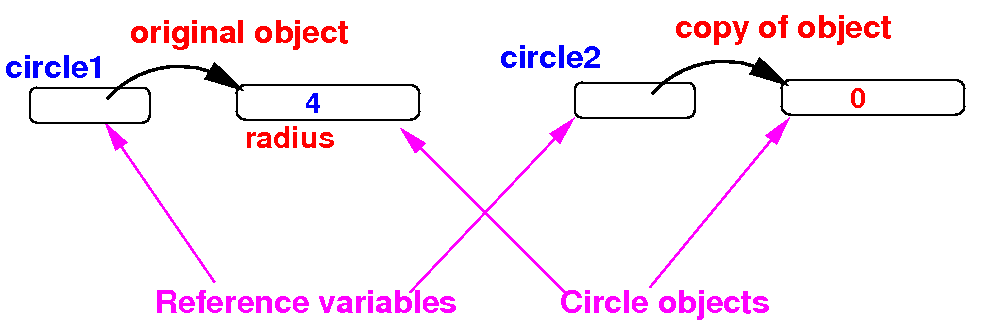
    public static void main(String[] args)
    {
        Circle circle1 = new Circle(4);  // The original object

        Circle circle2 = new Circle();


    }
|
|
How to
copy an object in
Java
step-by-step instructions
- Step 2:
copy the
instance variables from the
original to
the
copy object
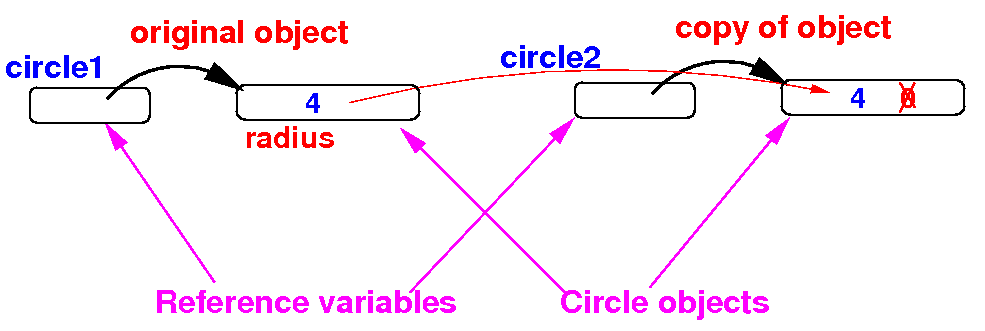
    public static void main(String[] args)
    {
        Circle circle1 = new Circle(4);  // The original object

        Circle circle2 = new Circle();

        circle2.radius = circle1.radius;

    }
|
|
How to
copy an object in
Java
step-by-step instructions
- Result:
updates on
the object copy will
not affect the
original object:
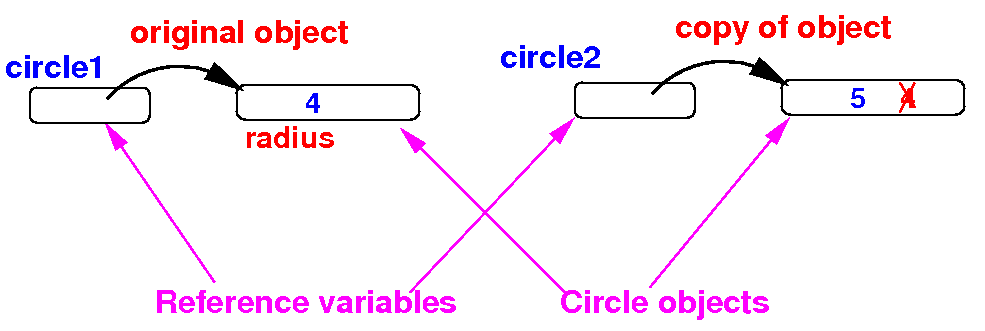
    public static void main(String[] args)
    {
        Circle circle1 = new Circle(4);  // The original object

        Circle circle2 = new Circle();

        circle2.radius = circle1.radius;
	circle2.radius++; // Will not affect circle1.radius
    }
|
|
Demo:
demo/10-classes/10-copy/Demo.java
+
Circle.java
A
common error
in copying objects
- Variables of
primitive
data types
(such as int,
double, etc)
can be
copied with
an
assignment statement:
    int x = 4;   // int is a primitive data type
    int xCopy;

    xCopy = x;   // Copies x to xCopy
|
- However,
in Java,
the
assignment statement will
not
copy
objects of
non-primitive
data types:
    Circle circle1 = new Circle(4);  // Non-primitive data type

    Circle circle2;

    circle2 = circle1;   // Does not copy an object
                           // ** This copies the reference
			   // ** in circle1 to circle2
|
|
Review: the
effect of
assignment
with a
reference variable
- Initially we
have the object
circle1:
Circle circle1 = new Circle(4);
|
Schematically:
|
Review: the
effect of
assignment
with a
reference variable
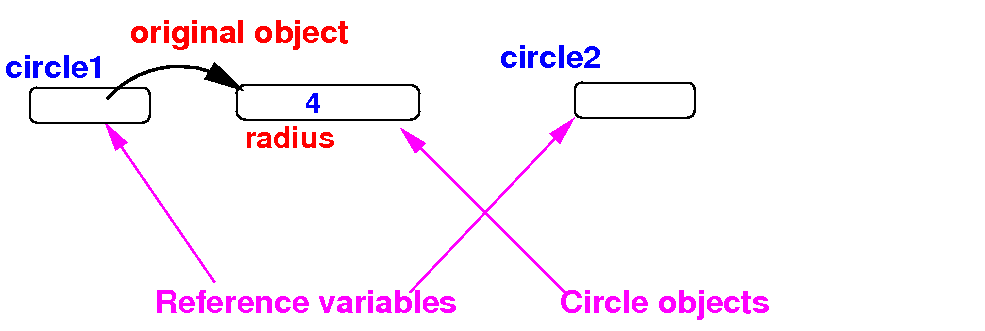
- The definition
Circle
circle2
defines another
reference variable:
    Circle circle1 = new Circle(4);

    Circle circle2;
|
Schematically:
|
Review: the
effect of
assignment
with a
reference variable
Review: the
effect of
assignment
with a
reference variable
Demo:
demo/10-classes/10-copy/Demo2.java +
Circle.java
❮
❯