Review: accessing
members in an object
|
Mystery:
where is
reference variable
used in the
instance methods ???
Consider the instance methods in the Circle class definition again:
public class Circle
{
    public double radius = 1;       /** The radius of this circle */

    public Circle() { }             /** Constructor 1 for a circle object */

    public Circle(double newRadius) /** Constructor 2 for a circle object */
    {
        radius = newRadius;  // Member radius is not accessed with a ref. var !?
    }

    public double getArea()      /** Return the area of this circle */
    {
        return 3.14159 * radius * radius;   // Again ??
    }

    public void setRadius(double newRadius) /** Set new radius for this circle */
    {
       radius = newRadius;   // Shouldn't it be:  refVar.radius  = newRadius ??
    }
}
|
The member variable radius is not accessed using a reference variable ! How is this possible ???
The
implicit (= hidden)
parameter
this
Here is the dirty little secret about Java's instance methods:
|
The
implicit (= hidden)
reference variable
this in the
instance methods
When we define a class as follows:
public class Circle
{
    public double radius = 1;       /** The radius of this circle */

    public Circle() { }             /** Constructor 1 for a circle object */

    public Circle(double newRadius) /** Constructor 2 for a circle object */
    {
        radius = newRadius;
    }

    public double getArea()      /** Return the area of this circle */
    {
        return 3.14159 * radius * radius;
    }

    public void setRadius(double newRadius) /** Set new radius for this circle */
    {
       radius = newRadius;
    }
}
|
The
implicit (= hidden)
reference variable
this in the
instance methods
The Java compiler will secretly insert the implicit parameter this in every instance method:
public class Circle
{
    public double radius = 1;       /** The radius of this circle */

    public Circle(Circle this) { }

    public Circle(Circle this, double newRadius)
    {
        radius = newRadius;
    }

    public double getArea(Circle this)
    {
        return 3.14159 * radius * radius;
    }

    public void setRadius(Circle this, double newRadius)
    {
       radius = newRadius;
    }
}
|
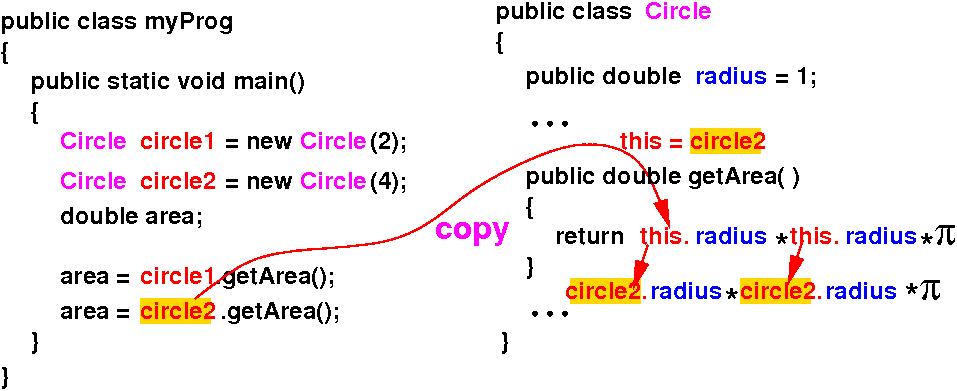
The parameter this is a copy of the reference variable in the method invocation (E.g.: circle1.getArea())
The
implicit (= hidden)
reference variable
this used by the
instance methods
The Java compiler will also insert this. to every member access in an instance method (and constructor):
public class Circle
{
    public double radius = 1;       /** The radius of this circle */

    public Circle() { }             /** Constructor 1 for a circle object */

    public Circle(double newRadius) /** Constructor 2 for a circle object */
    {
        this.radius = newRadius;
    }

    public double getArea()      /** Return the area of this circle */
    {
        return 3.14159 * this.radius * this.radius;
    }

    public void setRadius(double newRadius) /** Set new radius for this circle */
    {
       this.radius = newRadius;
    }
}
|
We can add the
this variable
explicitly
ourselves (if you wish)
DEMO:
10-classes/08-this/Circle.java
(proof
that the parameter variable
this
exists !)
The
implicit (= hidden)
parameter
this
Illustrated: how the reference variable is used as the implicit parameter this and to access radius:
|
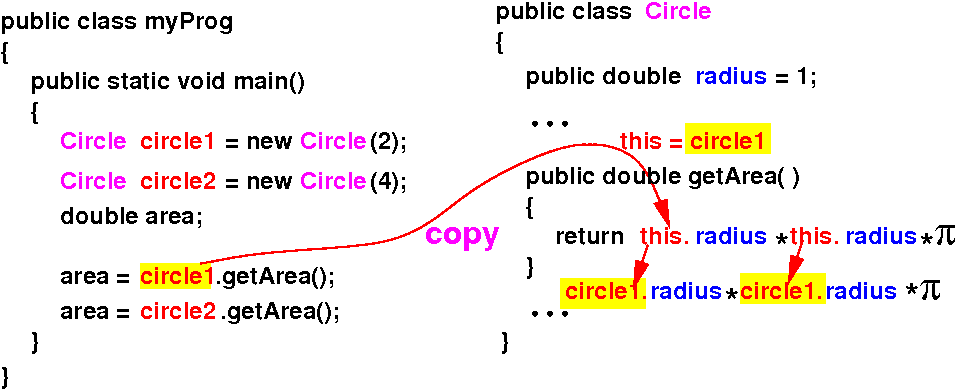
The
implicit (= hidden)
parameter
this
Example that illustrate the passing of the implicit parameter:
|
When is the
use
of this
necessary ???
|
DEMO: 10-classes/09-this/Circle.java -- edit and re-compile