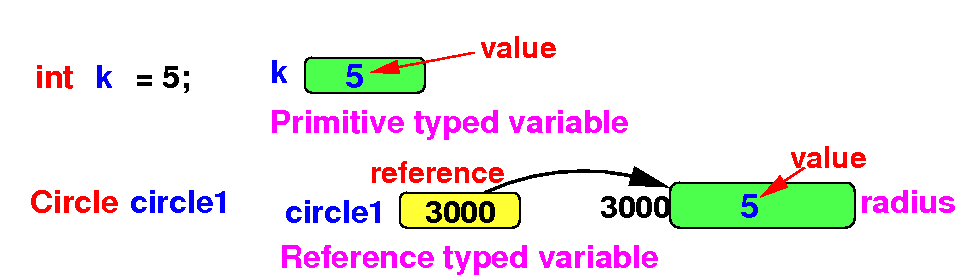
Review:   reference data types and objects

  • Reference data type:

    • All classes are reference data types

    Example:

      Circle  is a reference data type


  • Reference variables:

    • Variables defined with a reference data type are reference variables.

    • Reference variable (always) stores an address of an object

    Example:

     Circle circle1; // circle1 is a reference variable
                     // I.e.: circle1 stores an address of a Circle object
    

Review:   how reference data types and objects are stored in memory

Reference variables and objects are stored as follows:
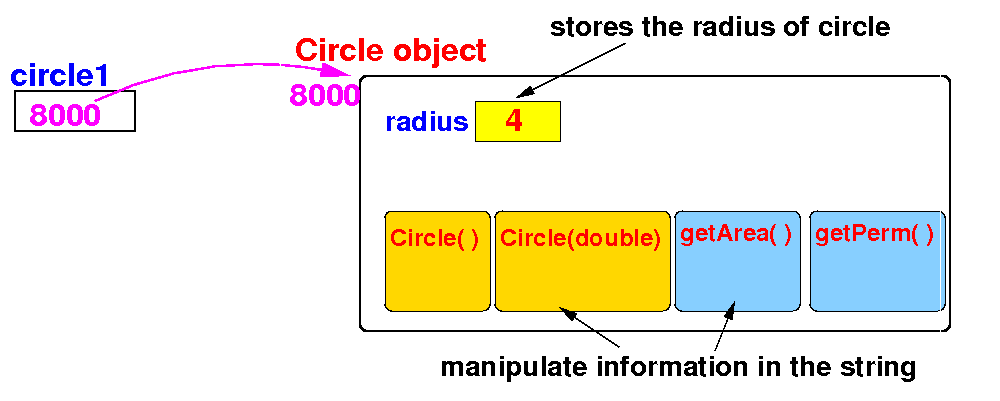


 Circle    is  a class or a reference data type


circle1 is a reference variable (stores an address) circle1 references (points to) a Circle object

Accesing members of an object   -   the member access operator (.)  

  • An object's member can refer to:

      1. A data field in the object         or      

      2. A method in the object

  • After an object has been instantiated, its data fields can be accessed and its methods can be invoked using the dot operator (.):

     objectRefVar.dataField          accesses a data field in the object
    
     objectRefVar.method(arguments)  invokes a method on the object

    Example:   circle1.radius

  • The dot (.) operator is also known as the object member access operator

Accessing members of an object     -   Example

    public static void main()
    {
        Circle circle1 = new Circle();  // Create a Circle object circle1
        Circle circle2 = new Circle(2); // Create a Circle object circle2

	circle1.radius = 10;   // Access the radius in circle1 object
	circle2.radius = 99;   // Access the radius in circle2 object

	double area1 = circle1.getArea(); // Invoke getArea() method on circle1
	double area2 = circle2.getArea(); // Invoke getArea() method on circle2

    } 

DEMO: demo/10-classes/06-access-members

Terminology: instance method

  • The method getArea( ) is invoked as an operation on a specific instance of Circle objects.

  • The method getArea( ) is referred to as an instance method, because you invoke it only on a specific instance.

Reference type variables and primitive type variables are stored differently

  • All variables consist of memory cells that store a value (binary number)

    • However:   how the number is used can be different !


  • A variable of a primitive type stores the value itself

    • I.e.:   the number in used in computations

  • A variable of a reference type stores a reference (= memory address) of the location of the object (= properties of the object)

      • I.e.:   the number is used to locate (= access) an object (its properties)

    Schematically:

An important consequence of the difference ways of storing variables

  • Assigning to variables of primitive type will make a (real) copy:

    The variables k and c are separate/independent copies of the value 5

  • Therefore:   update using c will not change k:

        public static void main(String[] args)
        {
            int k = 5;
            int c = k;
            
            c = 99;                 // Does not update k
            System.out.println(k);  // Prints 5
        } 

DEMO: demo/10-classes/07-aliasing/Demo.java

An important consequence of the difference ways of storing variables

  • Assigning to variables of reference type will make a alias:

    The variables circle1 and circle2 reference the same Circle object (i.e.: alias !)

  • Therefore:  update using circle1.radius will also change circle2.radius:

        public static void main(String[] args)
        {
            Circle circle1 = new Circle(5);  
            Circle circle2 = circle1;   // alias !
            
            circle2.radius = 99;        // Same as circle1.radius
            System.out.println( circle1.radius ); // Prints: 99 
        } 

DEMO: demo/10-classes/07-aliasing/Demo.java

Why Java have reference typed variables and primitive typed variables
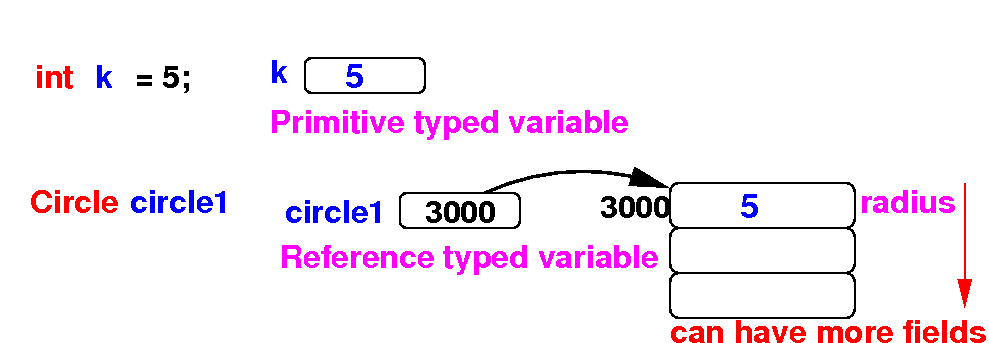
  • Variables of a primitive data type can only store 1 value but can be accessed quickly

      • Such variables are mainly used in computations      

  • Objects can have many data fields and can allow the programmer to represent complex things in the real world

      • Objects are mainly used for data representation      

      • Accessing to data in an object is slower (need 2 memory accesses)