Passing
objects
as
parameters
to methods
Here is an example of a method with an object reference variable as parameter:
    public static void main(String[] args)
    {
        Circle circle1 = new Circle(1);
        Circle circle2 = new Circle(4);

        printCircle(circle1);  // Pass object as argument
        printCircle(circle2);  // Pass object as argument
    }

    // Method with an object as parameter
    public static void printCircle( Circle c )
    {
        System.out.println("The area of the circle of radius "
                           + c.radius + " is " + c.getArea());
    }
|
In Java, the object reference in the actual parameter is copied to the object reference argument
Reminder:
assigning (= copying)
reference typed variables
|

What happens when
a method
updates its
object
passed as a
parameter
Since the formal parameter is an alias for the actual parameter, the original object will be updated:
    public static void main(String[] args)
    {
        Circle circle1 = new Circle(1);

	System.out.println( circle1.getArea() );  // 3.14159

	incrementRadius( circle1 );  // increment radius by 1

	System.out.println( circle1.getArea() );  // 4 × 3.14159
    }

    // Method updates object passed as parameter
    public static void incrementRadius( Circle c )
    {
        c.radius++;   // Increment radius by 1
    }
|
In Java, the formal parameter c is an alias of the actual parameter circle1
So c.radius++ will also updates circle1.radius
Review:
passing
primitive
variables to methods
|
Review:
passing
primitive
variables to methods
|
Review:
passing
primitive
variables to methods
|
Review:
passing
primitive
variables to methods
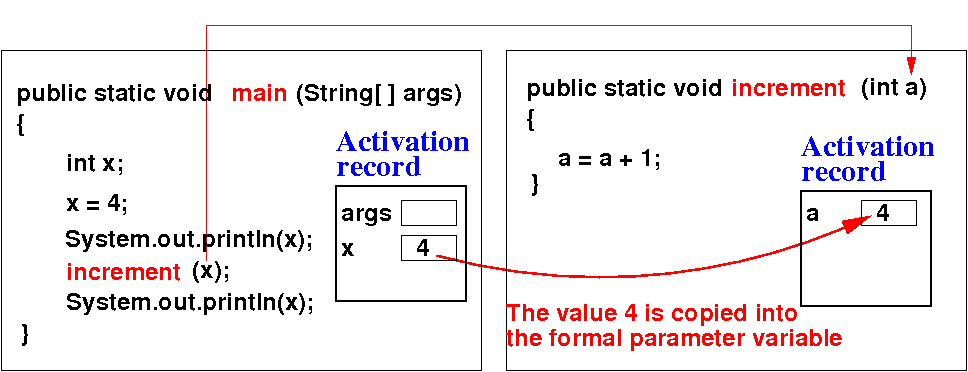
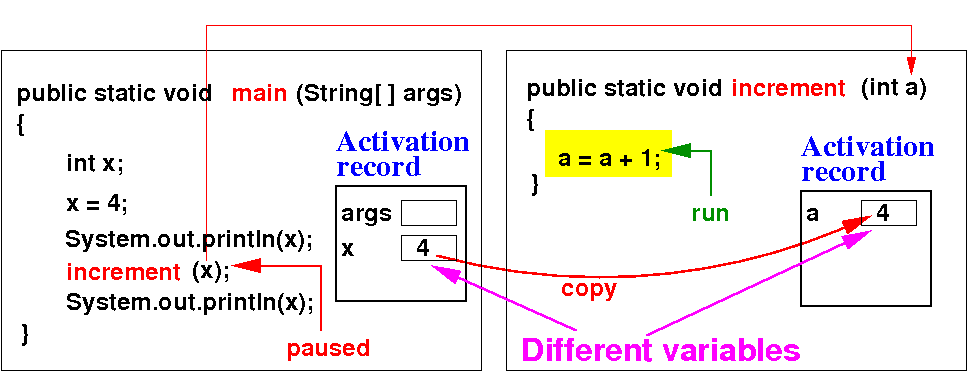
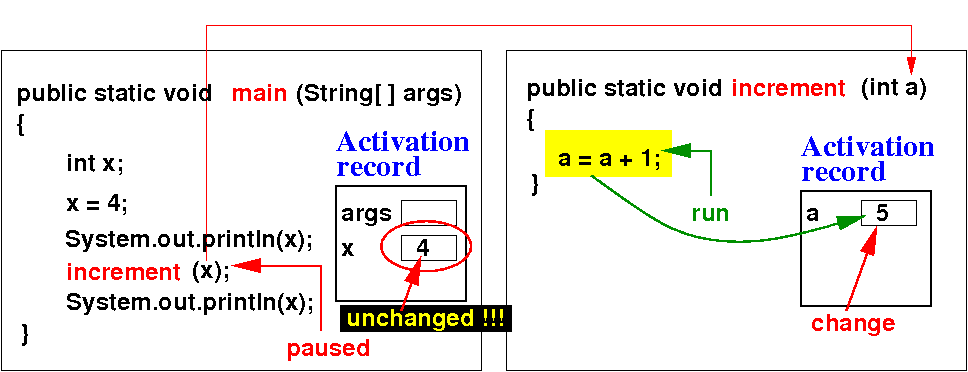
Demo program that shows that arguments as passed to method by copying the value:
    public static void main(String[] args)
    {
        int x;

        x = 4;
	System.out.println(x);

	increment( x );  // Pass x by copying: a = x

	System.out.println(x);
    }

    public static void increment(int a )
    {
	a = a + 1;
    }
|
Demo with BlueJ: show the activation record of main( ) and increment( ) when stopped in increment( )