2-dimensional arrays
used in
Mathematics
|
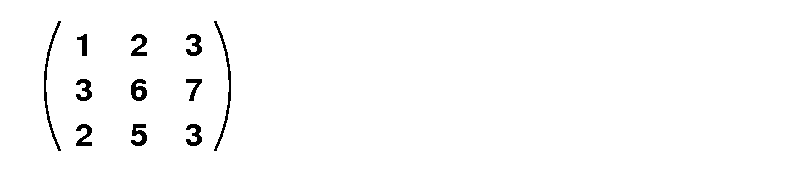
2-dimensional arrays
used in
Mathematics
|
Matrix operations
|


Matrix scalar multiplication
Write a scalarMultiply( ) method that multiplies a matrix m with a number a
    public static double[][] scalarMultiply(double[][] m, double a)
    {
        double[][] result = new double[m.length][m[0].length];


        for(int i = 0; i < m.length; i++)
        {
            for(int j = 0; j < m[0].length; j++)
            {
                result[i][j] = m[i][j] * a;
            }
        }

        return result;
    }
|
Matrix scalar multiplication
(1) Define a 2-dimensional array to store the result
    public static double[][] scalarMultiply(double[][] m, double a)
    {
        double[][] result = new double[m.length][m[0].length];
                            // result matrix has
			    // same # rows and # columns as m

        for(int i = 0; i < m.length; i++)
        {
            for(int j = 0; j < m[0].length; j++)
            {
                result[i][j] = m[i][j] * a;
            }
        }

        return result;
    }
|
Matrix scalar multiplication
(2) Compute the result
    public static double[][] scalarMultiply(double[][] m, double a)
    {
        double[][] result = new double[m.length][m[0].length];
                            // result matrix has
			    // same # rows and # columns as m

        for (int i = 0; i < m.length; i++)
        {
            for (int j = 0; j < m[0].length; j++)
            {
                result[i][j] = m[i][j] * a;
            }
        }

        return result;
    }
|
Matrix scalar multiplication
(3) Return the result
    public static double[][] scalarMultiply(double[][] m, double a)
    {
        double[][] result = new double[m.length][m[0].length];
                            // result matrix has
			    // same # rows and # columns as m

        for (int i = 0; i < m.length; i++)
        {
            for (int j = 0; j < m[0].length; j++)
            {
                result[i][j] = m[i][j] * a;
            }
        }

        return result;
    }
|
How to
use the
matrix scalar multiplication
method
Demo program
    public static void main()
    {
        double [][] a =  { {1, 8, -3},
                           {4, -2, 5} };

        double[][] b;

        b = scalarMultiply(a, 2);

        System.out.println( Arrays.toString(a[0]) );
        System.out.println( Arrays.toString(a[1]) );
        System.out.println( " * " + 2 + " = " );
        System.out.println( Arrays.toString(b[0]) );
        System.out.println( Arrays.toString(b[1]) );

    }
|
DEMO: demo/09-multi-dim-array/05-matrix/ScalarMult.java
Transpose a matrix
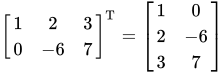
What happens when you transposes a matrix:
   Original matrix:           Transposed matrix:

      +-             -+             +-       -+
      | 1     2     3 |		    | 1     4 |
      | 4     5     6 |		    | 2     5 |
      +-             -+		    | 3     6 |
                                    +-       -+

    Change 1: Number of rows: 2         Number of rows: 3      (exchanged !)
              Number of columns: 3      Number of columns: 2

    Change 2: Row and column indexes: (exchanged !)

      +-             -+             +-        -+
      | 0,0  0,1  0,2 |		    | 0,0  0,1 |
      | 1,0  1,1  1,2 |		    | 1,0  1,1 |
      +-             -+		    | 2,0  2,1 |
                                    +-        -+
|
Transpose a matrix
Write a matrixTranspose( ) method that transposes a matrix M
    public static double[][] matrixTranspose(double[][] m)
    {
        double[][] result = new double[m[0].length][m.length];
	                    // result matrix has:
			    //   # rows    = # columns in m
			    //   # columns = # rows in m

        for (int i = 0; i < m.length; i++)
            for (int j = 0; j < m[0].length; j++)
                result[j][i] = m[i][j];
		            // Copy m's element in row i and column j
			    // to row j and column i in result

        return result;
    }
|
Transpose a matrix
(1) Define a 2-dimensional matrix to store the result
    public static double[][] matrixTranspose(double[][] m)
    {
        double[][] result = new double[m[0].length][m.length];
	                    // result matrix has:
			    //   # rows    = # columns in m (= m[0].length)
			    //   # columns = # rows in m (= m.length)

        for (int i = 0; i < m.length; i++)
            for (int j = 0; j < m[0].length; j++)
                result[j][i] = m[i][j];
		            // Copy m's element in row i and column j
			    // to row j and column i in result

        return result;
    }
|
Transpose a matrix
(2) Compute the transpose
    public static double[][] matrixTranspose(double[][] m)
    {
        double[][] result = new double[m[0].length][m.length];
	                    // result matrix has:
			    //   # rows    = # columns in m (= m[0].length)
			    //   # columns = # rows in m (= m.length)

        for (int i = 0; i < m.length; i++)
            for (int j = 0; j < m[0].length; j++)
                result[j][i] = m[i][j];
		            // Copy m's element in row i and column j
			    // to row j and column i in result

        return result;
    }
|
Transpose a matrix
(3) Return the result
    public static double[][] matrixTranspose(double[][] m)
    {
        double[][] result = new double[m[0].length][m.length];
	                    // result matrix has:
			    //   # rows    = # columns in m (= m[0].length)
			    //   # columns = # rows in m (= m.length)

        for (int i = 0; i < m.length; i++)
            for (int j = 0; j < m[0].length; j++)
                result[j][i] = m[i][j];
		            // Copy m's element in row i and column j
			    // to row j and column i in result

        return result;
    }
|
How to
use the
matrix transpose
method
Demo program
    public static void main()
    {
        double [][] a =  { {1, 8, -3},
                           {4, -2, 5} };

        double[][] b;

        b = matrixTranspose(a);

        System.out.println( Arrays.toString(a[0]) );
        System.out.println( Arrays.toString(a[1]) );
        System.out.println( "Transpose:" );
        System.out.println( Arrays.toString(b[0]) );
        System.out.println( Arrays.toString(b[1]) );
        System.out.println( Arrays.toString(b[2]) );
    }
|
DEMO: demo/09-multi-dim-array/05-matrix/TransposeMatrix.java