Prelude to the
merge sort algorithm
|
Prelude to the
merge sort algorithm
|
Prelude to the
merge sort algorithm
|
Prelude to the
merge sort algorithm
|
Prelude to the
merge sort algorithm
|
A simplied
merge sort algorithm
Let's write this sorting algorithm:
    public static void mergeSort(double[] a)  // Not the actual mergeSort algorithm
    {
	int middle     = a.length/2;
	double[] left  = new double[a.length/2];            // left half
        double[] right = new double[a.length - a.length/2]; // right half

	if ( a.length == 1 )
	    return;     // No need to sort an array of 1 element...

	// Split:       a[0 ..... middle-1]  a[middle .... a.length-1]
        //	        left[0 .. middle-1]  right[0 ... a.length-1-middle]
	for ( int i = 0; i < middle; i++ )
	   left[i] = a[i];

	for ( int i = 0; i < a.length-middle; i++ )
	   right[i] = a[i+middle];

	// Sort both halves - you can any sort algorithm !
	BubbleSort.sort( left );
	BubbleSort.sort( right );

	/* Merge both sorted arrays
	merge( a, left, right );   // We have discussed merge() already...
    }
|
A simplied
merge sort algorithm
Define 2 arrays to store the left half and the right half of the input array:
    public static void mergeSort(double[] a)  // Not the actual mergeSort algorithm
    {
	int middle     = a.length/2;
	double[] left  = new double[a.length/2];            // left half
        double[] right = new double[a.length - a.length/2]; // right half

        // Define variables to split input array into 2 halves
	if ( a.length == 1 )
	    return;     // No need to sort an array of 1 element...

	// Split:       a[0 ..... middle-1]  a[middle .... a.length-1]
        //	        left[0 .. middle-1]  right[0 ... a.length-1-middle]
	for ( int i = 0; i < middle; i++ )
	   left[i] = a[i];

	for ( int i = 0; i < a.length-middle; i++ )
	   right[i] = a[i+middle];

	// Sort both halves - you can any sort algorithm !
	BubbleSort.sort( left );
	BubbleSort.sort( right );
	/* Merge both sorted arrays
	merge( a, left, right );   // We have discussed merge() already...
    }
|
A simplied
merge sort algorithm
If the input array only contains 1 element, we do not need to sort it (because it's already sorted):
    public static void mergeSort(double[] a)  // Not the actual mergeSort algorithm
    {
	int middle     = a.length/2;
	double[] left  = new double[a.length/2];            // left half
        double[] right = new double[a.length - a.length/2]; // right half

	if ( a.length == 1 )   // Base case
	    return;            // No need to sort an array of 1 element...

	// Split:       a[0 ..... middle-1]  a[middle .... a.length-1]
        //	        left[0 .. middle-1]  right[0 ... a.length-1-middle]
	for ( int i = 0; i < middle; i++ )
	   left[i] = a[i];

	for ( int i = 0; i < a.length-middle; i++ )
	   right[i] = a[i+middle];

	// Sort both halves - you can any sort algorithm !
	BubbleSort.sort( left );
	BubbleSort.sort( right );

	/* Merge both sorted arrays
	merge( a, left, right );   // We have discussed merge() already...
    }
|
A simplied
merge sort algorithm
For arrays with > 1 element, we split the input array into 2 equal halves:
    public static void mergeSort(double[] a)  // Not the actual mergeSort algorithm
    {
	int middle     = a.length/2;
	double[] left  = new double[a.length/2];            // left half
        double[] right = new double[a.length - a.length/2]; // right half

	if ( a.length == 1 )   // Base case
	    return;            // No need to sort an array of 1 element...

	// Split:       a[0 ..... middle-1]  a[middle .... a.length-1]
        //	as:     left[0 .. middle-1]  right[0 ... a.length-1-middle]
	for ( int i = 0; i < middle; i++ )
	   left[i] = a[i];

	for ( int i = 0; i < a.length-middle; i++ )
	   right[i] = a[i+middle];

	// Sort both halves - you can any sort algorithm !
	BubbleSort.sort( left );
	BubbleSort.sort( right );

	/* Merge both sorted arrays
	merge( a, left, right );   // We have discussed merge() already...
    }
|
A simplied
merge sort algorithm
We sort both halves of the arrays -- we use insertionSort( ), but any sort method can be used:
    public static void mergeSort(double[] a)  // Not the actual mergeSort algorithm
    {
	int middle     = a.length/2;
	double[] left  = new double[a.length/2];            // left half
        double[] right = new double[a.length - a.length/2]; // right half

	if ( a.length == 1 )   // Base case
	    return;            // No need to sort an array of 1 element...

	// Split:       a[0 ..... middle-1]  a[middle .... a.length-1]
        //	as:     left[0 .. middle-1]  right[0 ... a.length-1-middle]
	for ( int i = 0; i < middle; i++ )
	   left[i] = a[i];

	for ( int i = 0; i < a.length-middle; i++ )
	   right[i] = a[i+middle];

	// Sort both halves - you can use any sort algorithm !
	insertionSort( left );
	insertionSort( right );

	/* Merge both sorted arrays
	merge( a, left, right );   // We have discussed merge() already...
    }
|
A simplied
merge sort algorithm
Finally, we use the merge( ) method to merge the 2 sorted array to obtain one sorted output array:
    public static void mergeSort(double[] a)  // Not the actual mergeSort algorithm
    {
	int middle     = a.length/2;
	double[] left  = new double[a.length/2];            // left half
        double[] right = new double[a.length - a.length/2]; // right half

	if ( a.length == 1 )   // Base case
	    return;            // No need to sort an array of 1 element...

	// Split:       a[0 ..... middle-1]  a[middle .... a.length-1]
        //	as:     left[0 .. middle-1]  right[0 ... a.length-1-middle]
	for ( int i = 0; i < middle; i++ )
	   left[i] = a[i];

	for ( int i = 0; i < a.length-middle; i++ )
	   right[i] = a[i+middle];

	// Sort both halves - you can use any sort algorithm !
	insertionSort( left );
	insertionSort( right );

	// Merge both sorted arrays
	merge( a, left, right );   // We have discussed merge() already...
    }
|
Test program for
mergeSort
    public static void main(String[] args)
    {
        double[] myList = {5.6,  7.8,  2.4,  3.3};

        for (int i = 0; i < myList.length; i++)
            System.out.print( myList[i] + "  ");
        System.out.println();

        mergeSort( myList );

        for (int i = 0; i < myList.length; i++)
            System.out.print( myList[i] + "  ");
        System.out.println();
    }
|
DEMO: demo/08-array/12-sorting/PreMergeSort.java
Note: the merge( ) and insertionSort( ) methods have been discussed previously and must be included in the program
The
official
merge sort
algorithm
    public static void mergeSort(double[] a)  // Not the actual mergeSort algorithm
    {
	int middle     = a.length/2;
	double[] left  = new double[a.length/2];            // left half
        double[] right = new double[a.length - a.length/2]; // right half

	if ( a.length == 1 )   // Base case
	    return;            // No need to sort an array of 1 element...

	// Split:       a[0 ..... middle-1]  a[middle .... a.length-1]
        //	as:     left[0 .. middle-1]  right[0 ... a.length-1-middle]
	for ( int i = 0; i < middle; i++ )
	   left[i] = a[i];

	for ( int i = 0; i < a.length-middle; i++ )
	   right[i] = a[i+middle];

	// Sort both halves - we can use any sort algorithm here:
	insertionSort( left );  // I used insertionSort( ) to make it simple
	insertionSort( right ); // to explain what we want to achieve

	// Merge both sorted arrays
	merge( a, left, right );   // We have discussed merge() already...
    }
|
The
official
merge sort
algorithm
    public static void mergeSort(double[] a)  // The actual mergeSort algorithm
    {
	int middle     = a.length/2;
	double[] left  = new double[a.length/2];            // left half
        double[] right = new double[a.length - a.length/2]; // right half

	if ( a.length == 1 )   // Base case
	    return;            // No need to sort an array of 1 element...

	// Split:       a[0 ..... middle-1]  a[middle .... a.length-1]
        //	as:     left[0 .. middle-1]  right[0 ... a.length-1-middle]
	for ( int i = 0; i < middle; i++ )
	   left[i] = a[i];

	for ( int i = 0; i < a.length-middle; i++ )
	   right[i] = a[i+middle];

	// Sort both halves - the mergeSort algorithm is recursive !
	mergeSort( left );      // We use mergeSort itself here !
	mergeSort( right );     // We use mergeSort again here !

	// Merge both sorted arrays
	merge( a, left, right );   // We have discussed merge() already...
    }
|
DEMO: demo/08-array/12-sorting/MergeSort.java
How the
mergeSort algorithm
works
Consider the mergeSort( ) algorithm on the following input:
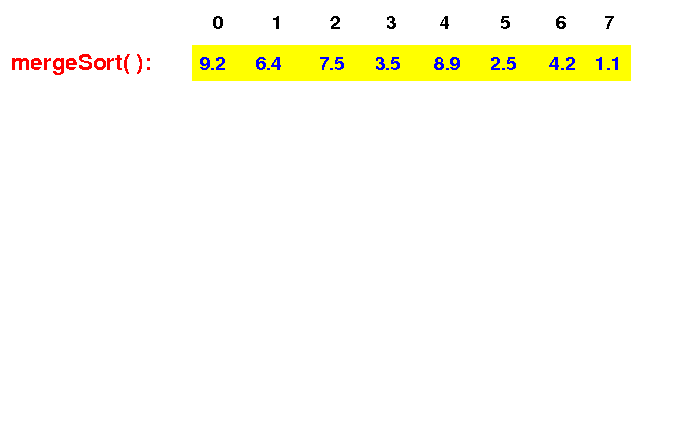
mergeSort(A[0-7]) |
How the
mergeSort algorithm
works
mergeSort( ) first split the input array into 2 halves:
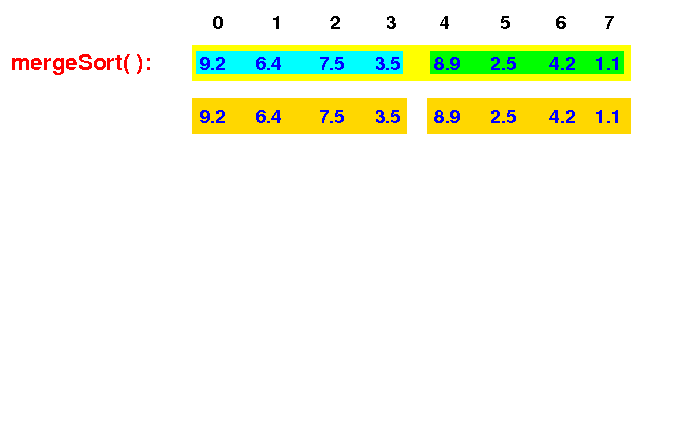
mergeSort(A[0-7]) |
How the
mergeSort algorithm
works
mergeSort( ) then recurses and sort the first half:
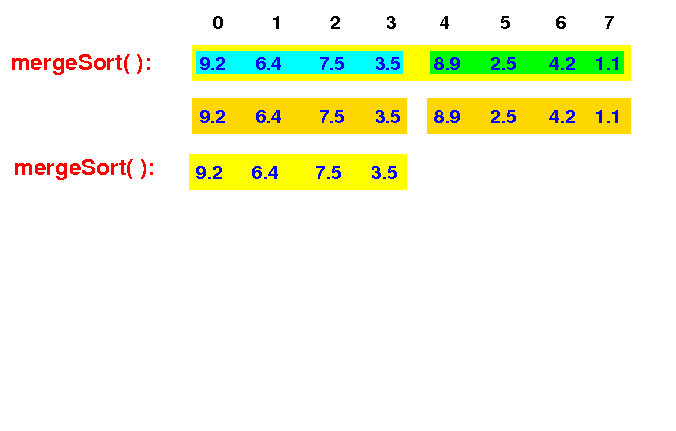
mergeSort(A[0-7]) --> mergeSort(A[0-3]) |
How the
mergeSort algorithm
works
The new mergeSort( ) first split the input array into 2 halves:
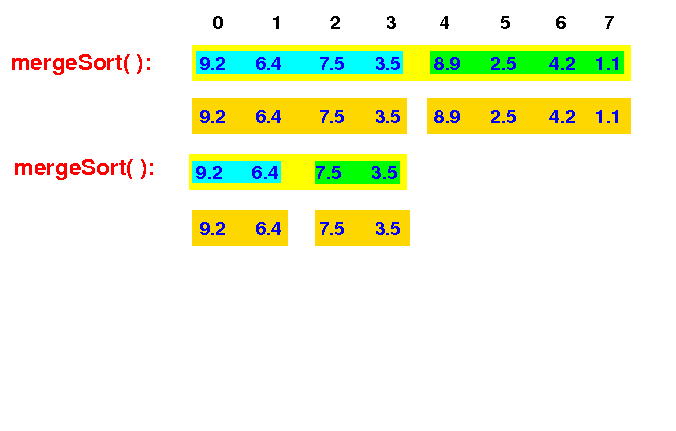
mergeSort(A[0-7]) --> mergeSort(A[0-3]) |
How the
mergeSort algorithm
works
This mergeSort( ) then recurses and sort the first half:
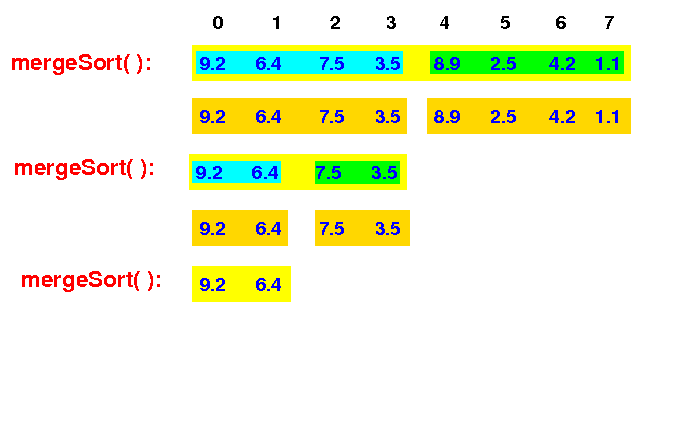
mergeSort(A[0-7]) --> mergeSort(A[0-3]) --> mergeSort(A[0-1]) |
How the
mergeSort algorithm
works
The new mergeSort( ) first split the input array into 2 halves:
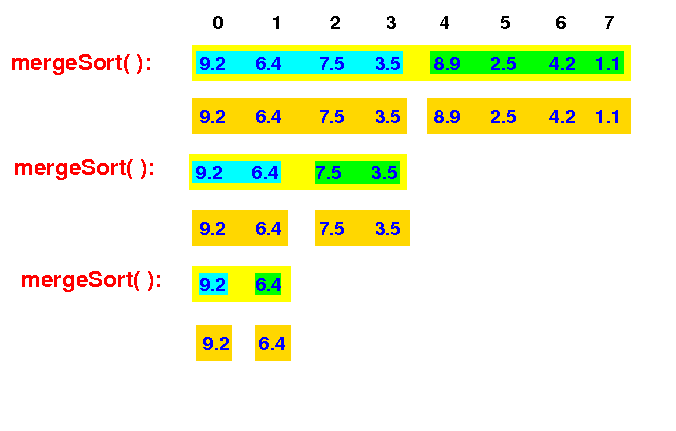
mergeSort(A[0-7]) --> mergeSort(A[0-3]) --> mergeSort(A[0-1]) |
How the
mergeSort algorithm
works
This mergeSort( ) then recurses and sort the first half:
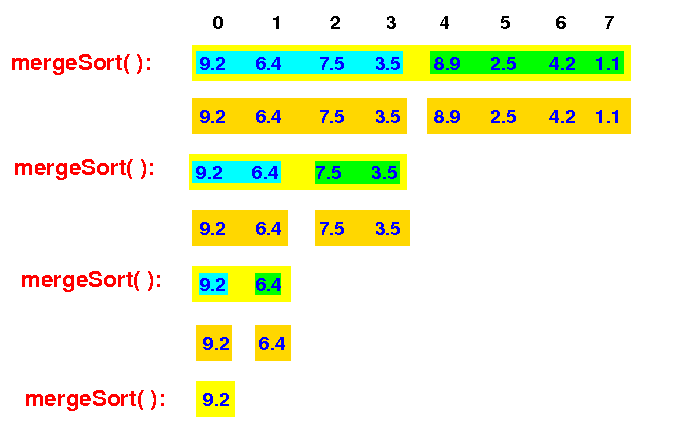
mergeSort(A[0-7]) --> mergeSort(A[0-3]) --> mergeSort(A[0-1]) --> mergeSort(A[0-0])
|
How the
mergeSort algorithm
works
The input array consists of 1 element (= base case) and mergeSort( ) returns
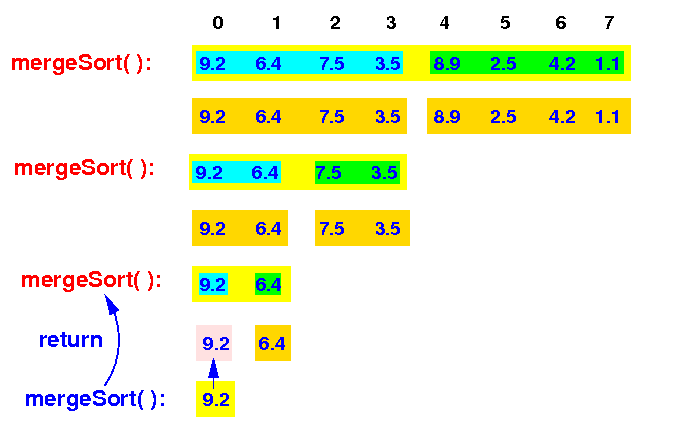
mergeSort(A[0-7]) --> mergeSort(A[0-3]) --> mergeSort(A[0-1]) <== |
How the
mergeSort algorithm
works
The mergeSort( ) then recurses and sort the 2nd half:
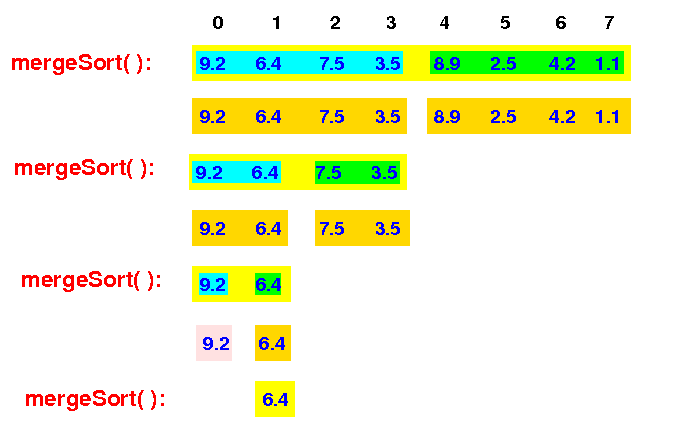
mergeSort(A[0-7]) --> mergeSort(A[0-3]) --> mergeSort(A[0-1]) --> mergeSort(A[1-1])
|
How the
mergeSort algorithm
works
The input array consists of 1 element (= base case) and mergeSort( ) returns
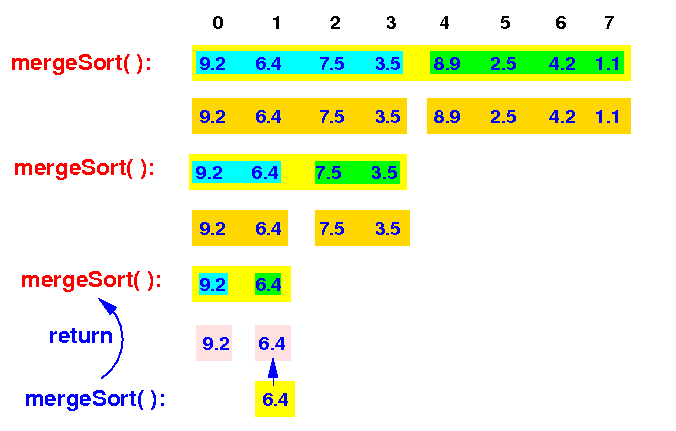
mergeSort(A[0-7]) --> mergeSort(A[0-3]) --> mergeSort(A[0-1]) <== |
How the
mergeSort algorithm
works
Merge sort will finally merge the 2 sorted arrays and return to the previous mergeSort( ):
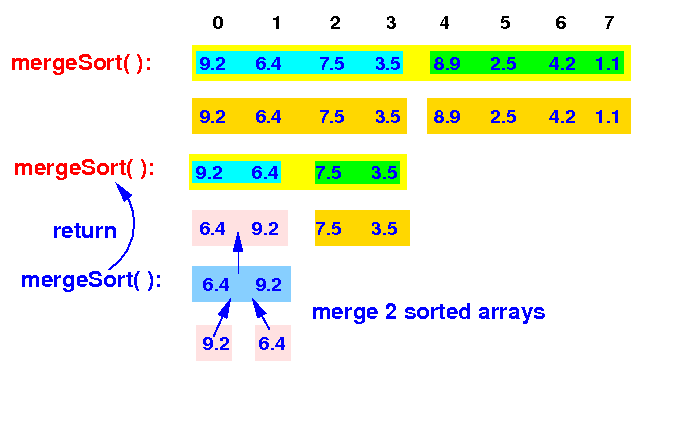
mergeSort(A[0-7]) --> mergeSort(A[0-3]) <== |
How the
mergeSort algorithm
works
This mergeSort( ) then recurses and sort the 2nd half:
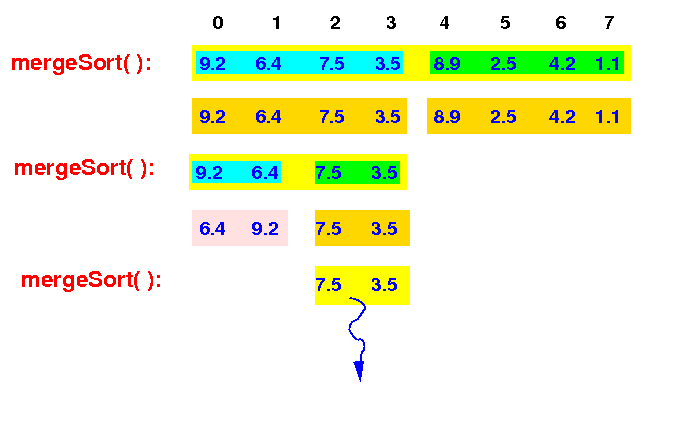
mergeSort(A[0-7]) --> mergeSort(A[0-3]) --> mergeSort(A[2-3]) |
How the
mergeSort algorithm
works
The new mergeSort( ) will repeat the previously shown steps (omitted) - the result is sorting the input array:
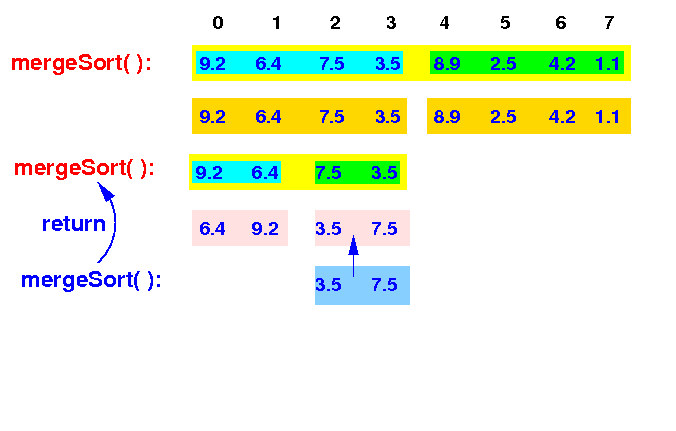
mergeSort(A[0-7]) --> mergeSort(A[0-3]) <== |
How the
mergeSort algorithm
works
The 2nd level mergeSort( ) will merge the 2 sorted arrays and ...
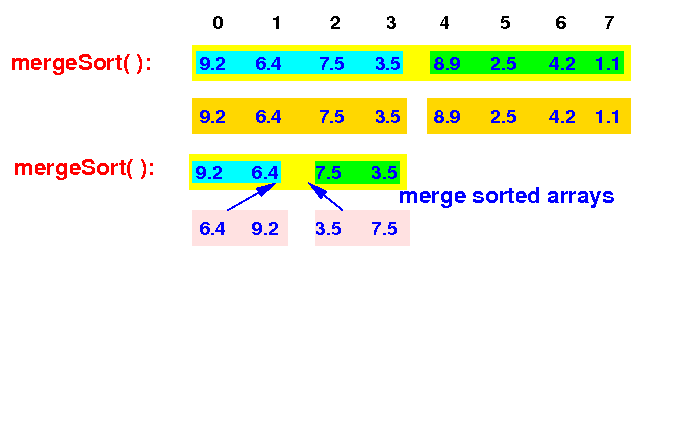
mergeSort(A[0-7]) --> mergeSort(A[0-3]): merge(A[0-1], A[2-3]) |
How the
mergeSort algorithm
works
The 2nd level mergeSort( ) will merge the 2 sorted arrays and return to the top level mergeSort( ):
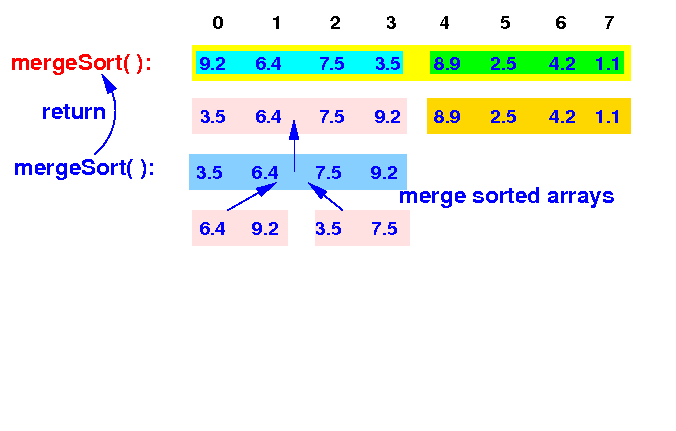
mergeSort(A[0-7]) <== |
How the
mergeSort algorithm
works
The top level mergeSort( ) then recurses and sort the 2nd half:
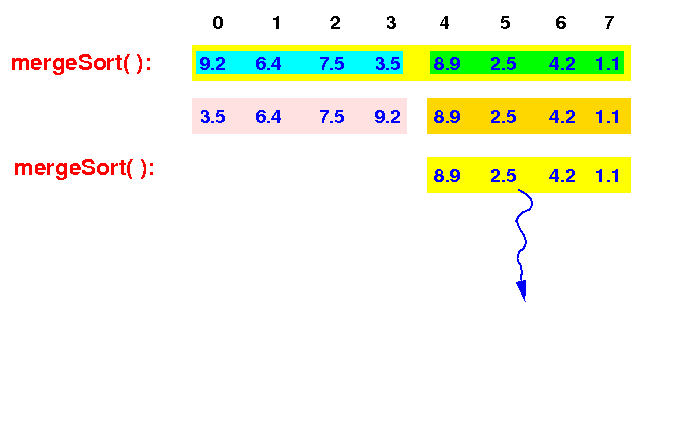
mergeSort(A[0-7]) --> mergeSort(A[4-7]) |
How the
mergeSort algorithm
works
The new mergeSort( ) will repeat the previously shown steps ( omitted) - the result is sorting the input array:
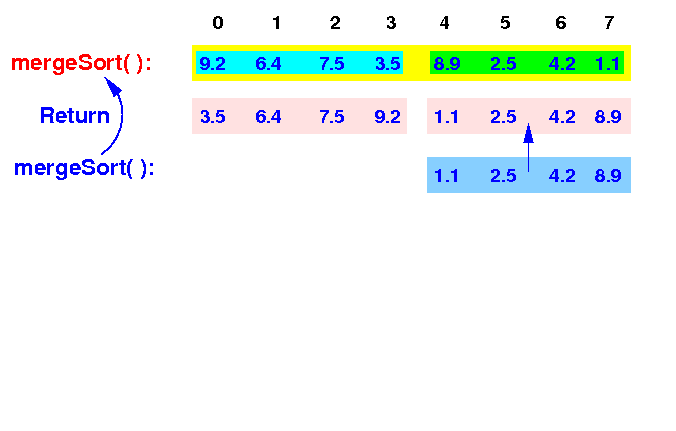
mergeSort(A[0-7]) <== |
How the
mergeSort algorithm
works
Finally, the top level mergeSort( ) will merge the sorted arrays:
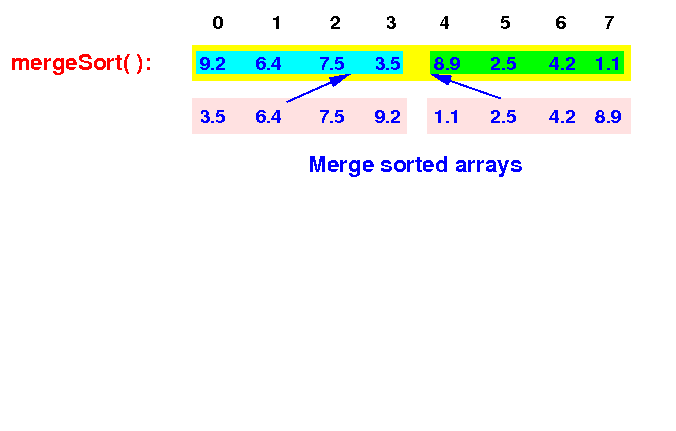
mergeSort(A[0-7]): merge(A[0-3], A[4-7]) |
How the
mergeSort algorithm
works
Final result:
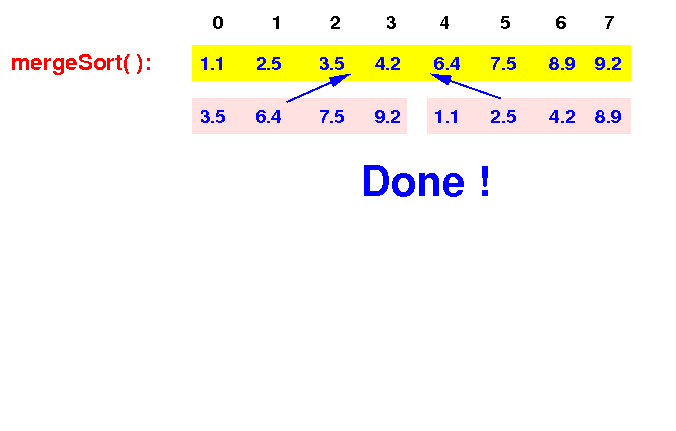
mergeSort(A[0-7]): return (array is sorted !) |