Review:   how Java passes arguments to methods

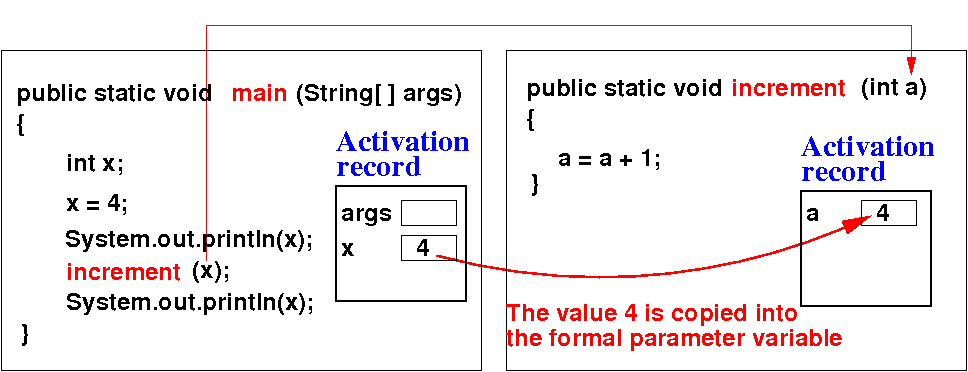
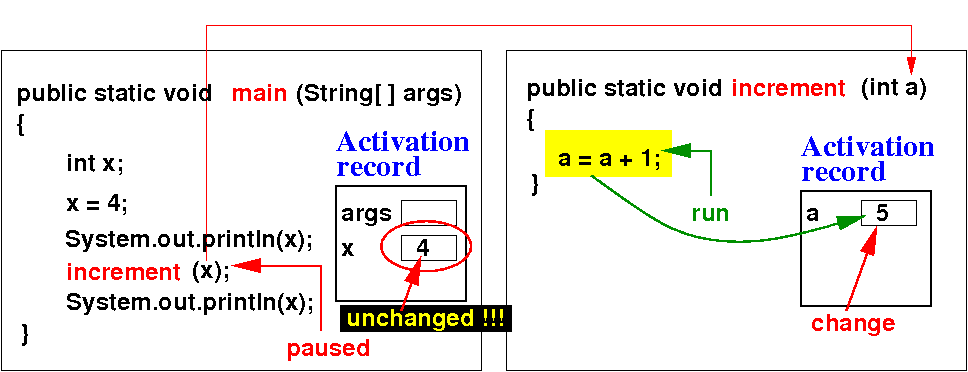
Recall:   Java passes the arguments to a method by copying each argument to the parameter variable:

    public static void main(String[] args) 
    {
        int x;
        
        x = 4;
	System.out.println(x);

	increment( x );  // Pass x by copying, just like: a = x

	System.out.println(x);  // x UNCHANGED !  Explained in more details next
    } 
    
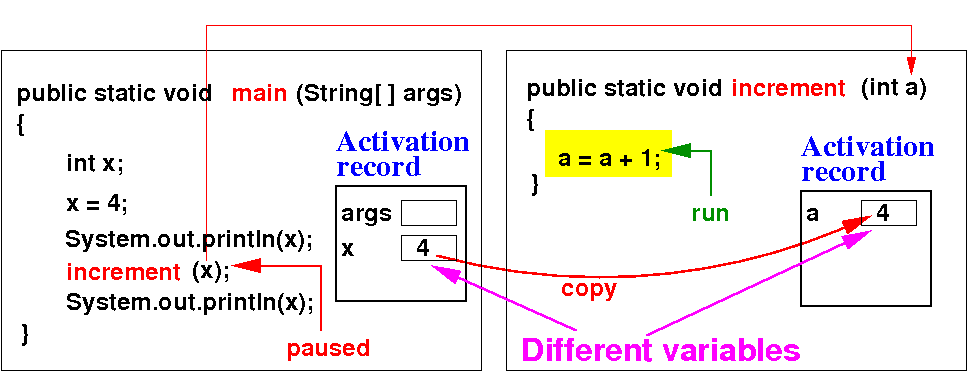
    public static void increment(int a )  //  a  and  x  are different variables !!
    {
	a = a + 1;
    }  

DEMO: demo/08-array/08-array-param/PassByCopy.java     --     Step in BlueJ

Methods with array variables as parameters

Array variables can be used as parameters in a method:

    public static void main(String[] args)
    {
        double[] myList1 = {1, 2, 3, 4};
        double[] myList2 = {5, 6, 7};
        double sum;
        
        sum = arraySum( myList1 );  // Pass array myList1 as argument

        sum = arraySum( myList2 );  // Pass array myList2 as argument
    }

    // Method with an array variable as parameter                
    // This method returns the sum of the elements in the array x
    public static double arraySum( double[] x )
    {
        double s = 0;
        
        for (int i = 0; i < x.length; i++ )
            s = s + x[i];

        return s;
    } 

DEMO: demo/08-array/08-array-param/ArrayParam1.java

There is an important difference when we update an array argument   -   discussed next

Review:   copying an array (reference) variable will make an alias !!

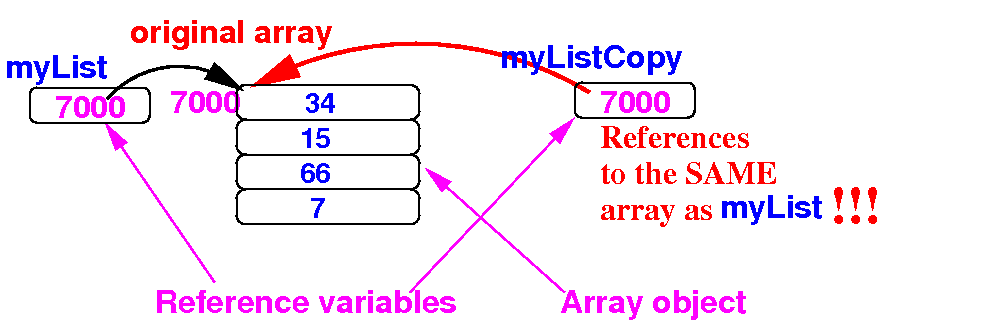
  • The assignment myListCopy = myList copies the reference in myList to myListCopy:

        double[] myList = {34, 15, 66, 7};
        double[] myListCopy;
    
        myListCopy = myList;   // Copies the reference
    
        myListCopy[1] = 999;   // Will also change myList[1] !!
        myList[3] = 999;       // Will also change myListCopy[3] !!  

    Schematically:

DEMO: demo/08-array/08-array-param/ArrayAlias.java

Passing array variable arguments in Java

  • How Java passes array variables to methods: ( just like before !)

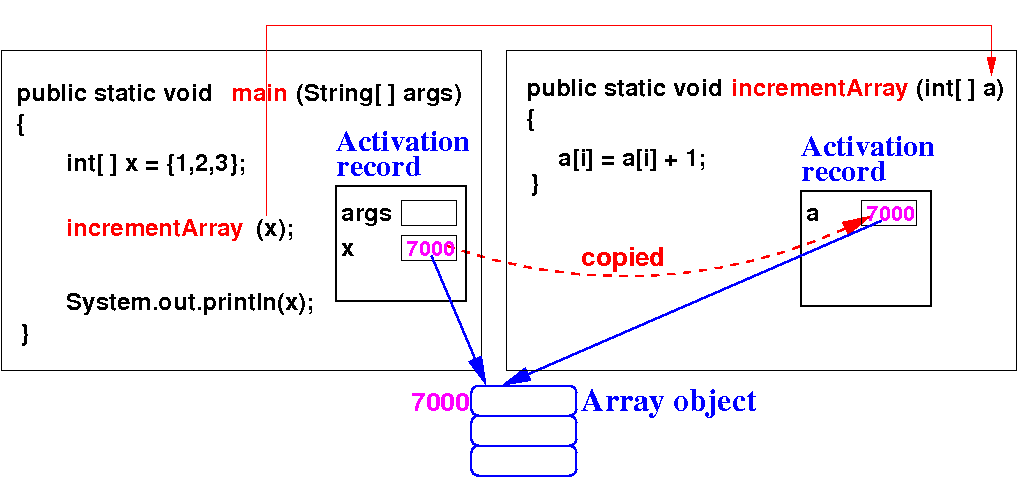
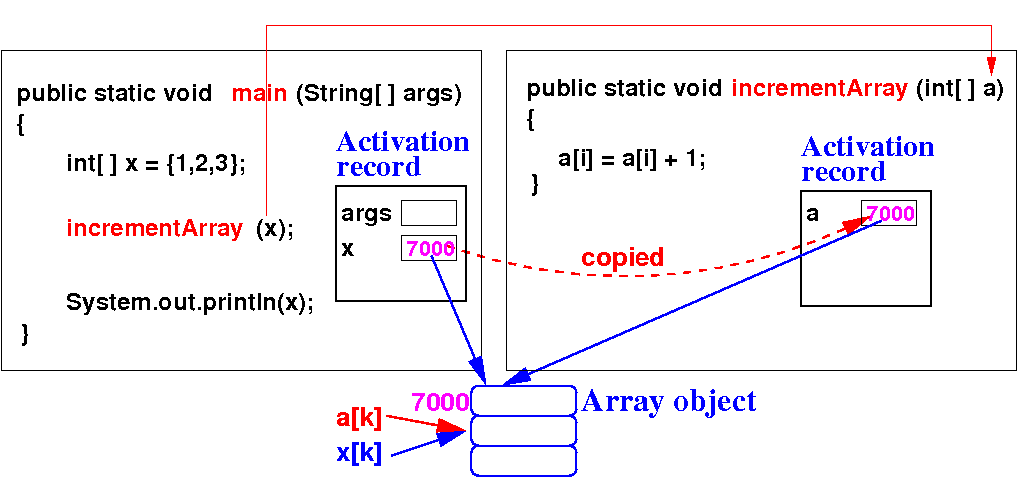
      • An array variable argument is copied to the corresponding array parameter variable

    Schematically:


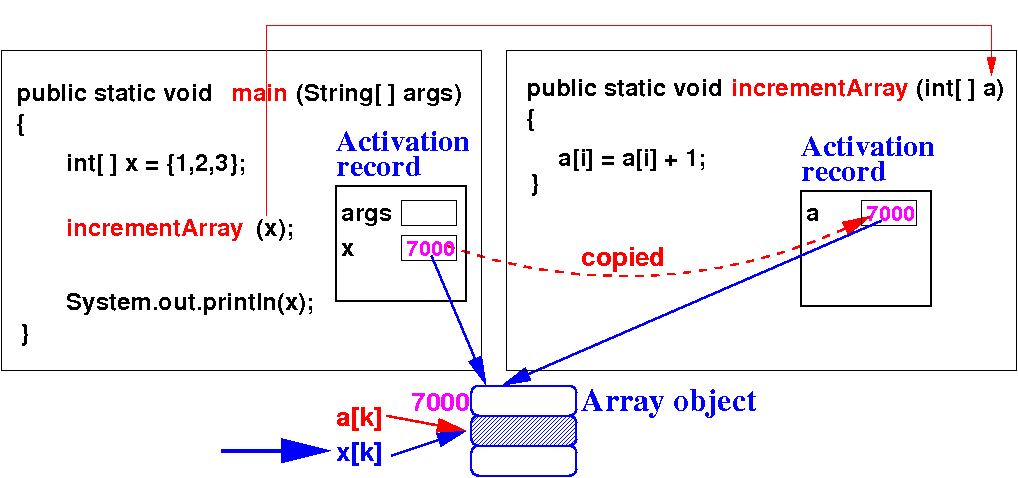
    Notice:   the array parameter variable a is an alias for the array argument variable x

Effect of passing array variable arguments in Java

  • Quiz:   can you tell what is printed by the following program:

          public static void main(String[] args) 
          {
              int[] x = {1, 2, 3};
      
      	incrementArray(x);  // Pass array reference x
      	
      	for ( int i = 0; i < x.length; i++ )
      	    System.out.print( x[i] + " " ); // Prints: ???
      	System.out.println();
          }
          
          public static void incrementArray( int[] a )
          {
              for ( int i = 0; i < a.length; i++ )
                  a[i] = a[i] + 1;
          }

  • Remember:   the variable a is an alias for the variable x

Effect of passing array variable arguments in Java

  • Answer: 2 3 4 !!!     Because a[i] is an alias for x[i] inside incrementArray( )

          public static void main(String[] args) 
          {
              int[] x = {1, 2, 3};
      
      	incrementArray(x);  // Pass array reference x
      	
      	for ( int i = 0; i < x.length; i++ )
      	    System.out.print( x[i] + " " ); // Prints: 2 3 4
      	System.out.println();
          }
          
          public static void incrementArray( int[] a )
          {
              for ( int i = 0; i < a.length; i++ )
                  a[i] = a[i] + 1;
          }

  • Because:   the variable a is an alias for the variable x ==> a[i] is the same as x[i]

DEMO: demo/08-array/08-array-param/ArrayParam2.java

Contrast:    passing primitive type variables vs passing array variables

  • Parameter passing mechanism in Java is always as follows:

      • When you invoke a method with an argument, the value of the argument is copied (= assigned) to the corresponding parameter variable.

  • When passing a primitive type variable, the parameter variable is a copy of the argument:

Contrast:    passing primitive type variables vs passing array variables

  • Parameter passing mechanism in Java is always as follows:

      • When you invoke a method with an argument, the value of the argument is copied (= assigned) to the corresponding parameter variable.

  • The method will work with an independent copy of the argument variable:

Contrast:    passing primitive type variables vs passing array variables

  • Parameter passing mechanism in Java is always as follows:

      • When you invoke a method with an argument, the value of the argument is copied (= assigned) to the corresponding parameter variable.

  • The method will not change the value in the argument variable:

Contrast:    passing primitive type variables vs passing array variables

  • Parameter passing mechanism in Java is always as follows:

      • When you invoke a method with an argument, the value of the argument is copied (= assigned) to the corresponding parameter variable.

  • When passing an array variable, the parameter variable is an alias of the argument:


Contrast:    passing primitive type variables vs passing array variables

  • Parameter passing mechanism in Java is always as follows:

      • When you invoke a method with an argument, the value of the argument is copied (= assigned) to the corresponding parameter variable.

  • Therefore:   a[k] and x[k] are the same array element:


Contrast:    passing primitive type variables vs passing array variables

  • Parameter passing mechanism in Java is always as follows:

      • When you invoke a method with an argument, the value of the argument is copied (= assigned) to the corresponding parameter variable.

  • The method can change the value in the argument array variable using x[k]: