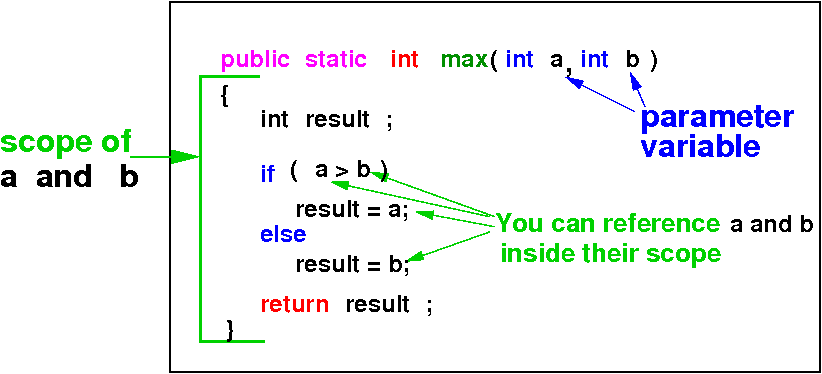
Review :
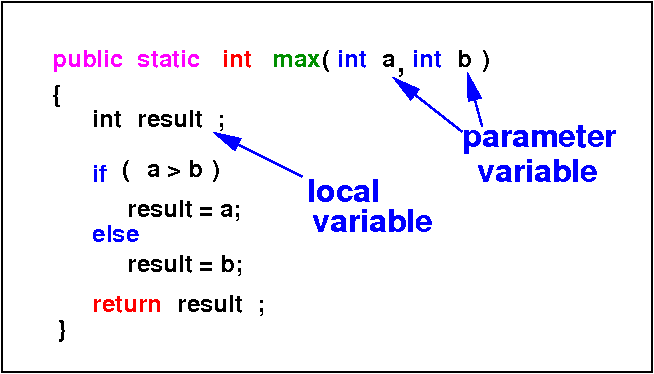
Local variables
and parameter variables
- A
local variable is
a variable that is
defined
inside a
method body
- A
parameter variable is
a variable that is
defined
inside a
method header
-
Recall:
- (All) variables
have
a
scope and
a
life time
(not covered in
AP Comp Sc)
|
|
Block
- A
block is
defined by
matching
curly braces
{ ... }
Example:
    public static void main(String[] args)
    {  // block 1
       int i, sum;

       sum = 0;
       i = 0;
       while ( i < 10 )
       {  // block 2
          sum = sum + i;
	  i++;
       }
    }
|
-
Blocks in
programming languages are
closely related to
the
scope
concept
|
The
scope
of local variables
-
Scope:
- The
scope of
a variable is
the
part
of the program
where the variable can be
used/accessed
|
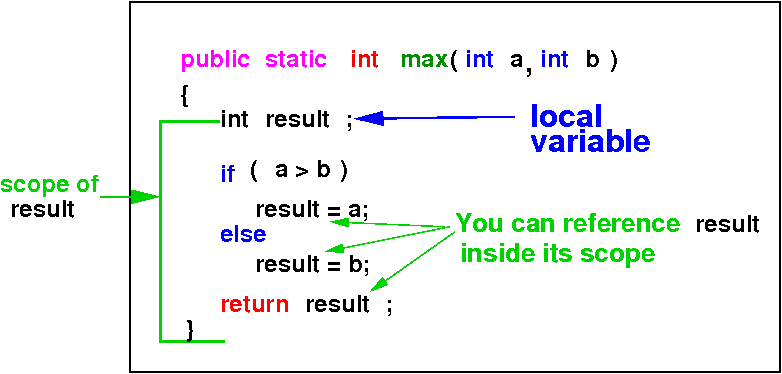
- The
scope
of a
local variable
starts
from its declaration
and continues to the
end of the block
that contains the
variable:
|
The
scope
of local variables
--
example 1
- The
scope of the
variable
a
in the program is
highlighted:
    public static void main(String[] args)
    {
        int a = 4;          // Line 1 - start of the scope of a

        {

            int x = 4;

            x = x + 1;
            a = 7;
        }

        a = 5;
    }			    // Line 2 - end of the scope of a
|
- When you
run this
program in
BleuJ,
the variable a will:
-
Appear when the
program
reaches
line 1
(now you can
use
a)
-
Disappear when the
program
reaches
line 2
(
a
cannot be
used!)
|
|
DEMO:
demo/06-methods/06-scoping/Scoping1.java
The
scope
of local variables
--
example 2
- The
scope of the
variable
x
in the program is
highlighted:
    public static void main(String[] args)
    {
        int a = 4;

        {

            int x = 4;      // Line 1 - start of the scope of x

            x = x + 1;
            a = 7;
        }                   // Line 2 - end of the scope of x

        a = 5;
    }
|
- When you
run this
program in
BleuJ,
the variable x will:
-
Appear when the
program
reaches
line 1
(now you can
use
x)
-
Disappear when the
program
reaches
line 2
(
x
cannot be
used!)
|
|
DEMO:
demo/06-methods/06-scoping/Scoping1.java
The
scope
of local variables
it is
illegal to
use a variable
outside its scope
- You
cannot use
the variable
x
outside
its
scope:
    public static void main(String[] args)
    {
        int a = 4;

        {

            int x = 4;      // Line 1 - start of the scope of x

            x = x + 1;
            a = 7;
        }                   // Line 2 - end of the scope of x
        x = 5;   // Illegal: x used outside its scope
        a = 5;
    }
|
- When you
compile this
program in
BleuJ,
you will get this
compile error:
|
DEMO:
demo/06-methods/06-scoping/Scoping2.java
The
for-loop:
creating a local (index) variable in a
for-loop
- Java has a
special syntax to
define a
for-loop index variable as a
local variable that
has the
for-loop body
as its
scope:
    public static void main(String[] args)
    {
        int sum = 0;

	for ( int i = 0; i < 10; i++ )  // Line 1: defines var i
        {
            sum = sum + i;
        }                               // Line 2

        System.out.println(sum);
    }
|
- When you
run this
program in
BleuJ,
the variable i will:
-
Appear when the
program
reaches
line 1
(now you can
use
i)
-
Disappear when the
program
reaches
line 2
(
i
cannot be
used!)
|
|
DEMO:
demo/06-methods/06-scoping/ForLoopIndex.java
The
scope
of local variables
creating a local index variable in
for-loop
-
Common error in
using for-loop index variable:
    public static void main(String[] args)
    {
        int sum = 0;

	for ( int i = 0; i < 10; i++ )  // Line 1: defines var i
        {
            sum = sum + i;
        }                               // Line 2

        System.out.println( i );  // Error: used i outside its scope
    }
|
- You will get
a compile error:
|
DEMO:
demo/06-methods/06-scoping/ForLoopIndex.java
The
scope
of parameter variables
Block configurations
- 2
different
blocks can have
the following
configurations:
-
Disjoint:
blocks
do not have any
no overlapping area
  { // Block 1
     ...
  }

  {
    // Block 2
     ...
  }
|
-
Nested:
one block is
contained
by another
block
  { // Block 1
     ...
     {
        // Block 2
        ...
     }
  }
|
|
|
Scoping rules
for
non-intersection
blocks
DEMO:
demo/06-methods/07-block-conf/NonIntersectBlks.java
--
Show
i has
different
data type !
Java's
scoping rules
for
nested
blocks
DEMO:
demo/06-methods/07-block-conf/NestedBlks.java
Life time of
parameter and
local variables
-
Life time of a
variable:
-
Life time of a
variable = the
duration/time frame
that the variable
exists in
memory
|
-
Background information:
- Parameter variables are
created when
the method is
invoked
(they are used to
pass
arguments)
- Local variables are
also
created when
the method is
invoked
(they are used to
help you
code the
method)
- Parameter and
local
variables are
de-allocated
(= removed from memory)
when the method
returns (= exits)
|
-
Life time of
parameter and
local
variables:
- The
duration
from the
start of the
method invocation
until
the
method
returns (= exits)
|
|
❮
❯