What happens
to the argument if
we update
the parameter variable ?
Consider a method increment( ) that updates the parameter variable:
    public static void main(String[] args)
    {
        int x;

        x = 4;
	System.out.println(x);

	increment( x );  // Pass x

	System.out.println(x);  // What value will be printed ?
    }

    public static void increment(int a )
    {
	a = a + 1;  // Changes the parameter variable
    }
|
DEMO: demo/06-methods/03-pass-by-value/Demo.java -- Run in BlueJ
Background info:
making a copy of a variable
Program that shows the effect of copying a variable:
public class Copy
{
    public static void main(String[] args)
    {
        int a, x;

        x = 4;      // CHANGES the value in x to 4

        a = x;      // CHANGES the value in a in x (i.e.: copy)

        a = a + 1;  // CHANGES the value in a to a+1
    }
}
|
DEMO: demo/06-methods/03-pass-by-value/Copy.java -- Step in BlueJ
Background info:
making a copy of a variable
The statement a = x makes a copy of the variable x in the variable a
public class Copy
{
    public static void main(String[] args)
    {
        int a, x;

        x = 4;      // CHANGES the value in x to 4

        a = x;      // Makes a copy of x in a

        a = a + 1;  // CHANGES the value in a to a+1
    }
}
|
Important:
a copy and its
original are
independent
when the copy
in variable a is
changed by
a =
a + 1, the
value
in variable x is
not changed
DEMO: demo/06-methods/03-pass-by-value/Copy.java -- Step in BlueJ
How Java
passes arguments to
methods
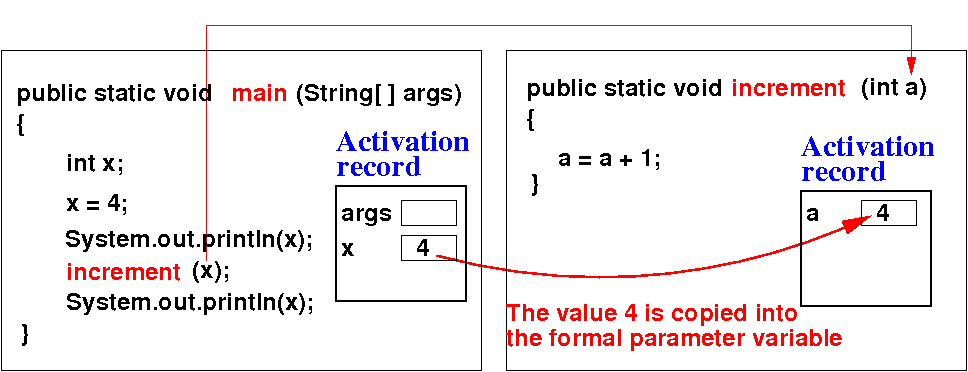
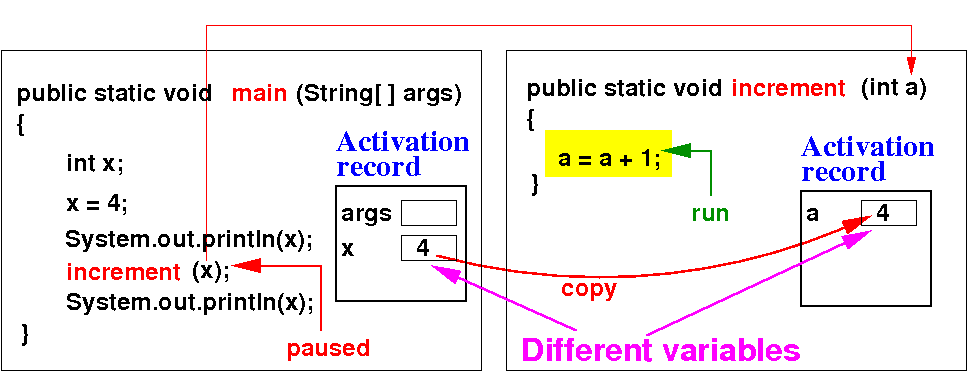
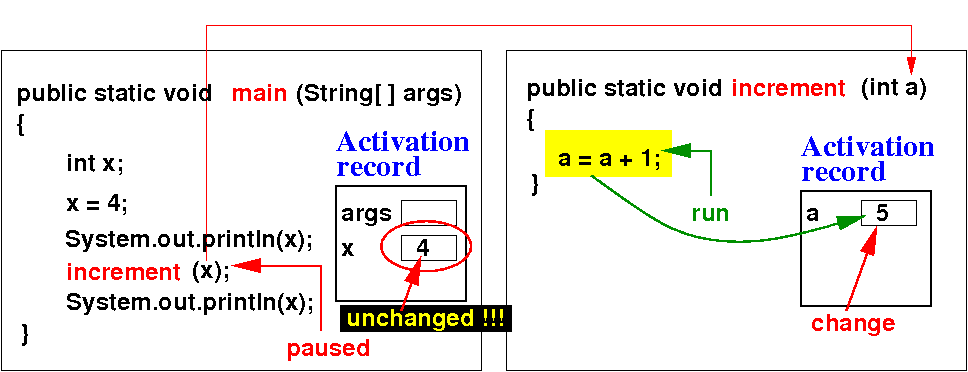
Java passes the arguments to method invocations by copying each argument to the parameter variable:
    public static void main(String[] args)
    {
        int x;

        x = 4;
	System.out.println(x);

	increment( x );  // Pass x by copying, just like: a = x

	System.out.println(x);  // x UNCHANGED !  Explained in more details next
    }

    public static void increment(int a )  //  a  and  x  are different variables !!
    {
	a = a + 1;
    }
|
DEMO: demo/06-methods/03-pass-by-value/PassByCopy.java -- Step in BlueJ
Passing arguments
by value
|
Arguments passed
by value
cannot be
updated by the
invoked method
|
Arguments passed
by value
cannot be
updated by the
invoked method
|
Important note:
variable names in
different methods are completely
separate and
unrelated
Each method can name their own variables independently from other methods:
    public static void main(String[] args)
    {
        int x ;

        x = 4;
	System.out.println(x);

	increment( x );  // Pass main's x by copying

	System.out.println(x);
    }

    public static void increment(int x )
    {
	x = x + 1;  // Uses increment's x in operation
    }
|
Variables defined in different methods are independent (different) variables
DEMO: demo/06-methods/03-pass-by-value/Copy.java
Demo with BlueJ: show the different value in variable x in the activation records when stopped after x++