Review of methods
|
Computer Science concept:
Program control
|
Program control in a
method invocation
Demo program used in explaining the program control flow in a method invocation:
    public static void main(String[] args)
    {
        int x, y, z;

        x = 3;
        y = 7;
        z = max(x,y);
    }

    public static int max(int a, int b)
    {
        int result;

        if ( a > b )
            result = a;
        else
            result = b;

        return result;
    }
|
DEMO: demo/06-methods/02-method/Max.java
Step in BlueJ --- Show variable content of main( ) while stopped in max( )
Program control in a
method invocation
Detailed explanation: when a Java program starts, it will call the main( ):
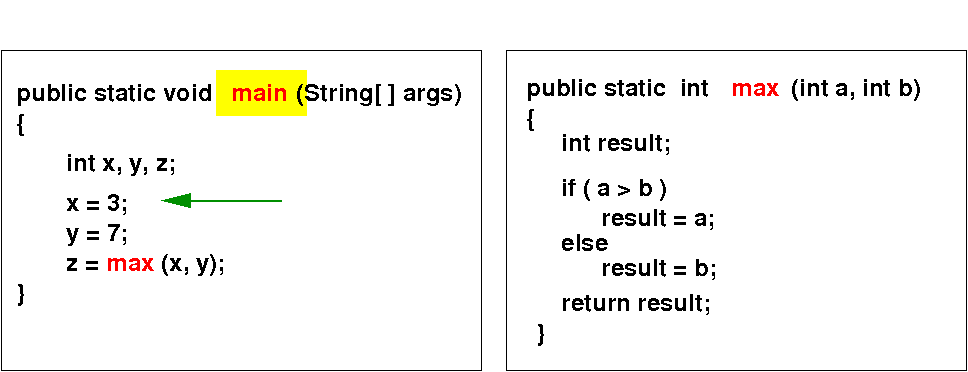
The program starts execution at the first statement in the main( ) method. |
Program control in a
method invocation
When the program invokes/calls the max( ) method, program control is transfered to the called method max:
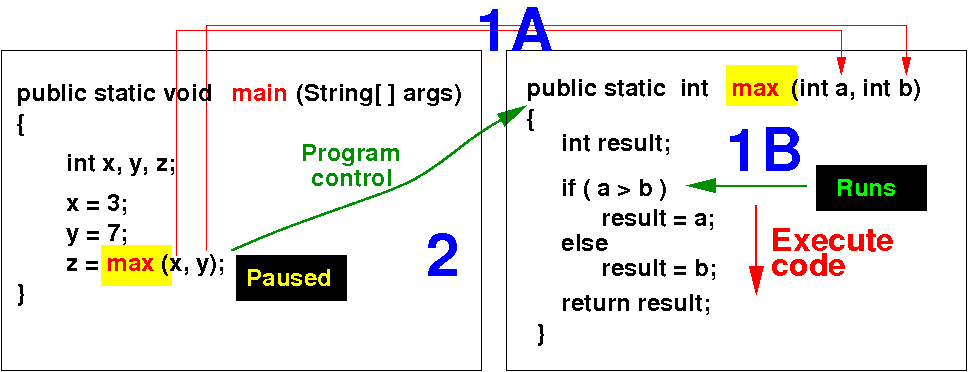
(1A) The method call passes (=copies) the actual parameters to the formal parameters (1B) Program control is transfered to max (2) The method that makes the call is paused at the call statement method |
Program control in a
method invocation
When the called method executes a return statement, program control is returned to the calling method:
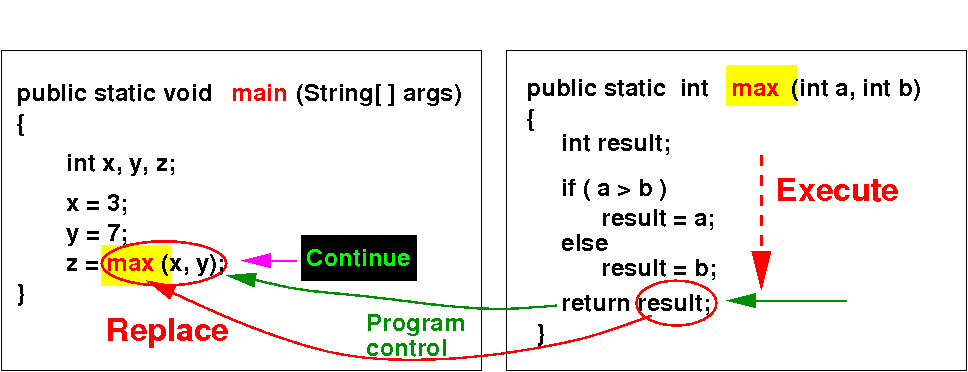
The method call is replaced by the return value
|
Activation record
Each time a method is invoked, Java creates an activation record that stores parameters and variables:
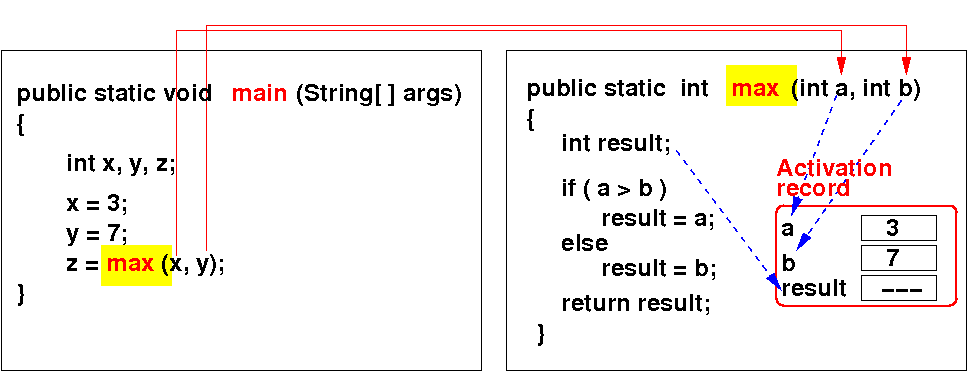
The activation record is placed in an area of memory known as a call stack. A call stack is also known as an execution stack, runtime stack, or machine stack, and it is often shortened to just "the stack". |
Activation record
The activation record remains on the stack as long as the method is active (= has not returned):
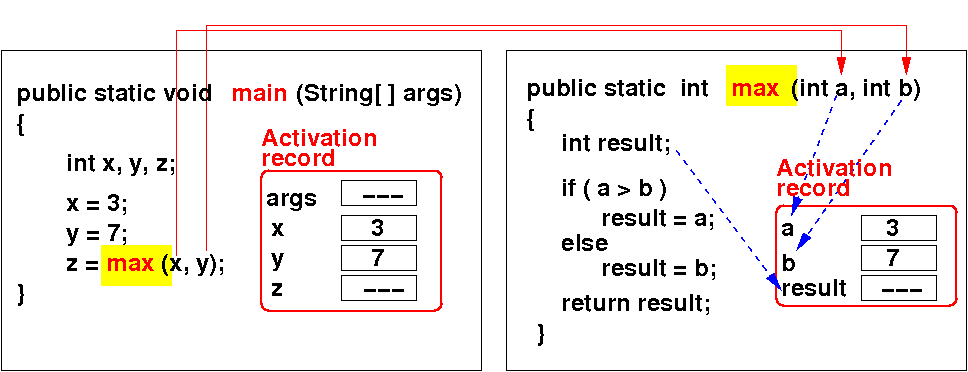
main( ) is active when max( ) is being run ! main( ) also has an activation record ! Show in BlueJ !!! |
Activation record
The activation record is deleted when a method returns :
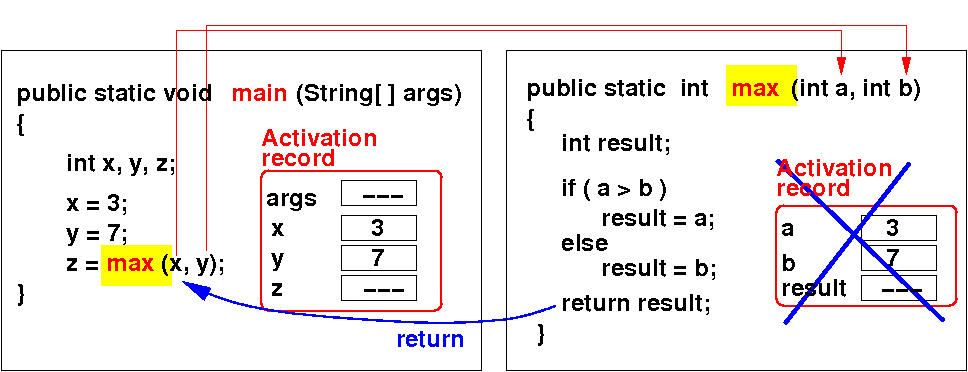
The activation record of max is gone in BlueJ when method returns |