The
for loop
|
The
for
loop:
a very commonly used syntax
|
The
for
loop:
a very commonly used syntax
example
|
DEMO: demo/05-loops/04-for/Summation.java
The
for
loop
flow chart
|
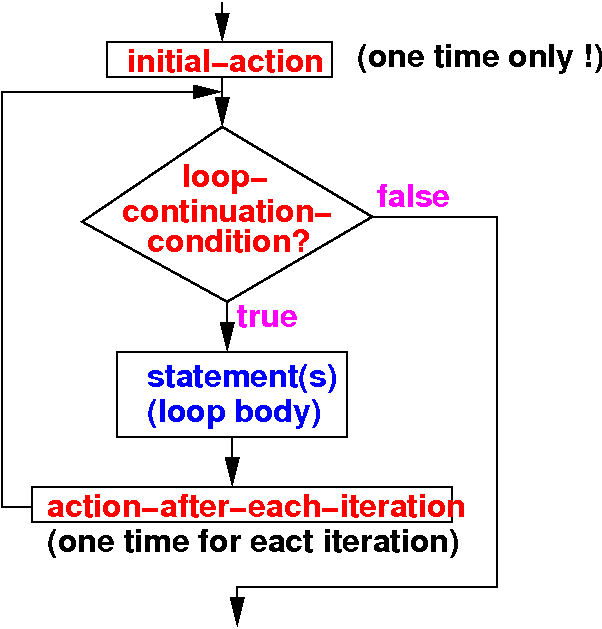
Application of the
for loop:
find
all
divisors of
a number
Write a program that reads in a number x and prints out all its divisors:
 Plan:

   Read in x

   We know that:  a divisor of x must be < x

   Try every number that is < x:

   for k = 1, 2, 3, 4, 5, 6, ....., x-1:

       check if k is a divisor of x

       if so: print k
|
Application of the
for loop:
find
all
divisors of
a number
Write a program that reads in a number x and prints out all its divisors:
   public static void main(String[] args)
   {
      Scanner input = new Scanner(System.in);

      int x, k;

      System.out.print("Enter a number: ");
      x = input.nextInt();

      for ( k = 1; k < x; k++ )
      {
          if ( x%k == 0 )
             System.out.println(k);
      }
   }
|
DEMO: demo/05-loops/04-for/Divisor.java